When people think of hemp today, wellness products like CBD oil and hemp seed oil tend to dominate the conversation. But hemp’s oldest and, for most of human history, most significant use was entirely different: as a source of some of the strongest natural fibre available, used to make textiles, rope, sails, and paper for thousands of years.
A Brief History of Hemp Fibre
Hemp fibre production dates back at least 8,000 years, with archaeological evidence of hemp textiles found in China dating to around 8,000 BCE, making it one of the oldest cultivated fibre crops in human history. Hemp rope and sailcloth were essential to maritime exploration for centuries; the word canvas itself derives from cannabis. In the United States, hemp cultivation was actively encouraged in the colonial era for its use in rope and sailcloth, and some historical accounts note that early versions of documents were drafted on hemp paper. Hemp’s industrial decline in the 20th century was driven primarily by the same regulatory shifts that affected cannabis broadly, including the Marihuana Tax Act of 1937 in the US, which made hemp cultivation impractical despite hemp containing negligible THC.
What Makes Hemp Fibre Different from Cotton
Hemp fibre comes from the stalk of the plant, specifically the bast fibres found in the outer layer of the stalk, as opposed to cotton, which comes from the seed pod fluff of the cotton plant. This structural difference produces fibre with notably different properties. Hemp fibre is significantly stronger and more durable than cotton fibre, which is part of why it was historically preferred for rope and sailcloth, applications where fibre strength under tension is critical. Hemp fibre is naturally resistant to mould and UV degradation to a greater degree than cotton. Hemp cultivation also has a substantially different environmental footprint: hemp requires approximately 50 times less water per kilogram of fibre produced than cotton, and requires minimal pesticide input due to the plant’s natural pest resistance and dense canopy that shades out weeds, compared to cotton, which accounts for an estimated 16% of global insecticide use despite occupying a much smaller share of agricultural land.
From Stalk to Fabric: How Hemp Fibre Is Processed
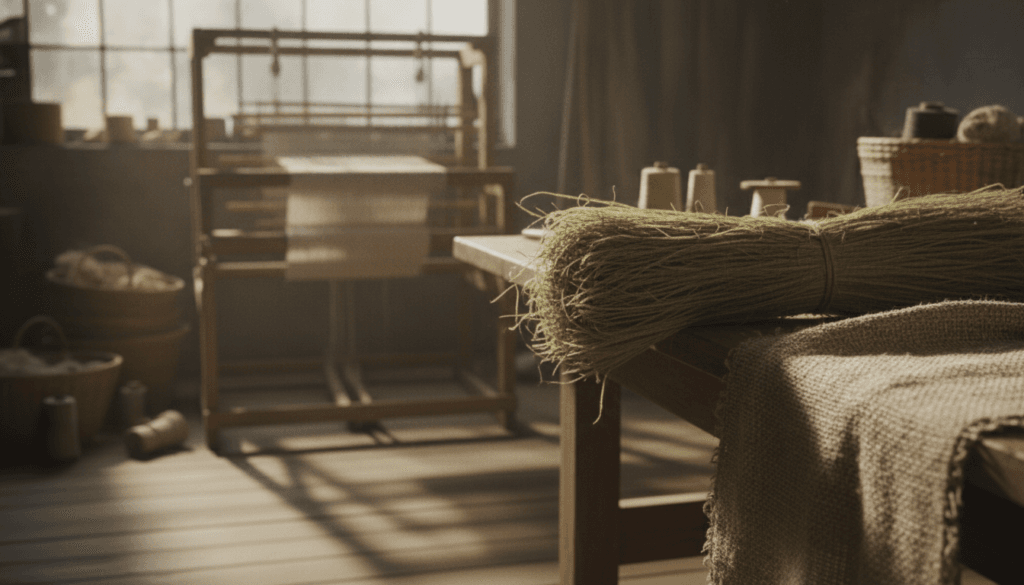
The process of turning a hemp stalk into usable textile fibre involves several traditional steps. Retting is the first step, where harvested hemp stalks are left in fields (dew retting) or submerged in water (water retting) for a period of days to weeks. This process uses naturally occurring bacteria and moisture to begin breaking down the pectin that binds the bast fibres to the woody core of the stalk. Breaking and scutching follow retting, where the retted stalks are mechanically broken to separate the long bast fibres from the woody hurd (the inner core). Hackling then combs the separated fibres to align them and remove remaining short fibres or debris, producing long, clean fibre strands ready for spinning. Spinning and weaving turn the processed fibre into yarn and then fabric, using techniques that have evolved from historical hand methods to modern industrial textile machinery, though hemp’s coarser natural fibre has historically required different processing approaches than finer fibres like cotton or flax.
What Happens to the Rest of the Plant
Textile fibre production uses only part of the hemp stalk, and the rest of the plant has its own significant uses. Hurd or shiv, the woody inner core of the stalk left over after fibre extraction, is used to produce hempcrete (a lime-based building material), animal bedding, and increasingly, paper pulp and packaging materials as alternatives to wood-based products. Hemp seeds, harvested from the same plants in seed-producing varieties, go on to produce hemp seed oil, hemp protein, and food products, an entirely separate supply chain from fibre production. This means a single hemp crop can, in principle, supply multiple distinct industries: textiles from the bast fibre, construction materials from the hurd, and food and nutritional products from the seeds, representing one of the most complete examples of whole-plant utilisation in agriculture.
Hempcrete: A Modern Application of an Old Material
Hempcrete is a building material made by combining hemp hurd with a lime-based binder and water, producing a lightweight, insulating material used for non-structural walls, insulation, and other building applications. Hempcrete has notable sustainability properties: the hemp plant absorbed CO2 from the atmosphere during its growth (research estimates 8 to 15 tonnes of CO2 absorbed per hectare per growing cycle), and this carbon remains locked into the hurd. The lime binder in hempcrete continues to slowly absorb additional CO2 from the air over decades through a natural carbonation process, meaning hempcrete buildings can continue to sequester carbon long after construction. Hempcrete is used across Europe in both new construction and renovation of older buildings, and is gaining adoption in North America and Australia as interest in sustainable building materials grows, though it remains a niche material compared to conventional concrete and lumber, primarily due to limited processing infrastructure and unfamiliarity among builders.
The Modern Hemp Textile Market
Hemp textiles today occupy a position somewhere between a niche sustainable fashion material and a re-emerging mainstream option. Hemp fabric is often blended with other fibres, commonly cotton or recycled materials, to balance hemp’s durability and sustainability credentials with the softer hand-feel that pure cotton or blended fabrics provide, since pure hemp fabric can have a coarser texture initially, though it tends to soften significantly with washing and wear over time. The primary barriers to hemp textiles becoming more mainstream are largely industrial rather than agricultural: processing infrastructure for hemp fibre (retting, decortication, and spinning facilities specifically suited to hemp’s fibre characteristics) is far less developed than the infrastructure built around cotton over the past two centuries, making hemp fabric production currently more costly per unit despite hemp’s lower agricultural input costs.
Frequently Asked Questions
Is hemp fabric the same as the hemp used for CBD or wellness products?
No, though both come from the Cannabis sativa species. Hemp grown for fibre is typically a different variety, bred and cultivated for tall, fibrous stalks with minimal branching, optimised for fibre yield. Hemp grown for CBD is bred for flower and cannabinoid content, typically shorter and bushier. Hemp grown for seed (for hemp seed oil and protein) is bred for seed yield. While all are legally classified as hemp (under 0.3% THC), the agricultural practices and plant varieties differ significantly between fibre, cannabinoid, and seed production.
Why isn’t hemp fabric more common if it’s so sustainable?
The primary barrier is processing infrastructure rather than agricultural viability. Cotton has over two centuries of dedicated processing infrastructure (ginning, spinning, weaving facilities optimised for cotton’s specific fibre properties) built up globally. Hemp fibre requires different processing steps (retting, decortication, hackling) and the infrastructure for this at scale is far less developed, making hemp fabric production currently more expensive per unit of output despite hemp’s lower water and pesticide requirements during cultivation.
What is hempcrete and is it as strong as concrete?
Hempcrete is a building material made from hemp hurd (the woody core of the stalk) combined with a lime-based binder. It is not a structural replacement for concrete in the sense of load-bearing strength; it is primarily used for insulation, infill walls, and non-structural applications within a structural frame (typically timber). Its advantages are in insulation performance, breathability (which can help regulate humidity within buildings), and its carbon-sequestering properties, rather than compressive strength comparable to concrete.
Did hemp paper exist before wood pulp paper?
Hemp was one of several fibre sources used for paper production historically, alongside other plant fibres, before wood pulp became the dominant paper source in the 19th century due to the development of chemical pulping processes that made wood a cheaper input at scale. Hemp paper has some properties (such as durability and resistance to yellowing) that some consider advantageous compared to certain wood pulp papers, but wood’s cost advantage at industrial scale, driven by established forestry and pulping infrastructure, is what made it the dominant material rather than any inherent superiority over hemp for paper-making.
Can hemp fibre be used to make plastic?
Hemp-derived bioplastics and composite materials have been developed and tested, using hemp fibre as a reinforcing material in biodegradable plastic composites or as a component in hemp-based bioplastic formulations. These materials can have a significantly lower carbon footprint than petroleum-based plastics and are biodegradable under appropriate conditions. However, they currently remain more expensive than conventional plastics and are not yet produced at a scale that allows them to broadly replace petroleum plastics, similar to the infrastructure challenges facing hemp textiles.
Is hemp fibre production legal everywhere hemp is grown?
Industrial hemp cultivation, including for fibre, is generally legal in countries that have established hemp legal frameworks based on THC content thresholds (typically 0.3% in the US, 0.2% in the UK and EU), since fibre hemp varieties are bred for low THC content regardless. Countries including France, China, and Canada have significant industrial hemp fibre production. Cultivation typically requires licensing even where legal, as hemp remains regulated as a cannabis variety regardless of its end use.