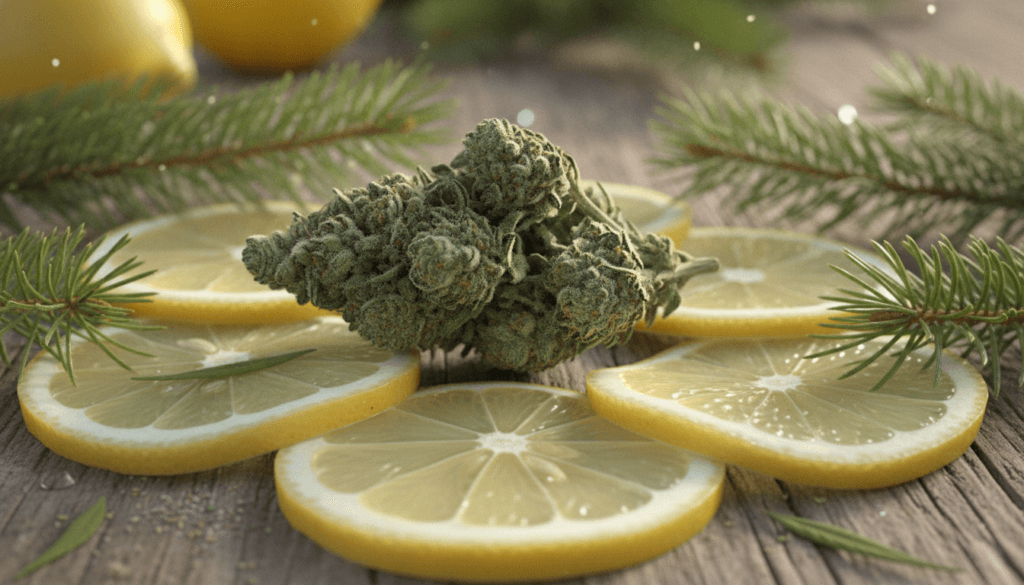
Walk past different cannabis strains and the smell alone tells you they are different: one might be sharp and citrusy, another earthy and musky, another piney. These distinct aromas come from terpenes, and they may be doing far more than just shaping how a product smells.
What Terpenes Are
Terpenes are aromatic compounds found throughout the plant kingdom, responsible for the scents of pine forests, citrus fruits, lavender, and hops, among countless other plants. Cannabis produces an unusually wide range of them, with at least 120 different terpenes identified in the plant. Terpenes are produced in the same glands as cannabinoids (the trichomes on the cannabis flower) and are present in far smaller quantities than cannabinoids like THC or CBD, but their distinct and often potent aromas mean they have an outsized influence on how a product smells and tastes, even at low concentrations.
The Major Cannabis Terpenes and What’s Known About Them
Myrcene is the most abundant terpene in cannabis, present in the majority of cultivars and dominant in roughly half of modern strains, with an earthy, clove-like, slightly sweet aroma often described as the smell that makes cannabis smell like cannabis. Research has linked myrcene to muscle-relaxing properties, with one study finding specific dosages more than doubled restful sleep time in laboratory mice, and other research showing anti-inflammatory effects and protection against oxidative damage in kidney cells. Limonene, with its bright citrus aroma, has been studied for analgesic (pain-relieving) properties. Notably, a 2024 study published in Drug and Alcohol Dependence found that vaporised D-limonene selectively mitigated the acute anxiogenic (anxiety-producing) effects of THC in healthy adults who use cannabis intermittently, a finding directly relevant to the entourage effect discussion below. Pinene (both alpha and beta forms) has a sharp pine aroma and has been studied for potential neuroprotective properties, though a comprehensive review found no clear evidence of neuroprotective effects against beta-amyloid-related toxicity specifically, while noting modest lipid peroxidation inhibition that may contribute to broader neuroprotective effects in combination with other compounds. Linalool, with a floral, lavender-like aroma, has exploratory evidence as a sleep aid and for relieving exhaustion and mental stress, consistent with its use in aromatherapy more broadly. Caryophyllene has a peppery, spicy aroma and has been studied for cold tolerance and analgesic properties, as well as protective effects in chronic inflammation models, though research has questioned earlier claims that it acts directly as a CB2 receptor agonist.
Indica vs Sativa: What Terpenes Actually Tell You
The popular framing of indica strains as relaxing and sativa strains as energising has long been attributed to genetic differences between these categories, but researchers increasingly point to terpene profiles as a more meaningful explanation, while also noting that indica and sativa labels themselves may not have the genetic relevance many assume. Strains commonly labelled indica tend to be myrcene-dominant, a terpene associated with relaxation and reduced anxiety in the research discussed above. Strains commonly labelled sativa often contain more limonene, associated with alertness and arousal. This has led some in the industry to argue that terpene testing and labelling provides more useful information to consumers about likely effects than the indica/sativa distinction itself, since two strains with identical THC content but different terpene profiles can produce noticeably different subjective experiences.
The Entourage Effect: What the Evidence Actually Shows
The entourage effect is the theory that cannabis compounds, cannabinoids, terpenes, and flavonoids, work better together than any single compound in isolation, originally proposed based on observations about how endocannabinoids interact with related lipid compounds in the body. The evidence for this theory specifically regarding terpenes is genuinely mixed and worth understanding honestly. On one hand, a comprehensive review found that myrcene demonstrated anti-inflammatory properties topically on its own, but when combined with CBD, did not show significant additional difference, suggesting no entourage effect for that specific combination. On the other hand, research has found that terpenes can bind to and modulate cannabinoid receptor activity directly; one study found that terpenes significantly boosted THC’s CB1 receptor activation in laboratory testing, and the 2024 D-limonene study found a specific, measurable interaction where limonene reduced THC’s anxiety-producing effects in human subjects. A separate line of research has specifically questioned whether terpenes act at cannabinoid receptors at all to produce entourage effects, suggesting other mechanisms may be more relevant where effects are observed. The honest summary is that the entourage effect is not a single proven phenomenon that applies uniformly; some specific terpene-cannabinoid interactions have reasonable evidence (like D-limonene and THC-related anxiety), while others remain unproven or have shown no effect in testing, and the field continues to call for more clinical research to clarify which combinations, if any, produce genuinely synergistic effects.
How Terpene Content Is Affected by Processing
Terpenes are volatile compounds, meaning they evaporate relatively easily, particularly when exposed to heat. This is directly relevant to how different cannabis products are made and why their terpene content varies so much. As discussed in our piece on live resin versus distillate, live resin extraction specifically preserves terpenes through flash-freezing and low-temperature processing, while distillate’s high-heat distillation process removes nearly all terpenes in favour of maximising cannabinoid purity. Similarly, drying and curing processes for cannabis flower itself affect terpene retention, with slower, more careful curing generally preserving more terpene content than rapid drying.
Terpenes in CBD and Hemp Products
Terpenes are not exclusive to high-THC cannabis; hemp plants also contain terpenes, and full spectrum and broad spectrum CBD products often retain some of the hemp plant’s natural terpene profile alongside cannabinoids. Some CBD products are also formulated with added terpenes, either derived from cannabis or from other plant sources (since many terpenes, like limonene and pinene, are found in other plants too, such as citrus fruits and pine trees respectively), to create specific aroma profiles or in an attempt to recreate entourage-style effects in isolate-based products that would otherwise contain no terpenes at all.
Frequently Asked Questions
Do terpenes get you high?
No, terpenes themselves are not psychoactive in the way THC is and do not produce intoxication on their own. However, research suggests some terpenes can modulate how cannabinoids like THC affect the body, potentially influencing the intensity or character of THC’s effects, as seen in the 2024 research on D-limonene reducing THC-related anxiety. This modulation is different from terpenes having their own intoxicating effect.
Why do some cannabis strains smell so different from each other?
The distinct aroma of different cannabis strains comes primarily from their terpene profiles. Cannabis can contain over 120 different terpenes, and the specific combination and ratio of terpenes present, myrcene, limonene, pinene, linalool, caryophyllene, and many others, creates each strain’s characteristic smell. Even strains with similar cannabinoid (THC or CBD) content can smell completely different due to differing terpene profiles, which is also part of why some researchers argue terpene content is more informative about a strain’s likely character than THC percentage alone.
Is the entourage effect scientifically proven?
The picture is mixed rather than a simple yes or no. Some specific interactions have reasonable supporting evidence, such as the 2024 finding that D-limonene reduced THC’s anxiety-producing effects in human subjects, and research showing terpenes can directly modulate CB1 receptor activation in laboratory settings. Other specific claims, such as myrcene enhancing CBD’s anti-inflammatory effects, have been tested and found no significant additional benefit from the combination. Reviews of the broader entourage effect literature consistently call for more clinical research, indicating the concept remains only partially substantiated rather than either fully proven or disproven.
Can terpenes found in cannabis also be found in other plants?
Yes, and this is actually quite common. Limonene is abundant in citrus fruit peels. Pinene is found in pine needles and rosemary. Linalool is found in lavender. Myrcene is found in hops, mangoes, and lemongrass, among other plants. Cannabis is unusual not because its terpenes are unique to it, but because of the particularly wide range and high concentrations of different terpenes it can produce, and because these terpenes occur alongside cannabinoids, which is the basis for entourage effect research specifically in the cannabis context.
Do CBD isolate products contain terpenes?
By definition, CBD isolate is refined to remove all compounds other than CBD itself, including terpenes, achieving around 99% purity. Full spectrum and broad spectrum products are more likely to retain some of the original plant’s terpene profile, though the amount retained depends on the extraction and processing methods used. Some isolate-based products have terpenes added back in during formulation, either cannabis-derived or from other plant sources, to create a specific aroma or in an attempt to introduce entourage-style effects.
How can I find out the terpene profile of a product I’m using?
A Certificate of Analysis (COA) from a reputable brand will often include a terpene panel alongside the cannabinoid panel, listing the specific terpenes present and their concentrations. Not all COAs include terpene testing, as this is a more involved and sometimes optional test compared to cannabinoid potency testing. If terpene content is something you’re specifically interested in, looking for products and brands that proactively publish terpene panel results, rather than just cannabinoid content, is the most direct way to access this information.