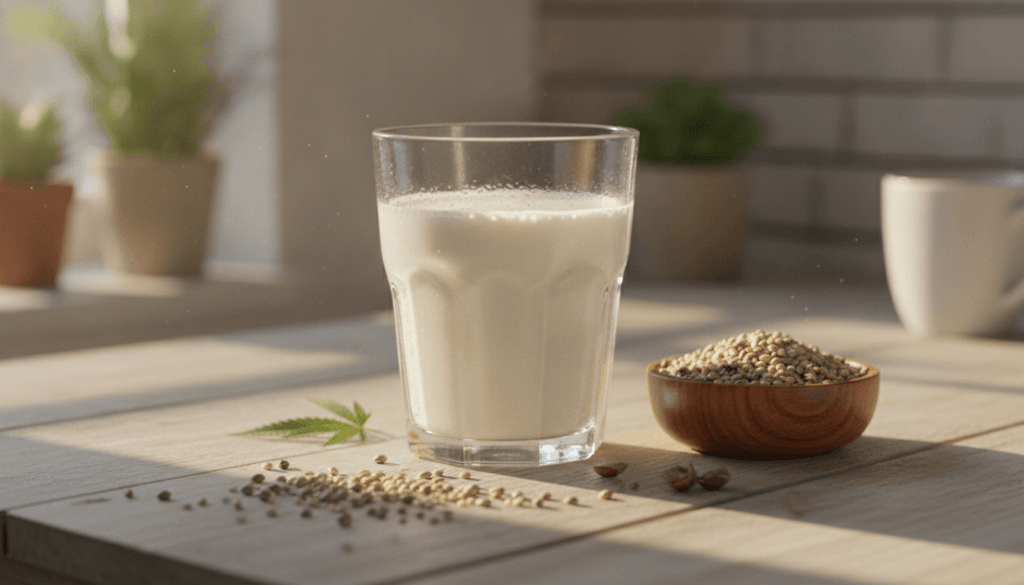
Most discussion of hemp as food centres on hemp seeds, hemp hearts, and hemp seed oil, all covered extensively in our earlier hemp nutrition content. But hemp’s culinary applications extend further, into a range of products that remain less familiar to most people, despite some having been part of traditional diets in hemp-growing regions for a long time.
Hemp Milk: The Plant Milk You’ve Probably Overlooked
Hemp milk is made by blending hemp seeds (typically hulled hemp hearts) with water and straining, similar in basic concept to the homemade hemp milk method described in our hemp seed recipes piece, though commercial hemp milk often includes additional ingredients for shelf stability, texture, and fortification. Compared to other plant milks, hemp milk has a distinct nutritional profile: it naturally contains the same complete protein and Omega-3/Omega-6 fatty acid balance found in hemp seeds generally, discussed in detail in our piece on hemp seed oil’s Omega ratio, giving it a notably different fat and protein profile compared to almond milk (low in both) or oat milk (higher in carbohydrates, lower in protein). Hemp milk has a naturally nutty, slightly earthy flavour, consistent with hemp seeds’ flavour profile discussed in our hemp recipes piece, and a creamier texture than some other plant milks due to its fat content. It does not require the same processing to remove problematic compounds that some other plant milks do (such as soy milk’s processing to address certain compounds), since hemp seeds do not contain common allergens like nuts, soy, gluten, or lactose, making hemp milk a relevant option for people avoiding these specific allergens who may still want to avoid other plant milks (like oat milk for gluten-sensitive individuals, depending on processing, or almond milk for tree nut allergies).
Hemp Flour and Hemp Protein in Baking
Hemp flour is made by milling the hemp seed cake left over after oil extraction (the same starting material used for hemp protein powder, discussed in our hemp protein versus whey comparison) into a finer, flour-like consistency. It is naturally gluten-free, with a notably high fibre and protein content compared to many gluten-free flour alternatives, which can otherwise be lower in protein and fibre than wheat flour. However, hemp flour is generally not used as a complete flour replacement in baking; its lack of gluten means it doesn’t provide the structure gluten provides in conventional baking, and its strong flavour and dense texture mean it’s typically used as a partial substitute, commonly replacing 10 to 25% of the flour in a recipe, contributing nutritional density (protein, fibre, minerals) and a nutty flavour without overwhelming the final product’s texture or taste.
Hemp Tofu and Hemp-Based Protein Products
Less common but existing in some markets, hemp-based tofu-like products use hemp protein as a base for plant-based protein products, similar in concept to how soy or pea protein are used to create various meat-alternative and protein-dense products. These products leverage hemp protein’s complete amino acid profile (discussed in our hemp protein piece) and its allergen profile (avoiding soy and gluten, relevant for people with those specific sensitivities) as differentiating factors compared to the more established soy-based or pea-based alternatives that dominate the plant protein product category currently.
Hemp Seed Butter
Similar in concept to nut butters like almond or peanut butter, hemp seed butter is made by grinding hemp hearts into a spreadable paste. It carries forward the same nutritional profile as hemp hearts (complete protein, balanced Omega fatty acids, minerals) in a more concentrated, spreadable format. Because hemp seeds are not tree nuts or peanuts, hemp seed butter represents an option for people with nut allergies who want a nutritionally similar spreadable product, though as with any product, checking for cross-contamination in facilities that also process actual nuts is relevant for anyone with severe allergies.
Hemp Beer and Hemp-Infused Foods
Hemp seeds and hemp oil have also found their way into more unexpected food and beverage categories, including hemp beer (where hemp seeds or hemp-derived flavour compounds are used in brewing, distinct from THC-containing hemp beverages discussed in our hemp beverages piece, which is an entirely different category involving cannabinoids rather than hemp seeds as a flavour or nutritional ingredient) and various hemp-infused snack foods, where hemp seeds or hemp protein are incorporated into products like granola bars, crackers, and snack mixes primarily for their nutritional contribution (protein, fibre, healthy fats) discussed throughout our hemp nutrition content.
Nutritional Comparison: Hemp-Based Foods at a Glance
| Product | Key Nutritional Feature | Common Use |
|---|---|---|
| Hemp milk | Complete protein, balanced Omega-3/6 fats | Plant milk alternative |
| Hemp flour | High fibre and protein, gluten-free | Partial flour substitute (10-25%) |
| Hemp protein powder | ~50% protein, complete amino acids, fibre | Smoothies, baking additive |
| Hemp seed butter | Complete protein, healthy fats, concentrated | Spread, nut butter alternative |
| Hemp hearts | 10g protein per 30g serving, Omega balance | Topping, smoothie addition |
Why These Products Remain Less Mainstream
Despite hemp’s nutritional advantages discussed across our hemp content, hemp-based foods beyond basic seeds and oil remain less mainstream than equivalents based on more established crops like soy, oats, or almonds. This mirrors the infrastructure-related barriers discussed in our pieces on hemp fibre and hempcrete: processing infrastructure for hemp into flour, milk bases, and protein products at the scale and cost-efficiency of more established plant-based food supply chains is still developing in most markets. As hemp cultivation for food purposes (as distinct from cannabinoid-focused cultivation, a distinction discussed in our hemp fibre piece) continues to develop, particularly as hemp’s complete amino acid profile and balanced fatty acid content (relatively unusual among plant protein sources) become more widely recognised, these products may follow a similar adoption curve to other plant-based foods that have moved from niche to mainstream over recent years.
Frequently Asked Questions
Is hemp milk as nutritious as dairy milk?
Hemp milk and dairy milk have different nutritional profiles rather than one being straightforwardly more nutritious. Hemp milk provides complete plant protein and a naturally balanced Omega-3 to Omega-6 ratio (discussed in our hemp seed oil Omega piece), along with being naturally lactose-free and dairy-free. Dairy milk provides different nutrients in different ratios, including calcium in a form some people absorb particularly well, and a different protein profile (casein and whey, discussed in our hemp protein versus whey comparison). Commercial hemp milk is often fortified with calcium and vitamins to more closely match some of dairy milk’s nutritional contributions, but the underlying nutritional profiles remain genuinely different rather than equivalent.
Can I make hemp milk at home?
Yes, a basic version is described in our hemp seed recipes piece: blending hemp hearts with water and straining if a smoother texture is wanted (or leaving unstrained for more fibre). Homemade hemp milk will not have the shelf stability, fortification, or sometimes the texture consistency of commercial versions, which often include stabilisers and additional ingredients, but it provides the core nutritional benefits of hemp hearts in a drinkable format using minimal ingredients.
Does hemp flour taste like hemp seeds?
Hemp flour carries forward the nutty, slightly earthy flavour characteristic of hemp seeds and hemp hearts, discussed in our hemp recipes piece, though in a more concentrated form due to the milling process. This is part of why it’s typically used as a partial flour substitute (10-25% of total flour) rather than a complete replacement; at higher proportions, the flavour can become more dominant than many recipes are designed to accommodate.
Is hemp-based food safe for people with nut allergies?
Hemp seeds are botanically seeds, not tree nuts or peanuts, and many people with tree nut or peanut allergies can safely consume hemp-based products. However, as with any food product for someone with significant allergies, checking for potential cross-contamination (if a product is processed in a facility that also handles actual nuts) and consulting with an allergist if there’s any uncertainty remains appropriate, since individual allergy profiles vary and cross-reactivity, while uncommon, is not impossible.
Why don’t more grocery stores carry a wide range of hemp-based foods?
This largely reflects the processing infrastructure considerations discussed in our hemp fibre and hempcrete pieces: hemp cultivation and processing specifically for food applications (flour, milk bases, protein isolates at scale) is less developed compared to the infrastructure built around more established plant-based food crops like soy, oats, and almonds. As demand grows and processing capacity develops, wider availability of hemp-based food products beyond basic seeds and oil is a plausible trajectory, following a similar pattern to how other plant-based foods have expanded from niche to mainstream availability over time.
Is hemp beer the same as a THC beverage?
No, and this distinction is important. Hemp beer typically uses hemp seeds or hemp-derived flavour compounds (which contain no cannabinoids, similar to hemp seed oil discussed throughout our hemp nutrition content) for flavour or nutritional purposes during brewing. THC beverages, discussed in our hemp-derived beverages piece, contain cannabinoid extracts specifically for their psychoactive or wellness effects. A hemp beer would not produce any cannabinoid-related effect, while a THC beverage is specifically formulated to do so. Checking a product’s ingredient list for cannabinoid content (or its absence) is the way to distinguish between these very different categories that both happen to use the word hemp.