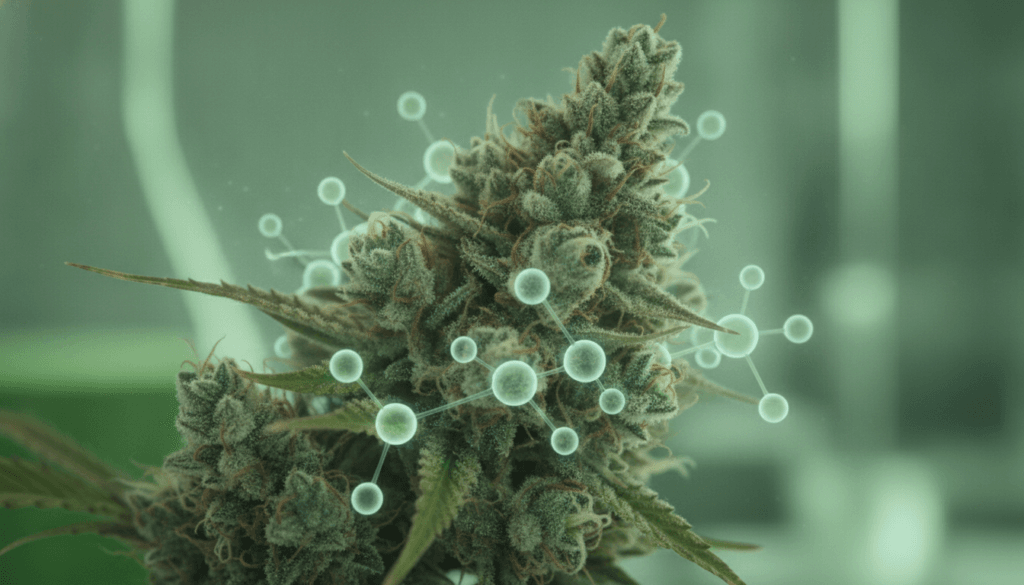
If you have followed the hemp regulatory debate of the past year, you have probably seen THCA mentioned constantly. It is the compound at the heart of the 2025 law that is reshaping the hemp industry, and yet most people who use cannabis or hemp products are not entirely clear on what THCA actually is, or why it matters so much.
What THCA Is
THCA stands for tetrahydrocannabinolic acid. It is the raw, acidic precursor form of THC found naturally in living cannabis plants. In a freshly harvested cannabis plant, almost all of the plant’s THC potential exists as THCA rather than as THC itself. The plant synthesises THCA during its growth; THC is not naturally abundant in the plant while it is alive and growing.
In its raw form, THCA is not psychoactive. It does not bind to CB1 receptors in the same way Delta-9 THC does and does not produce intoxicating effects. You could theoretically eat raw cannabis flower (which is not recommended and has no established benefits) and get very little psychoactive effect, because the THCA has not yet converted to THC.
How THCA Becomes THC: Decarboxylation
The conversion of THCA to Delta-9 THC happens through a process called decarboxylation, which essentially means the removal of a carboxyl group (a carbon dioxide molecule) from the THCA molecule. Heat is the primary driver of this conversion. When cannabis flower is smoked, the combustion temperature instantly decarboxylates THCA to THC. When cannabis is vaped, the lower temperatures (200 to 250 degrees Celsius) accomplish the same conversion, though less completely than combustion. When cannabis is used to make edibles, the baking or cooking process decarboxylates the THCA before it is consumed, which is why raw cannabis flower cannot simply be added to food without a heat step first. The conversion is not 100% complete, and the standard formula used in regulatory contexts to account for the decarboxylation efficiency is Total THC = Delta-9 THC + (THCA × 0.877), reflecting the molecular weight change during conversion.
Why THCA Created the Hemp Loophole
The 2018 Farm Bill defined legal hemp as Cannabis sativa L. with no more than 0.3% Delta-9 THC by dry weight. This specific threshold covered only Delta-9 THC, not THCA. Since THCA is not Delta-9 THC (it is a different molecule in its unconverted form), a cannabis plant or product could contain very high levels of THCA, sometimes 20 to 25% or more, and still technically meet the legal hemp definition as long as its Delta-9 THC level stayed below 0.3%. Once that high-THCA flower is smoked or vaped, however, essentially all of that THCA converts to Delta-9 THC, producing an effect identical to a marijuana product with comparable THC levels. The plant’s legal classification before heating was fundamentally misleading about what the consumer would actually experience after heating, which is precisely why this became known as the hemp loophole.
What the November 2025 Law Changed
Section 781 of the Continuing Appropriations Act signed on November 12, 2025, redefined hemp to use a total THC standard, calculated as Delta-9 THC + (THCA × 0.877), and set a threshold of no more than 0.3% total THC by dry weight. This single change makes the THCA loophole legally non-viable as of November 12, 2026, the law’s effective date, because a flower product with 20% THCA would have a total THC calculation of approximately 17.5%, far exceeding the 0.3% threshold. The law also added a per-container limit of no more than 0.4 milligrams of total THC for finished hemp-derived consumable products, which affects not just THCA flower but edibles, beverages, and other products at virtually any meaningful dose level.
State-Level Actions Ahead of the Federal Deadline
Several states did not wait for the November 2026 federal deadline. Tennessee adopted total THC regulations effective January 1, 2026, effectively banning high-THCA products ahead of schedule. Texas implemented similar rules effective March 31, 2026, through the state’s Department of State Health Services, though this rule was challenged in court and restrained by a Travis County temporary restraining order as of mid-2026. Florida already operated under a state-level total THC standard, making high-THCA flower effectively prohibited there. As of mid-2026, over a dozen states have banned or significantly restricted THCA products either through total THC adoption or outright restrictions, with the remaining states continuing under the 2018 Farm Bill’s Delta-9-only standard for the time being.
What Happens to THCA Products Between Now and November 2026
As of today (July 2026), THCA flower and products remain federally compliant under the 2018 Farm Bill’s Delta-9-only standard, which is still the operative federal law until November 12, 2026. However, state-level restrictions mean legality varies significantly depending on where you are. Legislative efforts to delay the federal effective date (including H.R. 7024 and the HEMP Act H.R. 1287) remain under consideration in Congress as of mid-2026 without having been enacted. The practical advice for anyone who uses THCA products is to monitor both federal and state developments closely as the November 2026 deadline approaches, since the landscape could change either through new federal legislation or through states adopting their own restrictions in the interim.
Frequently Asked Questions
Is THCA the same as THC?
No, but it converts to THC when heated. THCA (tetrahydrocannabinolic acid) is the raw, acidic form found in living cannabis plants. It is not psychoactive in its unconverted state. Delta-9 THC is the active psychoactive compound that THCA becomes when exposed to heat, through a process called decarboxylation. When cannabis flower is smoked or vaped, virtually all THCA converts to Delta-9 THC, making its practical effect identical to a Delta-9-labelled product with comparable potency.
Will THCA show up on a drug test?
Yes. Standard drug tests screen for THC metabolites, which are produced when the body processes Delta-9 THC. Since THCA converts to Delta-9 THC when smoked or vaped, using THCA flower produces the same THC metabolites as using any THC product. A positive drug test result from THCA use is indistinguishable from one caused by marijuana use, regardless of the product’s labelling or legal classification as hemp.
Why was THCA flower sold openly in stores if it converts to THC?
Because the 2018 Farm Bill’s hemp definition was based specifically on Delta-9 THC concentration at the time of testing, not on what the product would produce when consumed. THCA flower that tests below 0.3% Delta-9 THC at the point of harvest or testing meets the legal hemp definition, even though smoking that same flower would convert the abundant THCA to Delta-9 THC and produce an intoxicating effect. The law’s definition measured a static chemical snapshot rather than the product’s actual real-world effect, which is the loophole the 2025 legislation is closing.
What is the difference between THCA and THCO?
THCA is a naturally occurring compound found in all cannabis plants. THCO (THC-O acetate) is a synthetic cannabinoid made in a laboratory by chemically modifying hemp-derived THC. They are related only in that both have been part of the broader hemp-derived intoxicant market, but they are completely different compounds. The 2025 hemp redefinition addresses both by including THCA in the total THC calculation and by excluding cannabinoids synthesised outside the plant, which covers THCO and similar compounds.
Can THCA be used in any way that does not produce THC?
In theory, THCA consumed without heat, for example as raw cannabis juice, would not convert to Delta-9 THC and would not produce psychoactive effects. Some wellness advocates have explored raw cannabis as a health food for this reason. However, this application has no established evidence base for specific health benefits, and raw cannabis juice is not a commercially significant product category. The practical and commercial relevance of THCA is almost entirely in its conversion to THC when heated for smoking or vaping.
What is the THCA percentage I should look for in lab tests?
In legal markets where total THC is the compliance standard (including post-November 2026 federal law, and several states already), a compliant product must have a calculated total THC (Delta-9 THC + THCA × 0.877) at or below 0.3%. At this total THC level, a flower product would have almost no psychoactive potential. In states currently still using the Delta-9-only standard, high-THCA flower can legally test at 0.3% Delta-9 while carrying 20% or more THCA. This is the regulatory discrepancy the 2025 law addresses.