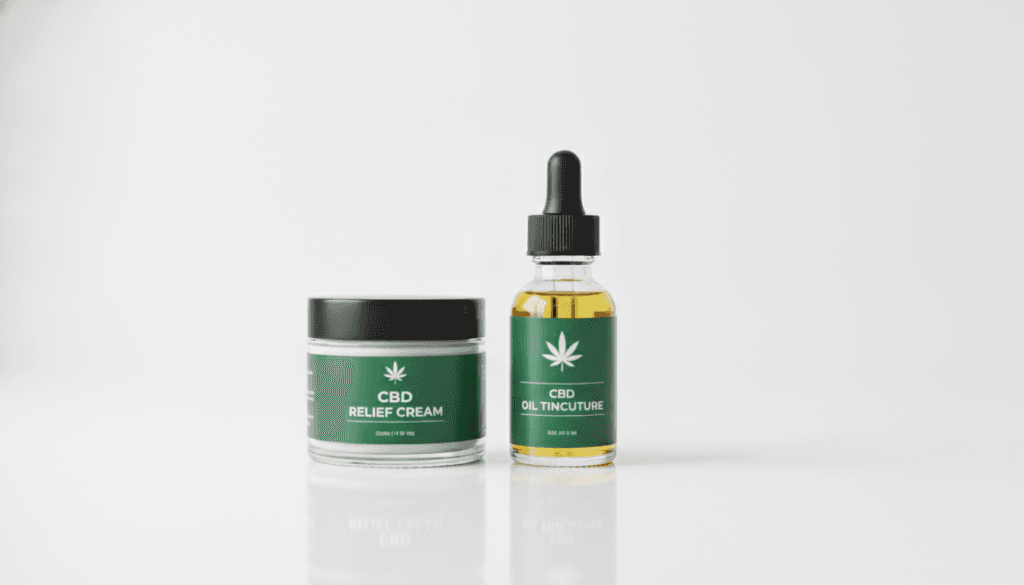
One of the most common points of confusion for new CBD users is the assumption that all CBD products work the same way regardless of how they are applied. In reality, CBD topicals and oral CBD products operate through fundamentally different pathways in the body, and choosing the wrong format for your goal can mean getting little to no benefit even from a high-quality product.
The Core Difference: Systemic vs Localised
Oral CBD, whether tinctures, capsules, or edibles, is absorbed into the bloodstream and circulates throughout the body, reaching the endocannabinoid system’s receptors wherever they are located, in the brain, immune cells, digestive tract, and beyond. This is called a systemic effect. CBD topicals, applied directly to the skin, work primarily at the localised site of application. CBD molecules interact with cannabinoid receptors (CB1 and CB2) present in the skin and underlying tissue, but very little CBD from a topical product enters the bloodstream in any meaningful amount. This means a CBD cream applied to your knee will not produce the same systemic effects (such as anxiety relief) that an oral tincture might, and conversely, an oral tincture will not deliver concentrated CBD to a specific sore joint the way a topical can.
When Oral CBD Is the Better Choice
Oral CBD is the appropriate choice for anything that requires a systemic effect. For anxiety and stress management, CBD needs to reach receptors in the brain and central nervous system, which requires it to enter the bloodstream. For sleep support, similarly, the relevant receptors are central, not localised to skin. For general wellness and inflammation support throughout the body, oral CBD provides broader distribution. For any condition where the goal is an effect felt throughout the body rather than at one specific location, oral CBD (sublingual tinctures for faster onset, or capsules and edibles for convenience) is the relevant format.
When CBD Topicals Are the Better Choice
Topicals are the appropriate choice when the goal is localised relief at a specific site. For sore muscles and joints, applying a CBD balm or cream directly to the affected area allows for higher local concentration without systemic absorption. For skin conditions, including inflammation, dryness, or localised irritation, CBD topicals can interact with the skin’s own cannabinoid receptors directly at the site. For targeted pain, such as a specific area affected by arthritis or an old injury, topical application allows you to direct the product exactly where it is needed. Topicals are also useful for people who want to avoid any systemic effects entirely, including any (extremely minimal) THC content from full spectrum products, since topical absorption into the bloodstream is negligible.
Can CBD Topicals Cause a Drug Test Issue?
This is a common concern, and the answer is reassuring: CBD topicals, even full spectrum products containing trace THC, are extremely unlikely to cause a positive drug test because topical absorption into the bloodstream is minimal. This is different from oral full spectrum products, where regular use can lead to detectable THC accumulation over time. If drug testing is a significant concern, topicals are actually one of the lowest-risk CBD product categories.
Combining Both: A Layered Approach
Many people use both formats together for different purposes. For example, someone managing both general anxiety and localised joint pain might take an oral CBD tincture daily for the systemic anxiety benefit while also applying a CBD topical to the specific joint for localised relief. These two approaches do not conflict and address genuinely different mechanisms, so there is no concern about combining them, though it is worth being aware of your total CBD intake if tracking dosage for any reason, even though topical CBD contributes negligibly to systemic levels.
What to Look for in Each Product Type
For oral CBD, look for a clearly stated CBD content in milligrams per serving, a Certificate of Analysis confirming cannabinoid content and absence of contaminants, and consider the spectrum type (full spectrum, broad spectrum, or isolate) based on your THC preferences. For topicals, look for the CBD concentration (often expressed as total mg per container, such as 500 mg CBD in a 2 oz jar), the presence of complementary ingredients that may enhance absorption or provide additional benefit (such as menthol for a cooling sensation, or arnica for its own anti-inflammatory properties), and a COA confirming the cannabinoid content of the topical specifically, as topical product testing is sometimes less rigorous than oral product testing in less reputable brands.
Absorption: How Topicals Actually Work
For a topical CBD product to have any effect, the CBD molecule needs to penetrate through the outer layer of skin (the stratum corneum) to reach the cannabinoid receptors in the deeper skin layers and underlying tissue. CBD is fat-soluble, which helps it penetrate the lipid-rich outer skin layer to some degree, but absorption is generally considered limited compared to many pharmaceutical topical formulations. This is part of why topical CBD products often use higher concentrations than might be assumed necessary, and why some formulations include penetration enhancers or are designed as gels or patches rather than simple lotions to improve delivery to deeper tissue.
Frequently Asked Questions
Will a CBD cream help with my anxiety?
Unlikely to any meaningful degree. CBD topicals work primarily at the local site of application and very little CBD enters the bloodstream from topical use. Anxiety relief requires CBD to reach receptors in the brain and central nervous system, which requires systemic absorption via oral or sublingual products. If anxiety is your primary concern, an oral tincture, capsule, or edible is the more relevant product category, not a topical.
How much CBD topical should I use for joint pain?
This varies by product concentration, but a common approach is to apply a generous amount directly to the affected area, massaging it in, two to three times per day. Unlike oral CBD, there is less concern about a precise milligram dose for topicals since systemic absorption is minimal; the relevant factor is applying enough product to adequately cover and be absorbed by the affected area. Some users find reapplying more frequently during periods of increased discomfort is helpful, since topical effects tend to be more localised and shorter-lived than systemic oral effects.
Can I use a CBD topical on my face for skin issues?
Yes, CBD topicals formulated for facial use (often lighter in texture than body balms) can be applied to address localised skin concerns, working through the same local cannabinoid receptor interaction in skin tissue. This is a different mechanism from hemp seed oil’s benefits for skin, which come from fatty acid content rather than cannabinoid receptor interaction. Some products combine both: hemp seed oil as a nourishing carrier and CBD as an active ingredient for localised effects.
Is oral CBD or topical CBD better value for money?
This depends entirely on your goal rather than being a general value comparison, since the two products are not interchangeable. If you need systemic effects (anxiety, sleep, general wellness), only oral CBD can provide this, making a topical poor value for that specific goal regardless of price. If you need localised relief at a specific site, a topical applied directly there will likely be more effective for that purpose than an oral product, again making the comparison about matching the product to the goal rather than price per milligram.
Do CBD topicals expire faster than oral CBD oil?
Topical products, particularly creams and lotions, often contain water-based components and additional ingredients (emulsifiers, other actives) that can affect shelf life differently than a simple oil-based tincture. Always check the specific product’s expiration date and storage instructions, as formulations vary significantly. Generally, both should be stored away from direct heat and light, and topicals in particular should be checked for any changes in texture, smell, or separation, which can indicate the product has degraded.
Can I make my own CBD topical by mixing CBD oil with lotion?
While technically possible, simply mixing an oral CBD tincture into a lotion does not guarantee effective topical delivery, as commercial topical formulations are often designed with specific carriers and sometimes penetration enhancers to improve how CBD interacts with skin tissue. The CBD content would also become diluted and difficult to gauge accurately. For reliable topical use, a product specifically formulated and tested as a topical is more likely to deliver the intended localised effect than a homemade mixture, though some people do experiment with this approach for general moisturising purposes (similar to how hemp seed oil is used) rather than for targeted cannabinoid receptor effects.