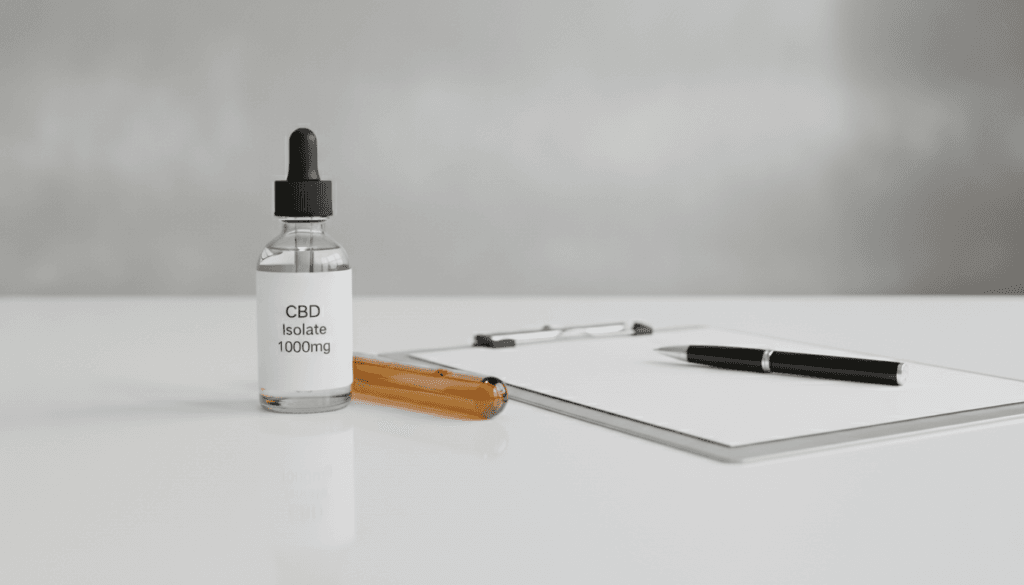
If you use CBD and have an upcoming drug test, whether for work, sport, or another reason, the question of whether it could cause a problem is a genuinely important one. The honest answer is: it depends, and the details matter more than most product marketing suggests.
What Drug Tests Actually Screen For
Standard workplace and most other drug tests do not screen for CBD. They screen for THC metabolites, specifically THC-COOH (11-nor-9-carboxy-THC), the inactive compound your body produces after metabolising THC. Under SAMHSA guidelines used widely in the US, the standard cutoff for a positive urine test is 50 nanograms per millilitre of THC-COOH. A test does not distinguish whether that THC-COOH came from a marijuana product, a full spectrum CBD product, or any other source. It only measures the metabolite level.
The Three CBD Types and Their Drug Test Risk
Full spectrum CBD contains up to 0.3% THC by dry weight (the legal hemp limit in the US). While each individual dose contains a very small amount of THC, frequent or heavy use can cause THC to accumulate in fat tissue over time, since THC is lipophilic (fat-soluble). With sustained daily use of full spectrum products, this accumulation can in some cases reach levels detectable on a standard drug test. Broad spectrum CBD has THC removed during processing but may still contain trace, non-quantified amounts due to the limitations of extraction technology. The risk is significantly lower than full spectrum but not entirely zero. CBD isolate is purified to around 99% CBD with everything else removed. Clinical research, including studies using doses up to 1,500 mg of pure CBD, has found no THC-positive results on standard testing devices. Isolate carries the lowest risk by a significant margin.
What the Research Shows
A randomised, double-blind crossover study using oral fluid testing devices (DrugWipe 5S and DrugTest 5000, both with 10 ng/mL THC cutoffs) administered pure CBD at doses of 15 mg, 300 mg, and 1,500 mg. Across 259 and 256 completed tests respectively, no THC-positive results were observed at any dose, including the 1,500 mg dose. This supports the conclusion that pure CBD isolate, even at high doses, does not produce false positives on oral fluid THC tests. In contrast, a smaller study involving participants vaping a CBD-dominant cannabis product (10.5% CBD, 0.39% THC, slightly above the legal hemp threshold) found that 3 of 18 participants tested positive for THC metabolites using a confirmatory cutoff of 15 ng/mL. This illustrates how product THC content, even close to the legal threshold, combined with the inhaled route, can produce different outcomes than oral isolate use.
Other Causes of Unexpected Positive Results
Beyond the product type itself, several other factors can contribute to an unexpected positive result. Mislabelled products are a real risk: studies analysing commercially available CBD products have repeatedly found discrepancies between labelled and actual cannabinoid content, including products labelled as THC-free that contained detectable THC. Cross-contamination during manufacturing, particularly at facilities that process multiple cannabis products, can introduce THC into products that were not intended to contain it. Genuine false positives, where a test incorrectly flags THC when none is present, are considered rare (estimated around 1 to 2%) but not impossible, particularly with lower-quality or older immunoassay-based tests.
How to Minimise Your Risk
If you have an upcoming drug test and use CBD regularly, choose CBD isolate or broad spectrum products with a Certificate of Analysis (COA) that explicitly states non-detectable THC, not just under the legal limit. Be aware that under the legal limit (0.3%) is not the same as zero, and accumulation with regular full spectrum use is the primary risk pathway. If you have been using full spectrum products regularly, consider that THC can remain detectable in urine for 3 to 30 days depending on frequency and amount of use, and in hair for up to 90 days, so switching products shortly before a test may not be sufficient. Buy from brands that publish batch-specific, third-party COAs, and avoid products that do not disclose cannabinoid content in milligrams at all.
Frequently Asked Questions
Can CBD isolate cause a positive drug test?
This is very unlikely. Clinical research using doses up to 1,500 mg of pure CBD found no THC-positive results on standard oral fluid testing devices. CBD isolate is refined to approximately 99% CBD with cannabinoids including THC removed during processing. If a positive test occurs while using a product marketed as isolate, the most likely explanations are mislabelling or cross-contamination during manufacturing, which is why a verified COA matters.
How long does THC from full spectrum CBD stay in your system?
This depends heavily on frequency and duration of use. THC metabolites can be detectable in urine for 3 to 30 days for occasional use, and longer with regular, heavy use due to THC’s fat-soluble nature and accumulation in fat tissue. Hair follicle tests can detect THC for up to 90 days. If you use full spectrum CBD daily over an extended period, the accumulation effect means a single day of abstinence before a test is unlikely to be sufficient.
Will hemp seed oil show up on a drug test?
No. Hemp seed oil is pressed from hemp seeds and contains no THC, CBD, or other cannabinoids. It poses no drug test risk whatsoever. This is a different product entirely from CBD oil, which is extracted from the flowers and leaves of the plant. If your concern is drug testing, confirm whether a product is hemp seed oil (no cannabinoids, no risk) or CBD oil (cannabinoid-containing, risk depends on spectrum type).
What should I look for on a COA to assess drug test risk?
Look for a cannabinoid panel that explicitly states the THC result, ideally as non-detectable (ND) or below the laboratory’s limit of quantification, rather than simply within legal limits. Under 0.3% still means THC is present and could contribute to accumulation with regular use. A COA showing ND for THC provides the strongest assurance, though even this does not provide an absolute guarantee given individual variation in metabolism and potential batch-to-batch variability.
If I stop using full spectrum CBD, how long should I wait before a drug test?
There is no universal answer because it depends on how much and how long you used the product, your body fat percentage (THC is stored in fat tissue), your metabolism, and the type of test being used. For occasional use, a window of one to two weeks may be sufficient for urine tests. For regular, long-term use, several weeks to over a month may be more realistic given THC’s accumulation and slow release from fat stores. If a drug test is a known and important event, switching to isolate or broad spectrum CBD well in advance, rather than relying on a short abstinence period from full spectrum products, is the more reliable approach.
Are CBD products legal to use before driving?
CBD itself does not impair driving ability and is not the target of roadside drug testing for impairment. However, full spectrum CBD products containing THC could theoretically affect roadside oral fluid tests in jurisdictions with zero-tolerance THC driving laws, even without producing any subjective impairment. If you are in a jurisdiction with strict THC driving limits and use full spectrum CBD, broad spectrum or isolate products eliminate this concern entirely.