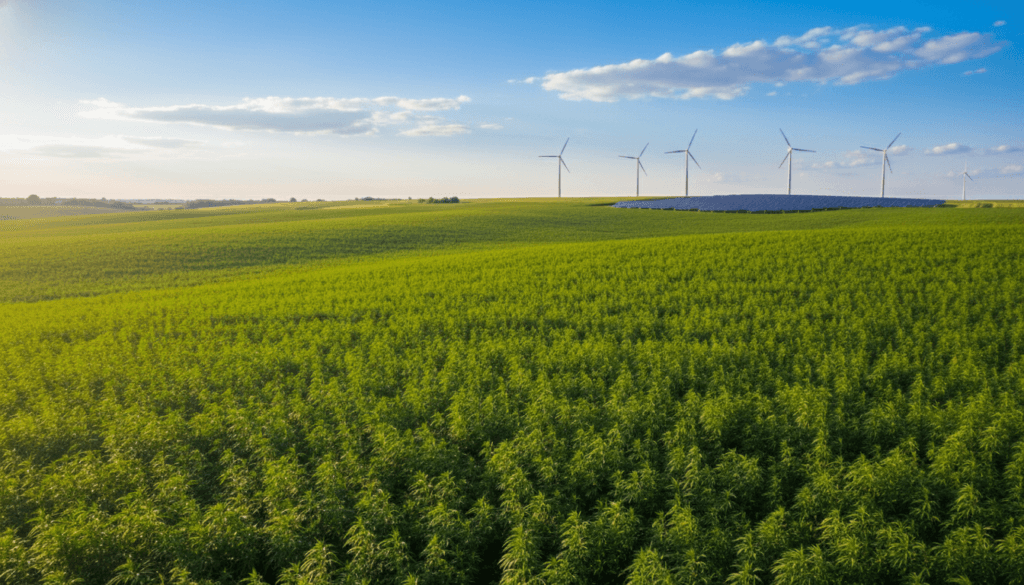
Sustainability has become a word that can mean almost anything in modern marketing. It gets applied to products and companies regardless of whether the underlying practices genuinely deliver environmental benefit. Hemp is different. The sustainability credentials of industrial hemp are grounded in measurable science, not branding, and the evidence is worth understanding clearly.
Hemp Grows Quickly with Very Little Input
Hemp reaches full maturity in 70 to 120 days, depending on the variety and growing conditions. This rapid growth cycle means more harvests per year are possible on the same land compared to slower-growing crops. More significantly, hemp requires significantly less water than many alternative crops. Cotton, one of the most widely grown industrial crops in the world, requires approximately 10,000 liters of water to produce one kilogram of fiber. Hemp requires approximately 300 to 500 liters for the same output. Hemp also requires very few pesticides. The plant’s dense growth canopy shades out competing weeds, reducing the need for herbicides. Its natural pest resistance means pesticide use is minimal compared to conventional cotton or many food crops.
Hemp Sequesters Carbon
One of hemp’s most compelling sustainability credentials is its carbon sequestration capacity. Hemp absorbs CO2 from the atmosphere as it grows through photosynthesis and stores that carbon in its biomass. Research from the University of Bath estimated that hemp crops absorb between 8 and 15 tonnes of CO2 per hectare per growing cycle, more than any forest ecosystem. This carbon remains stored in hemp-derived products including textiles, building materials, and paper for the product’s lifetime, making hemp potentially carbon-negative across its full lifecycle when processed sustainably.
Hemp Improves the Soil It Grows In
Unlike many monoculture crops that deplete soil nutrients over time, hemp actually improves soil health. Its deep root system (roots can reach 1.8 meters or more) breaks up compacted soil and improves aeration. When hemp leaves and stalks are returned to the soil after harvest, they decompose and add organic matter, improving the soil’s long-term fertility. Hemp has been used in phytoremediation projects to extract heavy metals and contaminants from polluted soil. Crops were planted around Chernobyl specifically to help draw radioactive cesium and strontium from the soil, demonstrating the plant’s capacity to absorb substances from the earth. This same capacity is why organic certification matters for hemp products intended for consumption or skin application.
Every Part of the Hemp Plant Is Usable
Industrial hemp is a zero-waste crop in principle. The seeds are processed into food products, supplements, and cosmetic oils. The stalks provide bast fibers (long, strong fibers from the outer stalk) used in textiles, rope, and construction materials, and hurd or shiv (the woody inner core) used in animal bedding, hempcrete building material, and paper. The leaves and flowers provide cannabinoid extracts including CBD, as well as biomass for biofuel. The roots are used in certain traditional medicine preparations and are being studied for their terpenoid content. No other major agricultural crop approaches this level of whole-plant utilisation.
Hempcrete: Building Carbon Out of the Air
One of the most remarkable applications of hemp in sustainability is hempcrete, a composite building material made from hemp hurd mixed with lime binder and water. Hempcrete is carbon-negative: the carbon absorbed by the hemp plant during growth is permanently locked into the building material, and the lime binder continues to slowly carbonate over decades, absorbing additional CO2 from the air. Buildings made with hempcrete are used across Europe and are gaining traction in the US and Australia as sustainable construction alternatives.
Frequently Asked Questions
Is hemp more sustainable than cotton?
Yes, by most measurable metrics. Hemp requires approximately 50 times less water per kilogram of fiber than cotton. Hemp requires minimal pesticides while conventional cotton is one of the most pesticide-intensive crops in the world, accounting for approximately 16% of global insecticide use. Hemp also produces more fiber per hectare than cotton and improves soil health, while intensive cotton farming often degrades soil over time.
Does hemp farming require pesticides?
Industrial hemp naturally requires very few pesticides. Its dense canopy shades out competing weeds, reducing herbicide needs, and the plant has natural pest resistance. This makes hemp one of the more pesticide-free crops to grow at scale. However, hemp’s bioaccumulation capacity means it will absorb pesticides present in the soil from previous crops, which is why organic certification and third-party lab testing for contaminants remain important for hemp products.
Can hemp replace plastic?
Hemp-derived bioplastics are technically feasible and have been produced and tested, but replacing petroleum-based plastic at scale is a complex challenge involving economics, infrastructure, and material properties. Hemp-based bioplastics are biodegradable under the right conditions and have a significantly lower carbon footprint in production. However, they are currently more expensive than petroleum plastics and lack the same industrial processing infrastructure. Hemp is one of several promising alternative materials for reducing plastic dependency rather than a single replacement solution.
How much CO2 does hemp absorb?
Research estimates that hemp absorbs between 8 and 15 tonnes of CO2 per hectare per growing cycle, which is among the highest carbon sequestration rates of any agricultural crop. For comparison, forests typically sequester 2 to 6 tonnes of CO2 per hectare per year. Hemp’s rapid growth cycle (70 to 120 days) means this absorption happens in a fraction of the time it takes a forest to achieve comparable results.
Is hemp clothing sustainable?
Hemp fabric is generally considered one of the more sustainable textile options available. It uses far less water and pesticide than conventional cotton, the fiber is naturally strong and durable, and hemp fields improve rather than deplete the soil they grow in. Hemp fabric tends to soften with washing over time. Its main limitation for mainstream clothing has been cost and availability of processing infrastructure, though both are improving as demand for sustainable textiles grows.