If you have spent any time reading about nutrition, you have likely come across warnings about the modern diet’s Omega-6 to Omega-3 imbalance. Most people eating a Western diet consume far too much Omega-6 and far too little Omega-3, with ratios ranging from 15:1 to 20:1 or higher. The recommended range for human health is somewhere between 2:1 and 4:1.
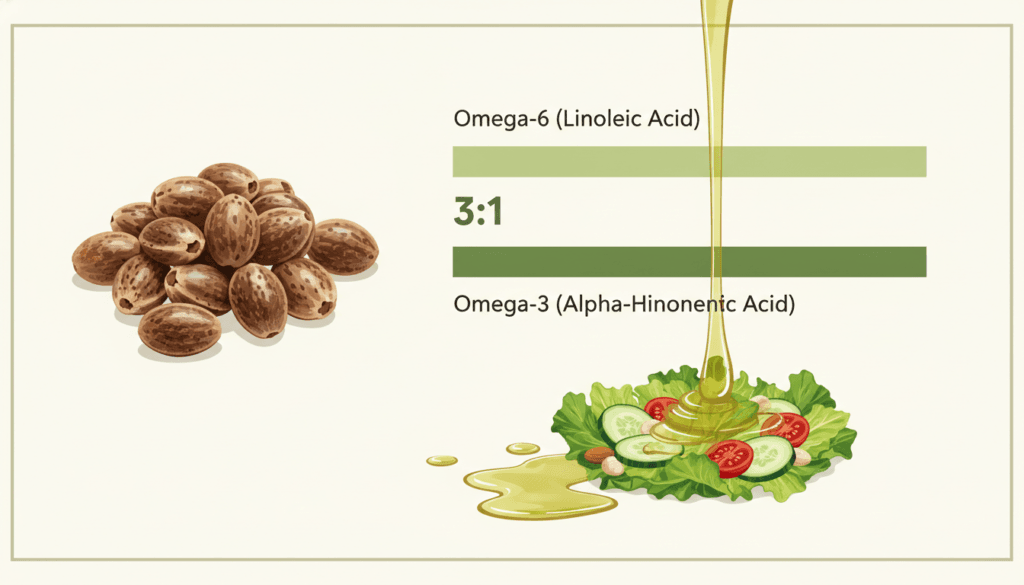
Hemp seed oil sits at approximately 3:1. It is one of the very few food oils that naturally delivers fatty acids in a ratio close to what the body actually needs.
What Are Omega-3 and Omega-6 Fatty Acids?
Omega-3 and Omega-6 are both polyunsaturated fatty acids (PUFAs) classified as essential fatty acids. Essential means the human body cannot produce them on its own and must obtain them from food. Both types play critical structural and functional roles in the body including building cell membranes, supporting brain function, regulating inflammation, and maintaining cardiovascular health. The challenge is that Omega-6 fatty acids, when consumed in excess relative to Omega-3s, can promote inflammatory processes. Omega-3s tend to have anti-inflammatory properties. Getting the balance right matters.
What Does Hemp Seed Oil Contain?
Hemp seed oil’s fatty acid profile breaks down approximately as follows. Linoleic Acid (LA), which is an Omega-6, accounts for 54 to 60% of total fatty acids. Alpha-Linolenic Acid (ALA), which is an Omega-3, accounts for 17 to 24% of total fatty acids. Gamma-Linolenic Acid (GLA), which is an Omega-6 with anti-inflammatory properties, accounts for 2 to 4%. Oleic Acid, which is a monounsaturated Omega-9, accounts for approximately 9 to 11%. Stearidonic Acid (SDA), which is an Omega-3, is present in trace amounts.
This gives hemp seed oil a typical Omega-6 to Omega-3 ratio of approximately 3:1, sitting comfortably within the 2:1 to 4:1 range considered optimal by nutritional researchers.
Why Is the 3:1 Ratio Considered Ideal?
Research published in the journal Biomedicine and Pharmacotherapy has examined how fatty acid ratios in the diet influence chronic disease development. A lower Omega-6 to Omega-3 ratio is associated with reduced risk of cardiovascular disease, reduced systemic inflammation, and improved outcomes in conditions including rheumatoid arthritis, asthma, and certain cancers. Hemp seed oil’s natural 3:1 ratio makes it a genuinely useful dietary addition for anyone trying to rebalance their fatty acid intake without supplements.
GLA: The Bonus Fatty Acid
Hemp seed oil contains a fatty acid that most other common food oils do not: Gamma-Linolenic Acid (GLA). GLA is an Omega-6 fatty acid but unlike standard Omega-6s, it is converted in the body to Prostaglandin E1 (PGE1), which has anti-inflammatory and vasodilatory effects. GLA is found in significant amounts in very few food sources, the main ones being evening primrose oil, borage oil, and hemp seed oil. The 2 to 4% GLA content in hemp seed oil is considered therapeutically meaningful and has been studied in the context of skin conditions including eczema and atopic dermatitis.
How Does Hemp Seed Oil Compare to Other Oils?
Olive oil has an Omega-6 to Omega-3 ratio of approximately 9:1 to 14:1 and contains minimal GLA. Flaxseed oil has a ratio of approximately 1:4 (strongly Omega-3 dominant) and no GLA. Sunflower oil has a ratio of approximately 40:1 to 70:1 (heavily Omega-6 dominant) and no GLA. Coconut oil contains virtually no polyunsaturated fatty acids. Hemp seed oil at 3:1 with GLA present is in a genuinely unique position among widely available food oils.
Practical Ways to Use Hemp Seed Oil for Omega Balance
Hemp seed oil should not be heated above 165 degrees Celsius to preserve its fatty acid integrity. It works well drizzled over salads and roasted vegetables, blended into smoothies or protein shakes, used as a base for dips and dressings, taken by the tablespoon as a daily supplement, and applied to the skin as a topical oil where its fatty acids support the skin barrier directly.
Frequently Asked Questions
What is the Omega-6 to Omega-3 ratio in hemp seed oil?
Hemp seed oil has an Omega-6 to Omega-3 ratio of approximately 3:1, with around 55 to 60% Linoleic Acid (Omega-6) and 17 to 24% Alpha-Linolenic Acid (Omega-3). This ratio falls within the 2:1 to 4:1 range that nutrition researchers consider optimal for human health, making hemp seed oil one of the most naturally balanced food oils available.
Is hemp seed oil better than flaxseed oil for Omega fatty acids?
Flaxseed oil is richer in Omega-3 ALA (approximately 53%) and has a stronger anti-inflammatory profile. Hemp seed oil is more balanced (3:1 Omega-6 to Omega-3) and also contains GLA, which flaxseed oil lacks. If your diet is already heavily Omega-6 dominant, flaxseed oil may provide a stronger corrective effect. If you want a more balanced daily oil with the added benefit of GLA, hemp seed oil is the better choice.
Can hemp seed oil help with inflammation?
Hemp seed oil may support inflammation management through two mechanisms. First, its Omega-3 content (particularly ALA) can convert in the body to anti-inflammatory compounds. Second, its GLA content converts to Prostaglandin E1, which has documented anti-inflammatory effects. However, hemp seed oil is not a medicine and should not be treated as a replacement for medical treatment of inflammatory conditions.
How much hemp seed oil should I take daily?
A commonly cited daily intake for nutritional benefit is 1 to 2 tablespoons of hemp seed oil per day. This provides approximately 2 to 4 grams of Omega-3 ALA and meaningful amounts of GLA. There is no established recommended daily dose and individual needs vary. If you are taking blood thinners or have a specific medical condition, discuss any new supplement with your doctor before starting.
Does cooking destroy the Omega fatty acids in hemp seed oil?
Yes. The polyunsaturated fatty acids in hemp seed oil (Omega-3, Omega-6, and GLA) are heat-sensitive and begin to degrade above 165 degrees Celsius (330 degrees Fahrenheit). High-heat cooking will oxidise these fatty acids and reduce or eliminate their nutritional benefit. Hemp seed oil is best used cold: in dressings, smoothies, as a finishing drizzle, or taken directly as a supplement.