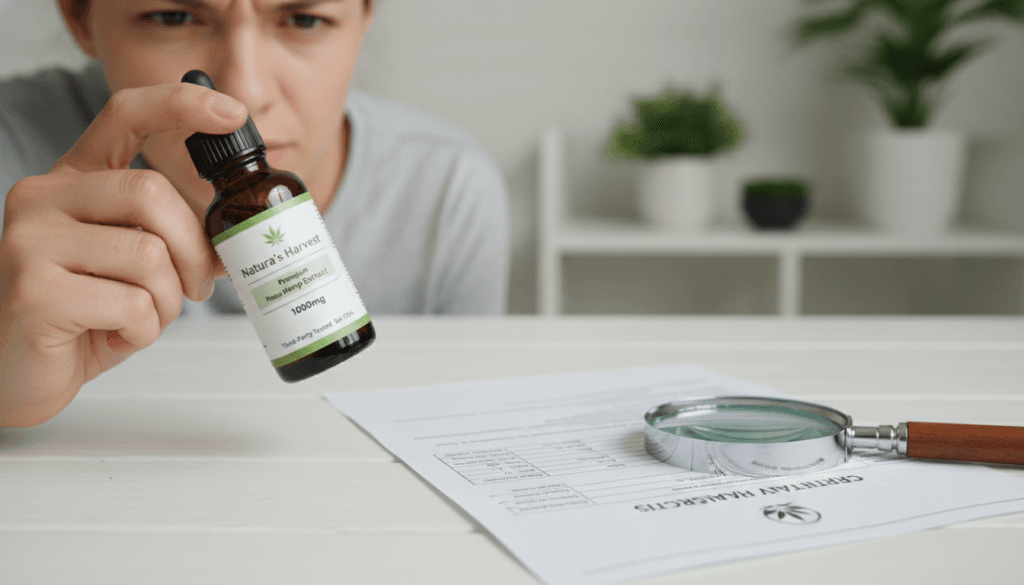
The hemp oil market is, to put it politely, a mixed landscape. For every well-made, honestly labelled product there are several that are overpriced, mislabeled, or simply ineffective for the purpose being marketed. The good news is that a few focused checks before purchase can reliably separate quality products from poor ones.
Here are the seven things that matter most.
1. Check the Certificate of Analysis (COA)
A Certificate of Analysis is a document produced by an independent, accredited laboratory that confirms exactly what is in the product. For hemp seed oil, a COA should confirm the fatty acid profile and absence of pesticide residues and heavy metals. For CBD oil, it must also confirm the CBD content in milligrams per milliliter and the THC level (should be below 0.3% in the US and 0.2% in the EU and UK). If a brand cannot provide a current, batch-specific COA from a named third-party laboratory, that is a serious red flag. QR codes linking to COAs on the packaging are the current standard for quality brands.
2. Look at the Extraction Method
How the oil was extracted determines its quality. For hemp seed oil, cold-pressed or expeller-pressed is what you want. Refined or heat-extracted oils lose significant nutritional value. For CBD oil, CO2 extraction is the gold standard, producing a clean extract without solvent residues. Ethanol extraction is also acceptable. Hydrocarbon extraction (butane, propane) is acceptable only if the final product has been tested to confirm no residual solvents. Avoid products that do not disclose their extraction method.
3. Verify the Ingredient List
For hemp seed oil, the ingredient list should say Cannabis sativa seed oil and nothing else for a pure product, or list hemp seed oil as the first ingredient if it is a formulated product. The INCI (International Nomenclature of Cosmetic Ingredients) name for hemp seed oil is Cannabis sativa seed oil. If you see this on a product marketed as CBD oil, you are looking at hemp seed oil without CBD, regardless of how the marketing copy describes it. For CBD oil, look for the CBD content expressed in milligrams per bottle or per milliliter, and verify that against the COA.
4. Check the Packaging
Hemp seed oil and CBD oil both contain polyunsaturated fatty acids and other compounds that degrade with exposure to light and oxygen. Quality products are packaged in dark (amber or green) glass bottles with dropper tops that limit air exposure. Clear plastic bottles allow light degradation. Large clear glass bottles look premium but accelerate oxidation once opened. Dark glass in a size appropriate for your usage rate is the practical choice.
5. Look for Organic Certification
Hemp is a bioaccumulator, meaning it absorbs substances from the soil including heavy metals, pesticides, and other contaminants. For products applied to skin or consumed daily, organic certification provides meaningful quality assurance. In the US, look for USDA Organic certification. In the UK and EU, look for Soil Association or EU Organic certification. These certifications require the hemp to be grown without synthetic pesticides or chemical fertilisers and involve third-party inspection.
6. Assess the Price Realistically
Quality cold-pressed hemp seed oil should not be expensive. A 250 ml bottle of quality cold-pressed hemp seed oil typically retails for $10 to $25. If you are paying significantly more for a plain hemp seed oil with no CBD content, you may be paying for marketing rather than quality. For CBD oil, pricing should be evaluated per milligram of CBD rather than per bottle. A rough quality benchmark in a legitimate market is $0.05 to $0.15 per milligram of CBD. Products priced well below this range warrant extra scrutiny of their COA.
7. Research the Brand’s Transparency
Reliable hemp oil brands make it easy to find their sourcing information, manufacturing practices, and laboratory results. Look for brands that state where their hemp is grown (US-grown or EU-grown hemp tends to have better regulatory oversight than unspecified or certain import sources), publish their COAs publicly on their website by batch number, provide clear customer service contacts, and have a physical business address and contact information. Brands that obscure these details or make health claims that exceed what is legally permitted in their market (such as claiming to treat, cure, or prevent diseases) are operating outside ethical and legal standards.
Frequently Asked Questions
What is a Certificate of Analysis and why do I need it?
A Certificate of Analysis (COA) is a document from an independent laboratory that confirms the composition of a hemp product. For hemp seed oil it confirms the fatty acid profile and absence of contaminants. For CBD oil it confirms CBD content, THC level, and screens for pesticides and heavy metals. Always request or look up the COA before purchasing any hemp product. If the brand cannot or will not provide one, do not buy from them.
How do I know if a hemp product contains real CBD?
A legitimate CBD product will list the CBD content in milligrams on the label and provide a COA from a named third-party laboratory confirming that content. The COA should show cannabinoid panel results with CBD milligrams per milliliter. If a product uses phrases like hemp extract or hemp oil without a specific CBD milligram content and a confirming COA, assume it contains little to no CBD.
Is it safe to buy hemp oil from Amazon?
Hemp seed oil (non-CBD) is generally safe to purchase from reputable sellers on Amazon as it is a food product with straightforward quality parameters. For CBD oil specifically, Amazon’s terms of service prohibit the sale of CBD products, meaning any product on Amazon marketed as CBD is likely mislabeled hemp seed oil with no actual CBD content. For genuine CBD products, purchase directly from brands with verifiable COAs and transparent sourcing.
What does cold-pressed mean on a hemp oil label?
Cold-pressed means the oil was extracted mechanically under low temperature conditions, typically below 49 degrees Celsius (120 degrees Fahrenheit), without the use of heat or chemical solvents. This preserves the full fatty acid profile including Omega-3, Omega-6, GLA, and antioxidants. Heat or solvent extraction degrades these compounds. Cold-pressed is the quality standard for hemp seed oil intended for nutritional or skincare use.
Should I worry about THC in hemp seed oil?
No. Hemp seed oil is pressed from hemp seeds, which contain no THC or CBD. There is no THC in pure hemp seed oil. For CBD oil, legitimate products will contain 0.3% THC or less (US standard) or 0.2% or less (EU and UK standard), confirmed by a COA. Full-spectrum CBD products with trace THC should not cause a positive drug test at normal doses, but very heavy use of full-spectrum products has occasionally produced positive results in sensitive testing scenarios.