Hemp has been cultivated for over 8,000 years, making it one of the oldest domesticated crops in human history. After decades of regulatory suppression in the US and elsewhere, the 2018 Farm Bill triggered a significant revival of domestic hemp farming. Understanding how hemp is actually grown clarifies a lot about why different hemp products exist, why quality varies between them, and what the agricultural industry around hemp looks like today.
Three Different Crops from One Plant
One of hemp’s most distinctive agricultural characteristics is that the same plant species, Cannabis sativa L., is cultivated in three fundamentally different ways depending on the intended product. Floral hemp, also called CBD hemp or cannabinoid hemp, is grown for its flowers and the cannabinoids they contain. Plants are typically grown as individual units with spacing to allow maximum lateral branching and flower development, similar to how any flowering crop would be grown to maximise yield. Female plants (or feminised seeds ensuring all plants are female) are essential since male plants produce pollen rather than the resin-rich flowers that contain cannabinoids. Fiber hemp is grown for the long, strong bast fibres in the plant’s outer stalk. These plants are seeded densely, sometimes at rates of 1 million seeds per acre or more, and grown close together to encourage tall, straight, single-stemmed plants that maximise fiber length. Individual plants receive no special attention; the density itself shapes the growth habit. Grain hemp is grown for its seeds, which are pressed into hemp seed oil, processed into hemp hearts, or used to make hemp protein. These plants are seeded at intermediate densities and managed to maximise seed set at the top of the plant.
Soil, Climate, and Licensing Requirements
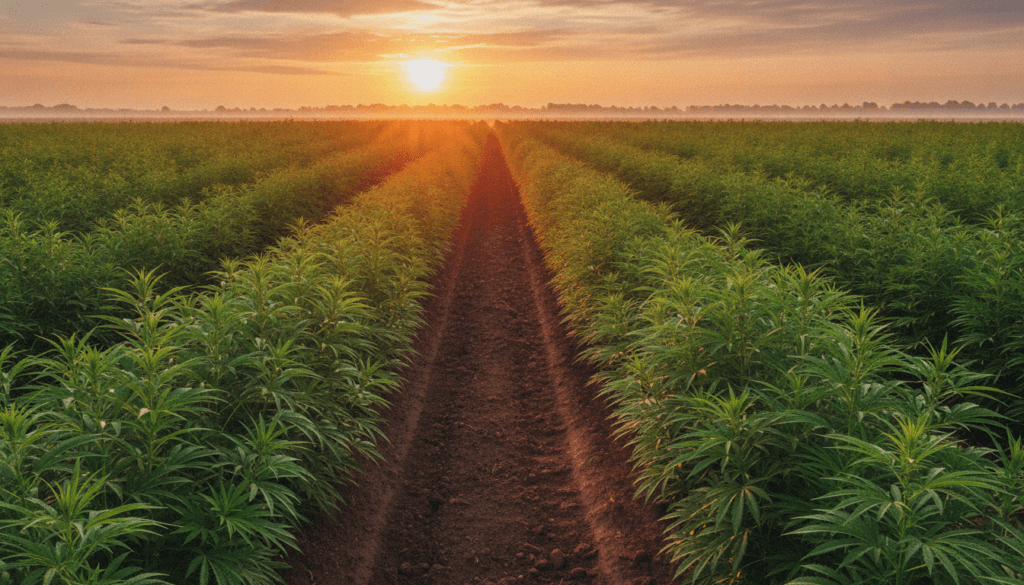
Hemp is relatively adaptable to a range of climates and soil types but performs best in well-drained, fertile soils with a pH between 6.0 and 7.0. It grows well in temperate climates across the northern and southern hemispheres, with the main US hemp-growing regions including Colorado, Oregon, Kentucky, North Carolina, and Tennessee for floral and grain hemp, and some of the same states plus others for fiber. The growing season for outdoor hemp typically runs from spring planting (April to May in most US regions) to fall harvest (August to October). Nitrogen is the primary fertiliser input, with recommendations commonly starting around 110 pounds of nitrogen per acre for grain crops, adjusted based on soil testing. Hemp’s dense canopy provides natural weed suppression that reduces herbicide needs compared to many conventional crops, and the plant has natural pest resistance that limits pesticide requirements significantly. In the US, growers must obtain a license under their state’s USDA-approved hemp production plan, which includes compliance with the applicable THC threshold (currently 0.3% Delta-9 THC, transitioning to total THC standards with the November 2026 law change). All hemp must be tested within a 30-day window before harvest to confirm compliance.
What the 2024 USDA Data Shows
The USDA’s 2025 National Hemp Report covering 2024 production provided a detailed snapshot of where US hemp farming stands. Floral hemp in the open field, the most labour-intensive and highest-value category, was harvested on approximately 11,827 acres in 2024, up 60% from 2023, with an average yield of approximately 1,757 pounds per acre. Fiber hemp was harvested on 18,855 acres with an average yield of 3,205 pounds per acre. Grain hemp covered 4,863 acres at an average yield of 702 pounds per acre. For comparison with international scale, China and France are the world’s largest hemp fiber producers, with China alone accounting for a majority of global fiber and seed production. The US hemp market is still developing its processing infrastructure, particularly for fiber, which limits the competitiveness of US-grown fiber hemp relative to internationally processed imports.
Harvest: Different Methods for Different Products
Floral hemp harvest is the most labour-intensive. Flowers must be harvested before the plant reaches full seed maturity (which degrades flower quality), dried carefully to the correct moisture content without degrading cannabinoids or promoting mould, and then cured for a period before processing. Many smaller floral hemp operations still hand-harvest, though mechanised harvesting equipment adapted from tobacco and other specialty crops is increasingly used. Drying facilities are a significant infrastructure requirement for floral hemp producers. Fiber hemp is harvested using modified grain combines or specialized hemp harvesting equipment, then undergoes a retting process (either field retting where stalks are left on the ground for weeks to allow microbial breakdown, or water retting for faster processing) before the fiber can be extracted from the stalk. Grain hemp is harvested when seeds reach approximately 70% maturity, using modified grain combines. Seeds require immediate drying after harvest due to their high moisture content, using aerated bins or carefully controlled heat (not exceeding 120°F to preserve nutritional value).
How Farming Type Relates to Product Quality
The farming approach directly shapes product characteristics. Floral hemp grown with attention to soil health, nutrient management, and pest control without synthetic inputs produces flower with a richer terpene profile and more consistent cannabinoid levels, characteristics that flow through to CBD extracts and full spectrum products made from it. Hemp grown under organic certification has demonstrated reduced heavy metal and pesticide uptake, relevant for a bioaccumulator plant where soil quality directly influences what ends up in the product. In 2026, carbon credit opportunities are becoming a real consideration for hemp farmers, with estimates of $30 to 60 per acre available for verified carbon sequestration from hemp crops, recognising hemp’s documented capacity to absorb 8 to 15 tonnes of CO2 per hectare per growing cycle.
Frequently Asked Questions
How long does it take to grow hemp?
Hemp is a fast-growing crop. From seed planting to harvest, the typical growing period is 70 to 120 days depending on the variety and intended use. Fiber hemp tends toward the shorter end since it is harvested before seed set. Floral hemp for CBD requires the full flowering cycle through to flower maturity. Grain hemp falls in between. This relatively short growing cycle is part of what makes hemp an attractive rotation crop for farmers looking to add a season between conventional grain crops.
Is hemp farming profitable?
Profitability varies significantly by crop type and market access. Floral hemp, while the highest-value category at an average price of approximately $19.10 per pound of biomass in 2024 according to USDA data, is also the most capital-intensive with high labour, seed, and infrastructure (drying, curing) costs. Hemp grain is the most accessible for traditional row-crop farmers, with lower input costs and equipment compatibility with existing grain farming operations. Fiber hemp offers lower per-acre returns but also lower input costs and strong demand from emerging sectors including hempcrete and bioplastics. The 2025 and 2026 regulatory changes affecting high-THC hemp products have introduced uncertainty specifically for floral hemp producers who supplied the cannabinoid market.
Do hemp farmers need a special license?
Yes in the US. Hemp cultivation requires licensing under a state hemp production plan approved by the USDA, or directly under a USDA-administered plan where states have not established their own. Growers must register their planted acreage with the Farm Service Agency within 10 days of planting, comply with mandatory pre-harvest THC testing, and maintain records of their licensed production. Requirements and fees vary by state, with some states historically charging significantly higher licensing and inspection fees than others. The regulatory burden has been cited by small farmers as a barrier to entry compared to conventional crops.
Can hemp be grown indoors?
Yes, and some floral hemp for premium CBD production is grown under controlled indoor conditions, allowing year-round production, more precise environmental control, and multiple harvests per year. Indoor production dramatically increases costs (lighting, climate control, infrastructure) and is generally only economically viable for high-value floral hemp destined for premium CBD products where the per-pound price justifies the higher production cost. Fiber and grain hemp are not economically viable for indoor production at any scale.
Does hemp farming deplete soil nutrients?
Unlike many intensive monoculture crops, hemp is generally considered a soil-improving rotation crop. Its deep taproot (which can extend 1.8 metres or more) breaks up compacted soil layers, improves drainage, and increases aeration. Decaying hemp roots and returned plant material add organic matter to the soil. Data from 2025 and 2026 growing seasons has shown that farmers rotating hemp with corn or soybeans see a 10 to 15% yield increase in subsequent crops, a phenomenon sometimes called the hemp bump by producers. This soil improvement benefit, alongside hemp’s natural weed suppression and low pesticide requirements, has made it an attractive component of sustainable farming rotations.
Which states produce the most hemp in the US?
Based on USDA data through 2024, the leading hemp-producing states vary by category. For floral hemp (CBD production), Colorado, Oregon, and Kentucky have historically been significant producers. For fiber hemp, the expanding acres in 2024 represent growing interest across multiple states. Montana and North Dakota have become notable for hemp grain production. The overall acreage of US hemp cultivation remains small compared to major row crops like corn and soybeans, though it has grown significantly since the 2018 Farm Bill legalised it.