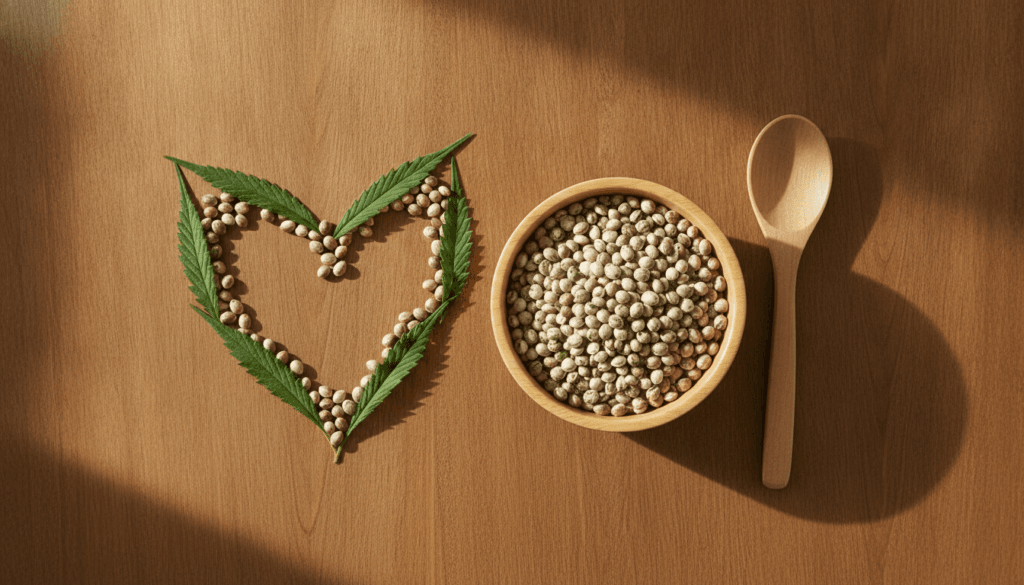
Hemp seeds and hemp seed oil are regularly described as heart-healthy foods, and unlike many wellness claims, this one has a genuine nutritional science basis. The cardiovascular interest in hemp comes primarily from its fatty acid profile, its arginine content, and its GLA content, each of which maps onto known cardiovascular risk factors through reasonably well-characterised mechanisms.
The Omega-3 to Omega-6 Ratio Connection
The most significant cardiovascular nutrition finding of recent decades is the relationship between dietary fatty acid balance and inflammatory risk. The modern Western diet consumes Omega-6 fatty acids at a ratio of roughly 15:1 to 20:1 relative to Omega-3s, while the ratio associated with reduced cardiovascular inflammatory risk is closer to 2:1 to 4:1. Hemp seed oil naturally sits at approximately 3:1, one of the most balanced ratios among common food oils. The primary Omega-3 in hemp seed oil is ALA (alpha-linolenic acid). ALA is the plant-based Omega-3 that converts in the body to EPA and DHA, the forms of Omega-3 most directly associated with cardiovascular protection in research. However, this conversion is inefficient in most people, typically estimated at less than 10%, which is part of why hemp seed oil’s cardiovascular case is supporting rather than equivalent to fish oil’s more direct EPA and DHA delivery. The regular dietary inclusion of ALA-rich foods like hemp seed oil is nevertheless associated in population studies with reduced cardiovascular risk markers, likely reflecting both the partial EPA/DHA conversion and the overall improvement in the dietary Omega ratio.
Arginine and Blood Pressure
Hemp seeds are a rich source of arginine, an amino acid that is a precursor to nitric oxide (NO) in the body. Nitric oxide is a signalling molecule that causes blood vessel walls to relax (vasodilation), which reduces vascular resistance and lowers blood pressure. Research on dietary arginine and cardiovascular outcomes supports a relationship between higher arginine intake and improved endothelial function (the health of blood vessel inner linings), which is considered an early indicator of cardiovascular risk. The arginine in hemp seeds contributes to this pathway. Hemp seeds contain approximately 2.5 grams of arginine per 30-gram serving, making them one of the more arginine-dense plant foods available.
GLA and Cardiovascular Markers
Hemp seed oil contains Gamma-Linolenic Acid (GLA) at approximately 2 to 4% of its total fatty acids. GLA is an Omega-6 fatty acid that converts in the body to prostaglandin E1 (PGE1), which has vasodilatory and anti-inflammatory effects. Research on GLA supplementation has found associations with reduced blood pressure and improved blood lipid markers in some studies. GLA is found in only a few food sources, with hemp seed oil, evening primrose oil, and borage oil being the primary ones, which gives hemp seed oil a relatively unique cardiovascular fatty acid profile compared to more commonly consumed food oils.
What Specific Research Shows
A review published in the journal Nutrition and Metabolism found that hemp seed oil reduced cardiovascular disease risk markers through its fatty acid profile in experimental models. Animal studies have found hemp seed oil consumption associated with reduced atherosclerotic plaque formation and lower blood pressure. Research on hemp seed consumption in humans has found associations with improved blood lipid profiles including reduced LDL cholesterol and improved total to HDL cholesterol ratios. The clinical evidence in humans is less developed than in animal models, following the general pattern across hemp nutritional research where mechanistic plausibility is well-established but large-scale randomised clinical trials specific to hemp seed products and cardiovascular outcomes are limited.
Practical Cardiovascular Dietary Use
Incorporating hemp seeds and hemp seed oil as part of a broader heart-healthy diet is well-supported by their nutritional profile. Two to three tablespoons of hemp seeds daily provides approximately 7 to 10 grams of protein, 10 to 14 grams of healthy fats (including the balanced Omega-3/6 ratio and GLA), and meaningful arginine content. Using hemp seed oil as a finishing oil on salads, grains, and vegetables rather than a cooking oil (due to its low smoke point) is the most effective way to preserve its fatty acid integrity. Hemp seed oil should not be used as a primary cardiovascular intervention or as a substitute for medical management of cardiovascular conditions, but it is a nutritionally well-justified component of a plant-forward, Omega-3 supportive eating approach.
Frequently Asked Questions
Is hemp seed oil good for the heart?
Hemp seed oil has a fatty acid profile that aligns well with dietary patterns associated with lower cardiovascular risk. Its approximately 3:1 Omega-6 to Omega-3 ratio is significantly better than most common food oils for cardiovascular fatty acid balance. Its GLA content has vasodilatory and anti-inflammatory properties. And hemp seeds’ arginine content supports nitric oxide production and endothelial function. The clinical evidence in human trials is still developing, but the nutritional mechanisms are well-characterised and plausible.
Does hemp lower blood pressure?
Hemp seed oil and hemp seeds contain arginine and GLA, both of which have mechanistic links to blood pressure reduction through vasodilation pathways. Animal research supports blood pressure reduction from hemp seed oil consumption. Human clinical trials specifically examining hemp and blood pressure are limited, so this cannot be described as an established clinical effect in humans with the same certainty as, say, established blood pressure medications. As a dietary component supporting vascular health alongside other lifestyle measures, hemp seeds and oil are appropriate and well-supported additions.
How does hemp seed oil compare to fish oil for heart health?
Fish oil provides EPA and DHA directly, the most potent anti-inflammatory and cardiovascular-protective forms of Omega-3, without requiring conversion from ALA. Hemp seed oil provides ALA, which converts to EPA and DHA at low efficiency (under 10% in most people), plus unique GLA content that fish oil lacks. For direct cardiovascular EPA and DHA delivery, fish oil is more efficient. Hemp seed oil offers a plant-based, sustainable alternative with its own complementary properties (GLA, arginine). For people following plant-based diets who cannot use fish oil, hemp seed oil is the most nutritionally comprehensive plant-based Omega fatty acid option available among common food oils.
Can CBD also help with heart health?
CBD has been studied in relation to cardiovascular function, with preclinical research suggesting it may reduce resting heart rate, lower blood pressure in stress conditions, and have cardioprotective properties through anti-inflammatory and antioxidant mechanisms. Human evidence is more limited than for hemp seed oil’s nutritional cardiovascular mechanisms. A small study found a single dose of CBD reduced resting blood pressure and the blood pressure response to stress in healthy volunteers, which is suggestive but not conclusive evidence for cardiovascular benefit in clinical populations.
Are hemp seeds safe for people on blood thinners?
Hemp seeds’ Omega-3 content at high intake levels may have mild anticoagulant properties through fatty acid effects on platelet aggregation. For most people, the amount of hemp seeds consumed in a typical daily serving (2 to 3 tablespoons) is unlikely to meaningfully affect anticoagulation. However, if you take prescription blood thinners like warfarin, discuss any significant dietary change, including regular hemp seed consumption, with your doctor, as fatty acid intake can affect how these medications work and appropriate dosing may need adjustment.
How do I add hemp seeds to my diet for cardiovascular benefit?
The most practical approach is adding 2 to 3 tablespoons of hemp hearts (shelled hemp seeds) to existing meals rather than creating separate hemp-focused preparations. Add them to morning oatmeal or yogurt for a protein and Omega fat boost. Blend into smoothies where they add nutrition without significantly changing flavour. Sprinkle over salads as a replacement for croutons. Use hemp seed oil as a cold dressing base for salads and grain bowls. These approaches integrate naturally into existing eating patterns and make consistent daily use easier than trying to consume hemp as a dedicated supplement.