Last updated: 29 August 2026. Informational only, not medical advice.
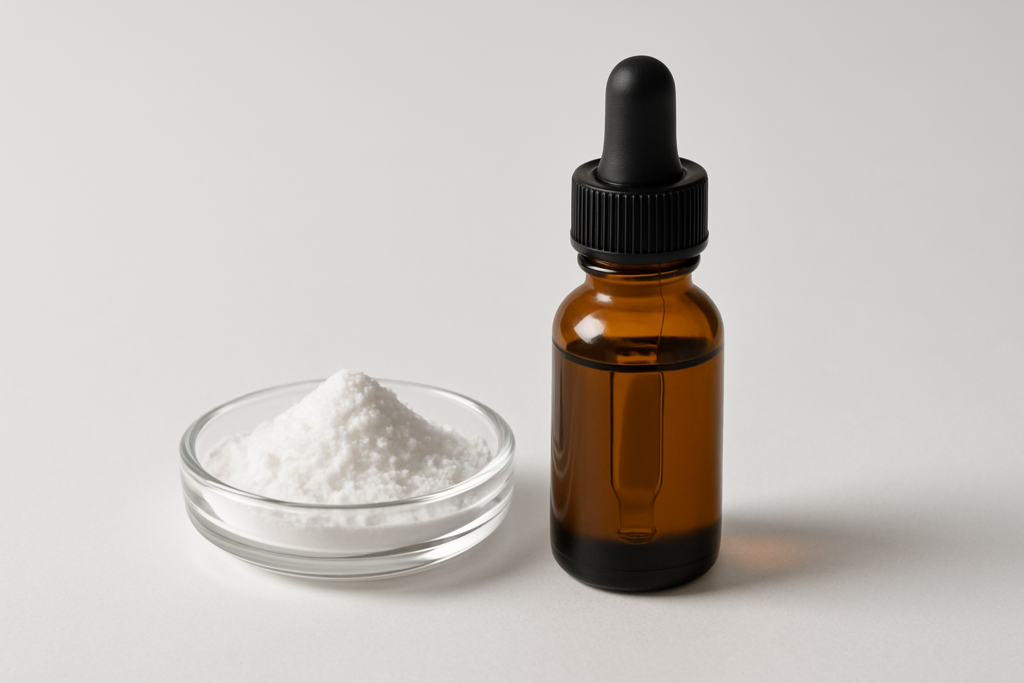
Full-spectrum CBD generally has a stronger case for pain than isolate, because it retains other cannabinoids and terpenes that may work together, an idea known as the entourage effect. The evidence for entourage effects is real in preclinical research but thinner in controlled human pain trials than marketing implies. Isolate remains the better choice for anyone who must avoid THC entirely, such as for drug testing reasons.
Isolate vs full-spectrum at a glance
| CBD Isolate | Full-Spectrum | |
|---|---|---|
| Contents | Pure CBD, 99%+, nothing else | CBD plus other cannabinoids, terpenes, trace THC (under 0.3%) |
| THC content | None | Trace amounts, legally under 0.3% |
| Entourage effect | Not applicable | Theoretically present, human evidence limited |
| Drug test risk | Minimal to none | Small but real risk with heavy, regular use |
| Taste | Flavorless | Earthy, distinctly hemp-like |
| Cost per mg | Generally lower | Generally higher |
| Best for | THC-sensitive situations, precise dosing | Broader symptom relief, chronic pain |
What the entourage effect actually claims
The entourage effect is the idea that cannabinoids and terpenes work better together than any single compound in isolation. It’s a legitimate area of pharmacological research, and there’s reasonable preclinical (lab and animal) evidence supporting synergistic effects between compounds like CBD, CBG, and various terpenes. What’s thinner is direct, controlled human trial evidence isolating this effect specifically for pain outcomes. Much of what’s cited as entourage effect support in marketing is preclinical or anecdotal rather than clinical.
This doesn’t mean the concept is false, it means “full-spectrum works better for pain” is a reasonable hypothesis with partial support, not a settled fact.
What the evidence actually supports
Full-spectrum
Some pain-focused studies and a substantial amount of user-reported data favor full-spectrum products, possibly due to entourage effects, possibly due to trace THC’s own analgesic properties, which are better documented than CBD’s alone. Separating which compound is doing the work is difficult in real-world use.
Isolate
Isolate has the advantage of precise, known dosing, since there’s only one active compound to account for. Research directly on CBD isolate for pain shows more modest effects compared to full-spectrum products in available comparisons, though rigorous head-to-head human trials remain limited.
Which fits which situation
| Situation | Better starting point |
|---|---|
| Subject to regular drug testing | Isolate |
| Chronic pain, want broadest potential relief | Full-spectrum |
| THC-sensitive or anxious about any psychoactivity | Isolate |
| Want to isolate exactly what’s working | Isolate, then experiment upward |
| Pain with an anxiety or sleep component | Full-spectrum |
| Budget-conscious, long-term daily use | Isolate, generally cheaper per mg |
Broad-spectrum as a middle ground
Broad-spectrum products retain other cannabinoids and terpenes but have THC removed or reduced to non-detectable levels. This is a reasonable compromise for anyone wanting potential entourage benefits without any THC exposure, though removal processes vary in how completely they eliminate THC, so “THC-free” claims deserve lab verification if drug testing is a concern.
The drug test question
Full-spectrum products contain legal trace THC (under 0.3%). For occasional use, this is very unlikely to trigger a positive drug test. For heavy, daily use over extended periods, trace THC can accumulate enough to occasionally trigger a positive result. Anyone subject to regular testing should choose isolate or verified THC-free broad-spectrum, and should not assume “legal THC level” means “undetectable.”
Who should be cautious
- Anyone drug tested for employment or sport. Choose isolate or lab-verified THC-free broad-spectrum.
- THC-sensitive individuals. Even trace amounts can cause anxiety or unwanted effects in a small subset of sensitive users.
- On multiple medications. Full-spectrum’s additional compounds mean a broader, less predictable interaction profile than isolate.
- New to CBD entirely. Starting with isolate can help establish a baseline before adding complexity.
Frequently asked questions
Is full-spectrum CBD better for pain than isolate?
It has a reasonable evidence and user-report edge for pain specifically, though controlled human comparison trials are still limited.
Will full-spectrum CBD get me high?
No. Legal full-spectrum products contain under 0.3% THC, far below intoxicating levels for virtually all users.
Can full-spectrum CBD cause a failed drug test?
It’s possible with heavy, regular, long-term use, though uncommon with occasional use. Choose isolate if this is a concern.
Is isolate weaker than full-spectrum?
Not weaker in terms of CBD content, but it lacks the additional compounds some evidence suggests contribute to broader effects.
What is broad-spectrum, exactly?
Full-spectrum with THC removed or reduced to non-detectable levels, while other cannabinoids and terpenes remain.
Which should a beginner start with?
Either is reasonable. Isolate simplifies figuring out your baseline response; full-spectrum offers broader potential effect from the start.