Last updated: 8 September 2026. Informational only, not medical advice.
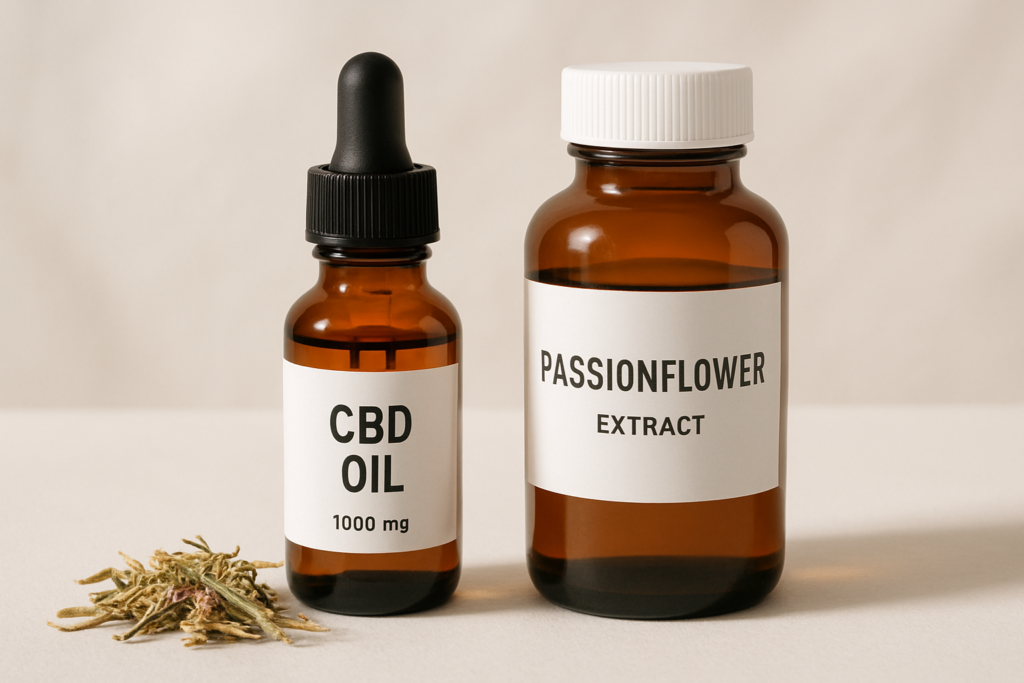
CBD and passionflower are both traditional calming botanicals, and they’re commonly combined rather than compared as alternatives. Passionflower has reasonable evidence for reducing anxiety, with some studies showing effects comparable to certain anti-anxiety medications in short-term use, and its GABA-related mechanism differs from CBD’s endocannabinoid pathway, making them a plausible complementary pairing.
CBD vs passionflower at a glance
| Passionflower | CBD | |
|---|---|---|
| Mechanism | Increases GABA activity in the brain | Endocannabinoid modulation |
| Best for | Situational anxiety, pre-procedure anxiety | General and social anxiety, broader use cases |
| Onset | 30 to 60 minutes | 30 to 90 minutes orally |
| Evidence context | Several small trials, including pre-surgical anxiety | Larger, more varied trial base |
| Sedation | Mild to moderate | Mild to moderate, dose-dependent |
What the evidence actually supports
Passionflower
Notably, some of passionflower’s better trials are in pre-surgical anxiety settings, where it’s shown effects comparable to standard anti-anxiety premedication in short-term, single-dose use. This is a fairly specific and well-controlled context, so it doesn’t necessarily generalize to long-term daily use for chronic anxiety, where evidence is thinner.
CBD
Broader trial base across situational, social, and generalized anxiety contexts, with both single-dose and longer-term use studied to varying degrees.
Which fits which situation
| Situation | Better starting point |
|---|---|
| Short-term situational anxiety (before an event) | Either; passionflower has specific supportive evidence here |
| Ongoing, daily anxiety management | CBD, broader long-term evidence base |
| Want a milder option to start with | Passionflower, often described as gentler |
| Sleep disrupted by anxious thoughts | Either, or combined |
Can you combine them?
Yes, this is a common combination in calming supplement blends, and no dangerous interaction between CBD and passionflower is established. Since both may contribute to mild sedation, evening use of the combination is more practical than daytime use for most people.
Who should be cautious
- Before surgery. Passionflower’s sedative properties mean it’s often recommended to stop before procedures, discuss timing with your surgical team.
- On other sedating medications. Combined drowsiness with sleep aids, benzodiazepines, or alcohol needs medical input.
- Pregnant or breastfeeding. Neither is well-established as safe in pregnancy.
- Operating machinery or driving. Assess your personal response before these activities, particularly when combining both.
Frequently asked questions
Is passionflower or CBD better for anxiety?
Passionflower has specific, well-controlled evidence for short-term situational anxiety, including pre-surgical contexts. CBD has a broader evidence base across more anxiety types and longer-term use.
Can I take CBD and passionflower together?
Yes, no dangerous interaction is established, and this is a common combination in calming supplement products.
Is passionflower sedating?
Mildly to moderately, similar in general character to CBD’s own mild sedative potential at higher doses.
Should I stop passionflower before surgery?
Many surgical teams recommend this due to its sedative properties interacting with anesthesia; follow your surgical team’s specific guidance.
How long does passionflower take to work?
Typically 30 to 60 minutes for acute situational use; evidence for sustained daily use is less established than for single-dose situational contexts.