Last updated: 11 September 2026. Informational only, not medical advice.
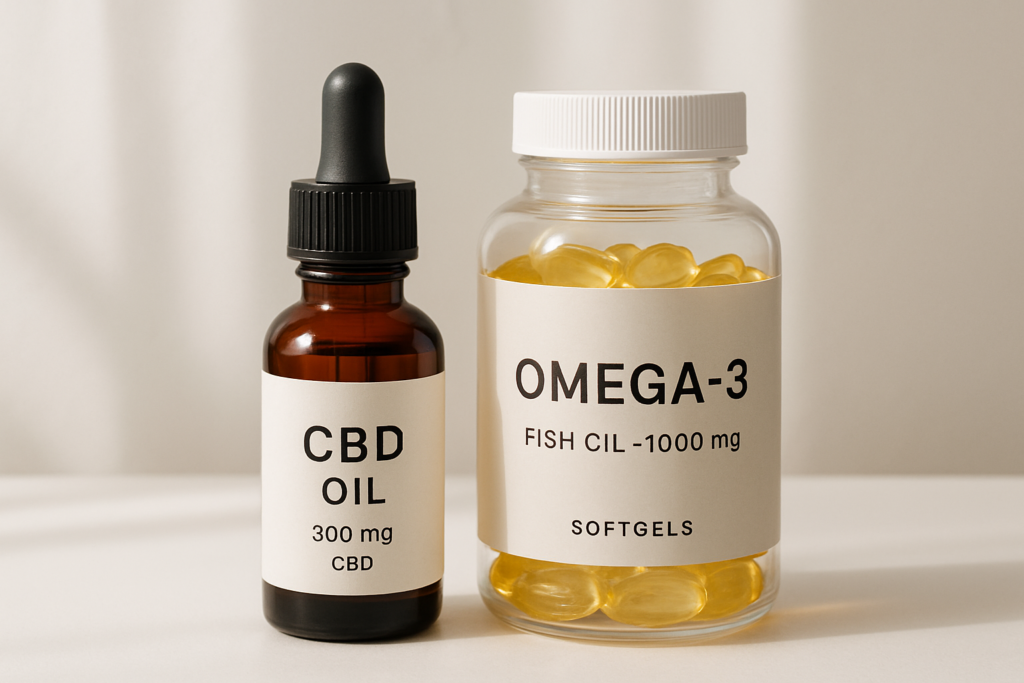
CBD and omega-3 fatty acids (fish oil) don’t share a documented dangerous interaction, and there’s a plausible reason to take them together: fat improves CBD absorption, and omega-3 supplements are typically taken with fat-containing capsules. The main practical consideration is a mild, additive effect on blood clotting, both have some blood-thinning association, relevant mainly for anyone already on anticoagulant medication.
CBD and omega-3 at a glance
| Omega-3 (fish oil) | CBD | |
|---|---|---|
| What it is | Essential fatty acids, EPA and DHA | A non-intoxicating cannabis compound |
| Best for | Cardiovascular support, general inflammation, brain health | Anxiety, sleep-adjacent effects, pain |
| Blood-thinning association | Mild, well documented at higher doses | Possible, less well quantified |
| Absorption synergy | Fat-based capsule may improve CBD absorption if taken together | Absorption improved by dietary fat generally |
Why taking them together might actually help absorption
CBD is fat-soluble, and its absorption improves meaningfully when taken with fat-containing food. Omega-3 supplements are, by nature, a fat-based capsule, so taking CBD alongside your omega-3 dose is a reasonably practical way to improve CBD absorption without needing a separate fatty meal specifically for that purpose.
The blood-thinning consideration
Both omega-3 fatty acids and CBD have some association with mild blood-thinning effects, omega-3’s is better established and dose-dependent, becoming more relevant at higher supplemental doses (above roughly 3 grams daily). CBD’s blood-thinning association is less well quantified in human studies but is a reasonable theoretical consideration given its broader interaction profile.
For most healthy people at typical supplemental doses of both, this combined effect is unlikely to be clinically significant. It becomes more relevant for anyone already on blood thinners or with a bleeding disorder.
Practical guidance
- Taking CBD with your omega-3 capsule is a reasonable, practical way to combine a fat source with CBD for better absorption
- If on blood thinners (warfarin, aspirin, clopidogrel), mention both your CBD and omega-3 use to your doctor, the combined mild blood-thinning association is worth being aware of
- High-dose omega-3 (above 3g daily) combined with CBD warrants more attention to bleeding-risk factors than typical supplemental doses of either
- Watch for unusual bruising or prolonged bleeding from minor cuts if combining both at higher doses
Who should be more cautious
- On blood thinners. Combined mild blood-thinning effects from CBD and omega-3 add another factor to monitor.
- Scheduled for surgery. Both are sometimes recommended to pause before procedures; ask your surgical team about timing for each.
- Bleeding disorders. Discuss any new supplement combination with your doctor.
- High-dose omega-3 users. The blood-thinning association becomes more relevant at doses above 3 grams daily.
Frequently asked questions
Can I take CBD and fish oil together?
Yes, no dangerous interaction is established, and the fat content of omega-3 capsules may actually help CBD absorption.
Does this combination increase bleeding risk?
Both have mild, independent associations with blood thinning. For most healthy people at typical doses, this isn’t clinically significant, but it’s relevant for anyone on blood thinners or with a bleeding disorder.
Should I take them at the same time?
This is a practical, reasonable approach, since omega-3’s fat content may improve CBD absorption when taken together.
Is high-dose fish oil different from a typical dose for this interaction?
Yes, omega-3’s blood-thinning association is more relevant at higher doses (above roughly 3 grams daily) than at typical supplemental amounts.
Should I stop either before surgery?
Many surgical teams recommend pausing both fish oil and CBD before procedures; follow your surgical team’s specific guidance and timing.