Last updated: 26 August 2026. Informational only, not medical advice.
CBD and caffeine can be taken together and no dangerous interaction is established. Caffeine is a stimulant, CBD is not a sedative at low doses, and many people use the pair to blunt caffeine jitters without losing alertness. The two real considerations are that CBD may slow caffeine metabolism through liver enzymes, and that both affect sleep if taken late.
What each one does
| Caffeine | CBD | |
|---|---|---|
| Effect | Stimulant, increases alertness | Non-intoxicating, often described as calming |
| Mechanism | Blocks adenosine receptors | Endocannabinoid modulation, 5-HT1A signalling |
| Onset | 15 to 45 minutes | 30 to 90 minutes orally, faster sublingually |
| Half-life | Roughly 5 hours, highly variable | Roughly 18 to 32 hours for oral CBD |
| Liver pathway | Mainly CYP1A2 | Mainly CYP3A4, with wider enzyme activity |
| Common downside | Jitters, raised heart rate, disturbed sleep | Dry mouth, drowsiness at higher doses |
Why people combine them
The appeal is straightforward. Caffeine delivers alertness with an edge of physical agitation for many people, particularly at higher intakes. CBD is used to take the edge off without cancelling the alertness, since it does not act as a direct sedative at typical doses. Whether it reliably does this is not settled by trial evidence, and a good deal of the enthusiasm is anecdotal, but the logic of the pairing is not unreasonable.
The interaction worth knowing
CBD influences several liver enzymes, and there is a plausible mechanism for it slowing the clearance of caffeine. In practice this would mean a given cup of coffee lasting longer and feeling stronger than usual. Anyone sensitive to caffeine should assume the combination hits slightly harder than caffeine alone and adjust down rather than up on the first attempt.
This matters more than it sounds for sleep. Caffeine’s half-life is around five hours in a typical adult, longer in slow metabolisers. Extending it further pushes an afternoon coffee closer to bedtime than the clock suggests.
Practical guidance
- Do not start both on the same day, establish your normal caffeine response first
- Start at the low end of your usual CBD dose when combining, not the high end
- Keep caffeine before mid-afternoon, and earlier if you are a slow metaboliser
- Space them 30 to 60 minutes apart if you want to feel which is doing what
- If you feel more wired rather than less, cut the caffeine, not the CBD
- Track for a week before deciding, single-day impressions are unreliable
Who should be cautious
- Heart rhythm conditions. Caffeine already warrants care, and adding a variable is not the moment to experiment without medical advice.
- Anxiety disorders. Caffeine can worsen anxiety, and the assumption that CBD will offset that is not something to rely on.
- Anyone on prescription medication. CBD’s enzyme interactions extend well beyond caffeine, so check the medication picture first.
- Pregnancy. Both carry separate cautions.
- Existing sleep problems. Adding a longer-lasting stimulant effect to poor sleep is the wrong direction.
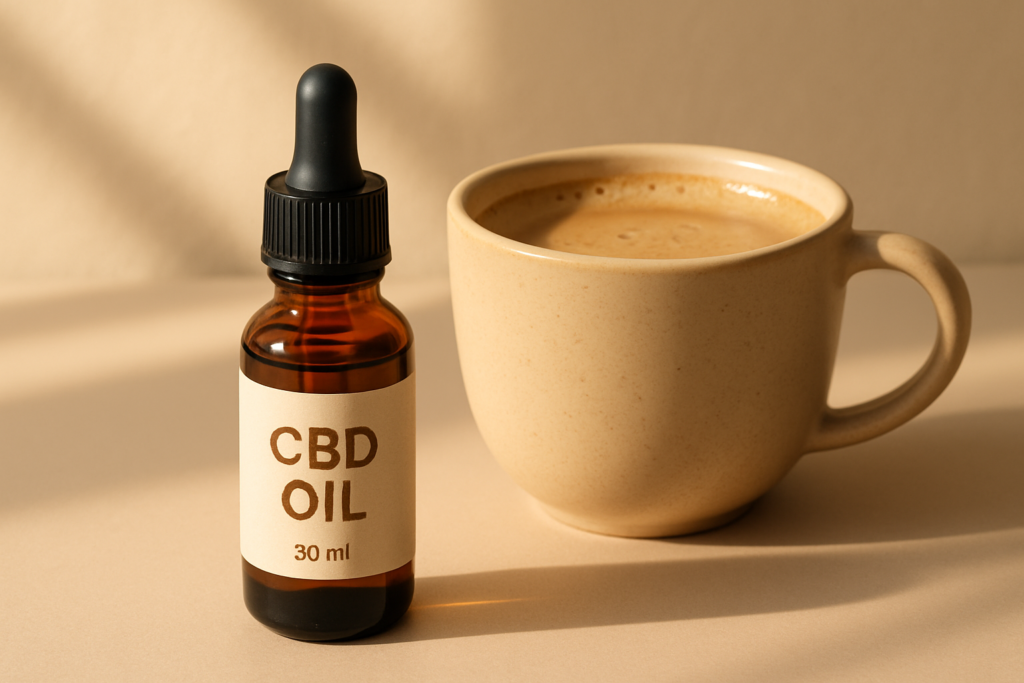
What about CBD coffee?
Pre-infused CBD coffees and energy drinks are widely sold. Two caveats. First, doses are frequently low, often 5 to 15mg, which may be below the level at which anyone notices anything. Second, heat and brewing conditions raise real questions about how much active CBD survives to the cup. Dosing separately, with the coffee and a measured CBD product side by side, gives you a known quantity. The bundled product mostly sells convenience.
Frequently asked questions
Is it safe to take CBD with coffee?
No dangerous interaction is established, and many people do it daily. The sensible precaution is to start with less of both than usual.
Will CBD cancel out caffeine?
No. CBD does not block caffeine’s stimulant action. At most it may soften the jittery physical edge, and that effect is individual rather than guaranteed.
Does CBD make caffeine last longer?
Possibly. CBD’s effect on liver enzymes provides a plausible mechanism for slower caffeine clearance, so treat an afternoon coffee as later than it is.
How much CBD should I take with coffee?
Stay at the low end of your normal range, commonly 10 to 25mg, and only increase after a week of stable response.
Is CBD coffee worth buying?
For convenience, possibly. For a reliable dose, separate products are the better choice, since infused drinks are often low-dose and the stability of CBD through brewing is uncertain.
Can the combination help me focus?
The alertness comes from caffeine. Any focus benefit attributed to CBD is more plausibly the absence of jitteriness than a direct cognitive effect, and the evidence for that is thin.