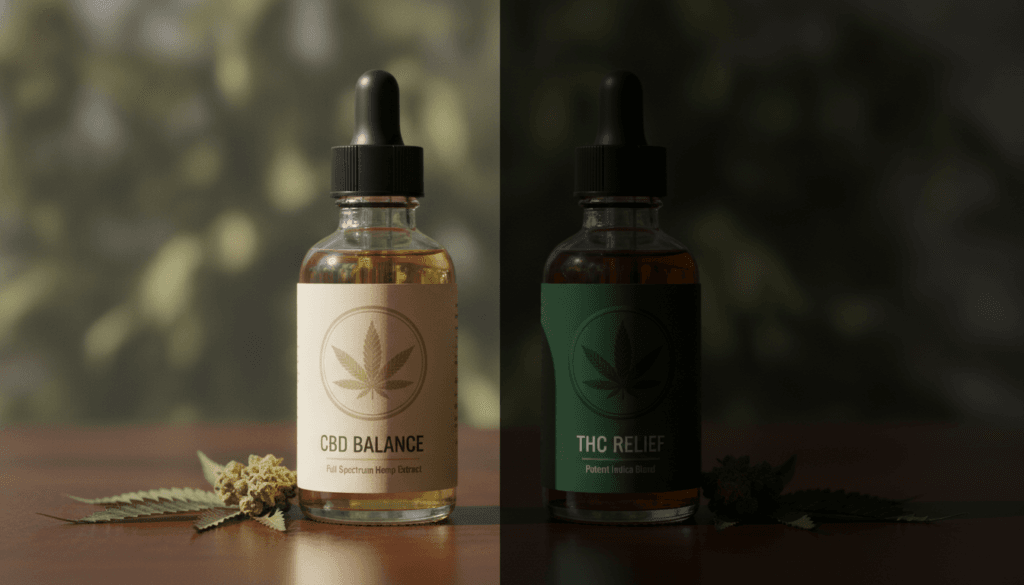
CBD and THC are the two most well-known cannabinoids, both extracted from the same plant species, Cannabis sativa. Beyond that shared origin, they diverge significantly. Understanding the differences is essential whether you are buying a wellness product, exploring options for a specific condition, or simply trying to make sense of cannabis-related labelling.
The Fundamental Difference: Psychoactivity
THC (tetrahydrocannabinol) is psychoactive. It binds directly to CB1 receptors in the brain and central nervous system, producing the intoxicating effect commonly described as a high, including euphoria, altered time perception, and changes in sensory experience. CBD (cannabidiol) is non-psychoactive. It does not produce intoxication, does not impair coordination, and does not bind to CB1 receptors in the same direct way. This single difference is the reason the two compounds occupy completely different legal, regulatory, and practical categories despite coming from the same plant.
Side-by-Side Comparison
| Factor | CBD | THC |
|---|---|---|
| Psychoactive | No | Yes |
| Primary receptor interaction | Indirect (5-HT1A, modulates CB1) | Direct CB1 agonist |
| Legal status (US federal) | Legal if hemp-derived, under 0.3% THC | Schedule I, but legal in 24+ states for adult use |
| Drug test risk | Low (isolate/broad spectrum), moderate (full spectrum) | High, detectable for days to weeks |
| FDA-approved medication | Epidiolex (epilepsy) | Dronabinol, Sativex (combination) |
| Common uses | Anxiety, sleep, inflammation, epilepsy | Pain, nausea, appetite, recreational use |
| Typical onset (sublingual) | 15-45 minutes | 15-45 minutes |
| Age restrictions | Generally none (varies by country) | 18+ or 21+ where legal |
How They Work Together: The Entourage Effect
CBD and THC are not always used separately. Research into what is called the entourage effect suggests that cannabinoids, terpenes, and other plant compounds may produce different and sometimes enhanced effects when consumed together compared to any single compound in isolation. One well-documented interaction is that CBD appears to moderate some of THC’s less comfortable effects, including anxiety and rapid heart rate, when the two are consumed together. This is part of the rationale behind full spectrum CBD products, which retain trace THC alongside CBD and other cannabinoids, and behind medications like Sativex, which combines THC and CBD in a roughly 1:1 ratio for multiple sclerosis spasticity.
Effects: What Each One Actually Feels Like
THC effects are dose-dependent and include euphoria or relaxation, altered sensory perception, increased appetite, and at higher doses or in sensitive individuals, anxiety, paranoia, or confusion. These effects are temporary but can be uncomfortable, particularly for inexperienced users or with edibles where onset is delayed and overconsumption is common. CBD effects are generally described as subtle. Users commonly report a sense of calm, reduced muscle tension, and improved sleep onset, without any change in alertness, coordination, or perception. CBD does not produce a noticeable acute effect the way THC does; its benefits, where they occur, tend to build gradually with consistent use.
Legal Status Around the World
In the United States, CBD derived from hemp with less than 0.3% THC is federally legal under the 2018 Farm Bill, though enforcement and state-level rules vary. THC remains a Schedule I controlled substance federally, but 24 states plus Washington DC have legalised recreational adult use and 38 states allow medical use. In the United Kingdom, CBD products are legal if THC content is below 0.2% and the product is registered as a novel food with the FSA. THC remains a Class B controlled substance, with medical cannabis available by prescription since 2018. In the European Union, CBD regulations vary by country but generally follow a similar THC threshold approach. Germany has moved furthest on THC, allowing personal possession and cannabis clubs under the 2024 CanG law. In Australia, CBD is available over the counter in low doses in some states following a 2021 rescheduling, while THC remains available only via medical prescription.
Drug Testing: A Critical Practical Difference
Standard workplace drug tests screen for THC metabolites (specifically THC-COOH), not CBD. CBD isolate and broad spectrum products, which contain no or negligible THC, are very unlikely to trigger a positive test. Full spectrum CBD products contain up to 0.3% THC, and with frequent, heavy use this can accumulate in the body to detectable levels. If a drug test is a concern, broad spectrum or isolate CBD products with a verified COA showing no detectable THC are the safer choice.
Frequently Asked Questions
Can CBD get you high like THC?
No. CBD does not produce the psychoactive effects associated with THC. It does not bind to CB1 receptors in the brain in the same direct way THC does, and it does not cause euphoria, altered perception, or impairment. This is true even for full spectrum CBD products, which contain only trace THC (up to 0.3%), an amount too low to be intoxicating for most people.
Does CBD cancel out the effects of THC?
CBD does not eliminate THC’s effects entirely, but research suggests it can moderate some of them, particularly anxiety and rapid heart rate, when the two are consumed together. This is sometimes referred to anecdotally as taking the edge off. The interaction is dose-dependent and varies between individuals, and CBD should not be relied upon to manage an uncomfortable THC experience; time and a calm environment remain the most reliable approaches.
Which is better for pain, CBD or THC?
Both have research supporting potential pain-related benefits but through different mechanisms. THC interacts directly with pain-signalling pathways via CB1 receptors and has more established evidence for certain pain types, including in approved medications like Sativex. CBD’s anti-inflammatory properties may provide complementary support, particularly for inflammatory pain. Many people use combination products precisely because the two may address different aspects of pain. Neither is a substitute for medical evaluation of chronic pain conditions.
Is it legal to travel with CBD products?
This depends entirely on the destination country and the THC content of the product. CBD products that are legal in your home country may be illegal or restricted elsewhere, particularly if they contain any detectable THC. Some countries treat any cannabis-derived product, including CBD, as a controlled substance regardless of THC content. Always research the specific laws of your destination before travelling with any CBD or THC product, and never assume legality transfers across borders.
Can I take CBD and THC together safely?
For most healthy adults, combining CBD and THC (as occurs naturally in full spectrum products) is considered safe and is the basis of several approved medications. However, the combination still produces the psychoactive effects of THC, simply potentially moderated by the CBD. Anyone new to cannabis products, or anyone in a situation requiring full cognitive function (driving, work), should be cautious with any THC-containing product regardless of CBD content.