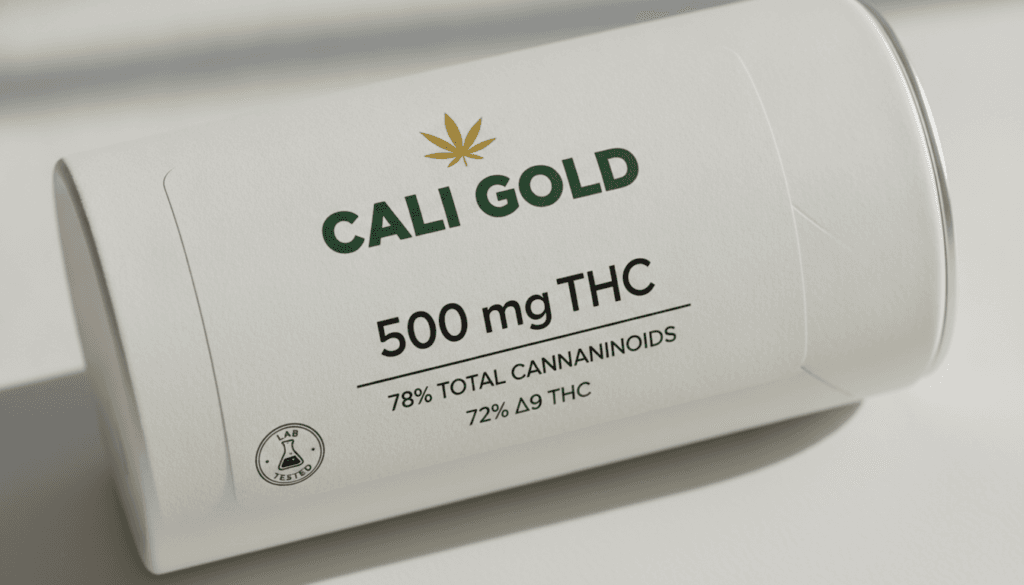
THC product labels pack a surprising amount of information into a small space, and misreading them is one of the most common ways people end up consuming far more THC than they intended, particularly with edibles where the consequences of a miscalculation are most pronounced given the delayed onset discussed in our edibles piece.
Percentage vs Milligrams: Two Different Things
This is the single most important distinction to understand, because these two measurements answer different questions and apply to different product types. THC percentage (often written as a % symbol, such as 22% THC) tells you the concentration of THC within the product itself, by weight. This is the standard way flower, concentrates like live resin and distillate, and pre-rolls are labelled. Milligrams (mg) tell you the absolute amount of THC in a specific unit, such as per gummy, per beverage serving, or per the entire product. This is the standard way edibles, beverages, and often vape cartridges are labelled. These two measurements are not directly interchangeable without doing a calculation, and a product labelled only with a percentage (like flower) requires you to think about how much of that product you’re actually consuming to estimate your THC intake, whereas a product labelled in milligrams (like a gummy) tells you more directly, though as discussed below, even milligram labels have nuances.
Converting Percentage to an Estimated Dose
For flower or concentrates labelled by percentage, a rough way to think about a single dose is: if a product is 20% THC, that means 200 mg of THC per gram of product (since 20% of 1000 mg is 200 mg). If you consumed, for example, a tenth of a gram (0.1g) in a single session, that would be approximately 20 mg of THC content in the material, though how much of that THC actually reaches your bloodstream depends heavily on the consumption method (smoking, vaping, or other) and is not a direct 1:1 absorption. This calculation is most useful for understanding relative potency between products (a 25% product has roughly 25% more THC by weight than a 20% product) rather than as a precise dose calculation, since absorption efficiency varies by method and individual.
Total THC vs Delta-9 THC vs THCA on Labels
This distinction has become particularly important given the regulatory discussion in our piece on the 2026 hemp law change. Some labels distinguish between Delta-9 THC (the THC content in its already-active form) and THCA (the acidic precursor that converts to Delta-9 THC when heated, as discussed in our piece on THC and the brain). A product might show a low Delta-9 THC percentage but a much higher THCA percentage; when that product is smoked or vaped (heated), the THCA converts to Delta-9 THC, meaning the effective THC content when consumed is much higher than the Delta-9 THC number alone suggests. Total THC (sometimes shown as a separate figure, calculated using a standard formula that accounts for this conversion) gives a more accurate picture of the product’s effective potency when heated. Labels that show only Delta-9 THC without addressing THCA can be significantly misleading about a product’s actual potency once consumed, which is part of why the regulatory shift toward total THC measurement, discussed in our hemp law piece, has been so consequential for products that previously relied on a Delta-9-only framing.
Reading Edible Labels: Per Serving vs Per Package
Edible packaging typically shows THC content both per serving (such as per gummy) and for the total package (such as a package of 10 gummies at 5 mg each, totalling 50 mg). The critical reading mistake is consuming based on the total package figure when the serving size is what’s relevant to a single dose. If a package says 50 mg total and contains 10 gummies, a single gummy is 5 mg, not 50 mg, and as discussed in our edibles piece, even 5 mg can produce a meaningful effect for someone new to edibles, particularly once the 11-hydroxy-THC conversion is factored in. Always identify the per-serving amount specifically, and be aware that serving size on cannabis products (a single gummy, for example) may be smaller than what feels like a normal portion (eating multiple gummies because that’s how you’d eat a different type of candy).
Reading Beverage Labels
As discussed in our piece on hemp-derived beverages, THC beverages are typically labelled in milligrams per serving, often in the 2 to 10 mg range, with the serving size usually being the entire can or bottle for single-serving formats. Some larger format beverages may contain multiple servings per container, similar to how a larger bottle of an alcoholic beverage might contain multiple standard drinks; checking whether the labelled mg figure is per container or per serving (if these differ) is relevant for the same reasons discussed for edibles above.
What a Certificate of Analysis Adds Beyond the Label
The product label itself is a summary, but a Certificate of Analysis (COA) from a third-party laboratory provides the underlying test data the label claims are based on. A COA will typically show the full cannabinoid panel (not just THC, but CBD, CBG, CBN, and others present, relevant to the minor cannabinoids discussed in our CBG and CBN piece), the specific testing methodology and date, and for products relevant to the hemp law discussion, the breakdown between Delta-9 THC, THCA, and total THC that may not be fully represented on the front-of-package label. Cross-referencing a product’s label claims against its COA, particularly checking that the batch number on the COA matches the product you have, is the most reliable way to verify that a label’s claims are accurate for your specific product.
Why Two Products with the Same THC% Can Feel Different
If you’ve ever consumed two products with similar THC percentages but had noticeably different experiences, the terpene and minor cannabinoid content discussed in our terpenes piece and live resin versus distillate comparison is often the explanation. THC percentage alone does not capture a product’s full chemical profile, and products with identical THC content but different terpene profiles (a live resin versus a distillate, for example, or two different flower strains) can produce different subjective experiences even at matched THC levels. This is part of why some experienced users pay attention to terpene content and strain information in addition to THC percentage when selecting products.
Frequently Asked Questions
What does total THC mean on a label?
Total THC is a calculated figure that accounts for THCA’s conversion to Delta-9 THC when heated, typically calculated using a formula like Delta-9 THC + (THCA × 0.877), reflecting the molecular weight change during conversion. This figure gives a more accurate picture of a product’s effective potency when smoked or vaped than Delta-9 THC alone, particularly for products like high-THCA hemp flower where the as-grown Delta-9 THC content is low but the THCA content (which converts upon heating) is high.
If a gummy package says 100mg THC, does that mean each gummy has 100mg?
Not necessarily, and this is one of the most important things to check. The 100mg figure likely refers to the total THC content across the entire package, divided among multiple individual gummies (servings). You need to find the per-serving (per gummy) THC content specifically, which would be the total divided by the number of servings in the package. Consuming based on the total package figure as if it applied to a single gummy could result in consuming far more THC than intended.
Why do some hemp flower products have low Delta-9 THC but still get you high?
This is the core of the loophole discussed in our piece on the 2026 hemp law change. These products can have low Delta-9 THC (compliant with the original 0.3% Delta-9-only threshold) while having high THCA content. THCA itself is not psychoactive, but when the flower is smoked or vaped (heated), the THCA converts to Delta-9 THC, producing the same psychoactive effect as a product with naturally high Delta-9 THC content. The label’s Delta-9 THC figure, in this case, does not reflect the product’s effective potency once consumed.
How do I calculate THC dose from a percentage on flower?
A rough calculation: a product’s THC percentage represents milligrams of THC per gram of product, multiplied by 10 (so 20% THC equals 200 mg of THC per gram, or 20 mg per 0.1 gram). This tells you the THC content in the material itself, but does not directly equal the dose that reaches your bloodstream, since absorption efficiency varies significantly by consumption method (smoking versus vaping, for example) and individual factors. This calculation is more useful for comparing relative potency between products than for precise dosing.
What’s the difference between a serving size and a package size on cannabis labels?
Serving size refers to the amount intended as a single dose, such as one gummy, one beverage, or a specified weight of flower. Package size refers to the total product in the container, which may contain multiple servings, such as a package of 10 gummies or a beverage multi-pack. Cannabis product labels are required in most regulated markets to show THC content per serving specifically, but always verify which figure (per serving or per package) any given number refers to, especially when comparing products from different brands that may format their labels differently.
Should I trust the THC percentage on a label without a COA?
A Certificate of Analysis provides verification of the label’s claims through third-party testing, including the testing date and methodology. While many regulated markets require accurate labelling as a matter of law, verifying claims against a COA, particularly checking that the batch number matches your specific product, provides an additional layer of confidence, especially relevant given the cannabinoid mislabelling concerns discussed in our CBD product quality piece, which can apply to THC products as well.