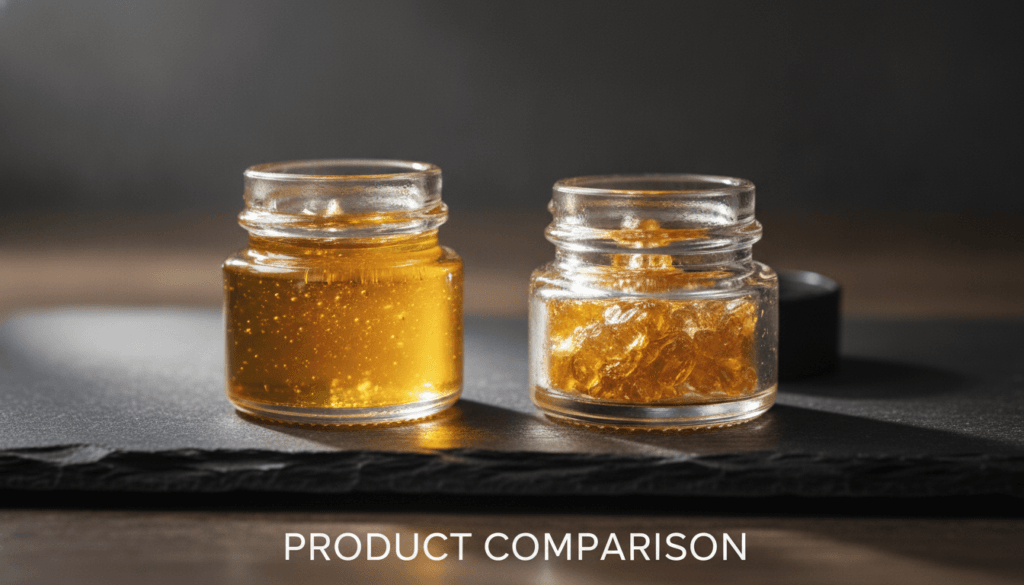
If you have looked at THC concentrates beyond basic vape cartridges, you have likely come across both live resin and distillate, often at noticeably different price points and with very different descriptions. Both are concentrated cannabis extracts, but the production processes and end results could hardly be more different.
The Fundamental Trade-Off: Purity vs Completeness
The simplest way to understand the difference is as a trade-off between two different goals. Distillate is produced to maximise the concentration of a single cannabinoid, typically THC, often reaching 85 to 99% purity, with virtually everything else (terpenes, flavonoids, minor cannabinoids) removed during processing. Live resin is produced to preserve as much of the original plant’s complete chemical profile as possible, typically resulting in lower overall THC concentration (commonly 50 to 80%, though figures vary across sources) but with substantial terpene and minor cannabinoid content intact.
How Distillate Is Made
Distillate production starts with dried and cured cannabis flower or trim, which is first extracted using a solvent (commonly ethanol or hydrocarbon solvents) to produce a crude extract. This crude extract then undergoes distillation, a process that involves heating the extract until specific compounds vaporise at their particular boiling points, then condensing them back into liquid form. This process is highly effective at isolating cannabinoids from the rest of the plant’s compounds, since different compounds have different boiling points, allowing the extractor to separate THC (or another target cannabinoid) from terpenes, waxes, and other plant material with high precision. The result is a clear to amber, viscous oil with very high THC concentration and minimal taste or aroma, since terpenes have largely been removed in the process. During this process, cannabinoids are also decarboxylated, meaning acidic precursor forms (like THCA) are converted to their active forms (like Delta-9 THC) through the heat involved.
How Live Resin Is Made
Live resin production starts differently and fundamentally shapes the end result: fresh cannabis flower is flash-frozen immediately after harvest, rather than being dried and cured first. This is the defining step, intended to preserve the plant’s terpene profile, which would otherwise degrade significantly during drying and curing (since terpenes are volatile and sensitive to heat and time, as discussed in our piece on terpenes). The frozen plant material is then extracted using hydrocarbon solvents (commonly butane or propane) at low temperatures, a slower process than distillate’s high-heat distillation, specifically to avoid degrading the preserved terpenes. The result is a concentrate, often with a sticky, sauce-like consistency ranging from golden to amber in colour, that retains a much fuller spectrum of the plant’s original cannabinoids and terpenes compared to distillate.
Side-by-Side Comparison
| Factor | Live Resin | Distillate |
|---|---|---|
| Starting material | Fresh, flash-frozen flower | Dried and cured flower or trim |
| THC concentration | Typically 20-80% (varies by source) | Typically 85-99% |
| Terpene content | High, preserves plant’s natural profile | Very low to none |
| Flavour and aroma | Strong, strain-specific | Minimal, neutral |
| Entourage effect potential | Higher (full spectrum of compounds) | Lower (largely isolated cannabinoid) |
| Common uses | Dabbing, vaping, topping flower | Vape cartridges, edibles, infused products |
| Typical price point | Higher | Lower to moderate |
Why Live Resin Often “Feels Stronger” Despite Lower THC
A common observation among experienced users is that live resin can feel more potent or produce a more complex experience than its THC percentage alone would suggest, even compared to a distillate with a higher THC number. This connects directly to the entourage effect discussion in our terpenes piece: live resin’s retained terpenes and minor cannabinoids may interact with THC in ways that influence the overall experience, even if the headline THC percentage is lower. Whether this represents a true pharmacological entourage effect or is partly attributable to the sensory experience (flavour and aroma contributing to perceived effect) is part of the broader unresolved entourage effect question, but the practical observation that live resin and distillate can feel different in character, not just intensity, at similar doses is widely reported.
Which Should You Choose?
If flavour, aroma, and a more complex, strain-specific experience are priorities, and you’re comfortable with a higher price point, live resin is generally the preferred choice, particularly for dabbing or vaping where the terpene content directly contributes to the experience. If you want the highest possible THC concentration, a neutral flavour profile, or you’re looking for a concentrate to use in making edibles or infused products where precise, predictable dosing matters more than flavour (since distillate’s near-pure THC content makes dosing calculations more straightforward), distillate is the more practical choice. For vape cartridges specifically, both are used, sometimes even blended together, with some cartridges combining distillate’s high potency with added terpenes (either reclaimed from the live resin process or from other sources) to balance potency, flavour, and cost.
A Related Distinction: Live Rosin
It’s worth being aware of a related but different product: live rosin. Like live resin, live rosin starts from fresh-frozen flower and aims to preserve terpenes, but the extraction method is entirely different. Live resin uses hydrocarbon solvents (butane or propane). Live rosin is solventless, using only water, heat, and pressure (mechanical extraction) to separate cannabinoids and terpenes from the plant material. Both are considered full-spectrum, terpene-rich concentrates with similar THC ranges, but the solventless nature of live rosin is sometimes preferred by users specifically seeking to avoid any solvent-based extraction, even though properly processed solvent-based concentrates are tested to ensure no residual solvents remain.
Frequently Asked Questions
Is live resin stronger than distillate?
In terms of raw THC percentage, generally no; distillate typically has a higher THC concentration (85-99%) compared to live resin (commonly 20-80%, varying by source). However, many users report live resin feeling more potent or producing a more complex effect due to its preserved terpene and minor cannabinoid content, which may interact with THC in ways that influence the overall experience beyond what the THC percentage alone indicates. Strength can mean different things depending on whether you’re referring to raw cannabinoid concentration or subjective effect.
Why is live resin more expensive than distillate?
Live resin production is more labour and resource-intensive: it requires immediate flash-freezing of fresh flower (which must happen quickly after harvest and requires specialised equipment), followed by a slower, lower-temperature extraction process specifically designed to preserve delicate terpenes. Distillate production, while still technically sophisticated, can use dried and cured flower (which is easier to store and process on a flexible timeline) and the distillation process itself, while precise, doesn’t require the same immediate post-harvest handling. These production differences are reflected in the typically higher price of live resin products.
Can distillate be made into something with more flavour?
Yes, this is common practice. Since distillate itself has minimal flavour due to the removal of terpenes during processing, manufacturers often add terpenes back into distillate-based products, either terpenes reclaimed during the distillation process itself, cannabis-derived terpenes from other sources, or terpenes derived from non-cannabis plants (since many terpenes like limonene and pinene occur in other plants too). This allows products to combine distillate’s high, predictable THC concentration with a customised flavour and aroma profile.
What is THC distillate used for besides vape cartridges?
Distillate’s high purity and near-flavourless profile make it popular for edibles and infused products generally, where precise dosing matters and where the cannabis flavour (which would be present with live resin’s retained terpenes) might not be desirable in the final product, such as a gummy or beverage with its own flavour profile. It’s also used in tinctures and capsules for similar reasons: predictable potency without imparting a strong cannabis taste.
Does live resin contain CBD as well as THC?
This depends on the source plant material. Because live resin preserves a fuller spectrum of the plant’s cannabinoids compared to distillate’s isolation process, a live resin made from a cannabis variety that naturally contains both THC and CBD (or other minor cannabinoids like CBG or CBN, discussed in our piece on those compounds) would retain that broader cannabinoid profile, not just THC. The specific cannabinoid profile of any live resin product depends on the genetics of the source plant material used.
Is live rosin better than live resin?
Better depends on what you’re prioritising. Both are full-spectrum, terpene-rich concentrates from fresh-frozen flower with broadly similar THC ranges. The main difference is the extraction method: live rosin is solventless (water, heat, and pressure), while live resin uses hydrocarbon solvents (butane or propane). Some users prefer live rosin specifically to avoid any solvent-based extraction, even though properly tested solvent-based products should have no meaningful residual solvent content. Beyond the extraction method itself, the practical differences in flavour and effect between a well-made live resin and live rosin from similar source material may be less significant than the difference between either of these and distillate.