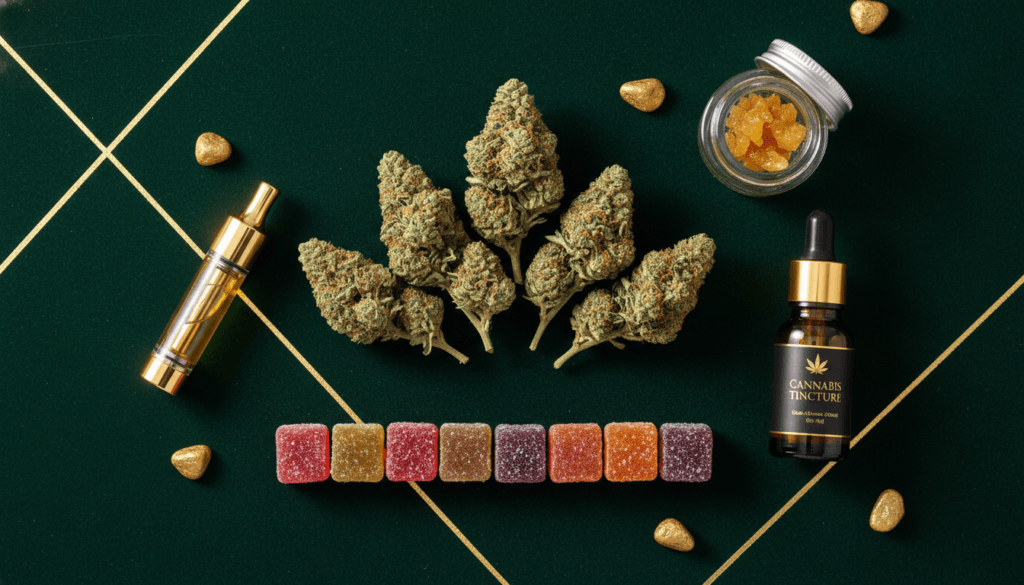
Walk into any legal cannabis dispensary in 2025 and you will find a product range that looks nothing like the cannabis market of even five years ago. Shelves are stacked with gummies, chocolates, beverages, oils, pre-rolls, vape cartridges, capsules, and topicals. Understanding which product type is right for you comes down to three things: how quickly you want effects to kick in, how long you want them to last, and how you prefer to consume.
The Six Key Variables Across Product Types
Before looking at each format individually, these six variables differ meaningfully between product types. Inhaled products (flower, vape) produce onset within 1 to 10 minutes, peak at 20 to 30 minutes, and last 1 to 3 hours with bioavailability of 40 to 56%. Ingested products (edibles, capsules) have onset of 30 minutes to 2 hours, peak 1 to 3 hours after onset, and last 4 to 8 hours with bioavailability of 4 to 20%. Sublingual products sit between the two.
1. Flower (Dried Cannabis)
Cannabis flower remains the most consumed THC product format globally and the largest category by revenue in virtually every legal market. It is consumed by smoking in a rolled joint, pipe, or bong, or by vaporizing in a dry-herb vaporizer. THC is activated by heat and absorbed through the lungs into the bloodstream within minutes.
Flower accounts for approximately 39.6% of all cannabis product sales in the US in 2025. In Canada, dried flower holds 59.7% of total retail sales. In Germany, flower dominates medical cannabis prescriptions at 86% of all products dispensed. THC content in modern strains typically ranges from 15% to 30%.
2. Pre-Rolls
Pre-rolls are factory or hand-rolled cannabis joints sold ready to smoke. They account for approximately 13.2% of US cannabis retail sales in 2025. Infused pre-rolls, which add concentrates or live resin, are one of the fastest-growing sub-formats, pushing THC content well above what flower alone delivers and particularly popular in California and Colorado.
3. Vape Cartridges and Disposable Vape Pens
Vape products contain cannabis oil heated by a battery to produce vapor without combustion. They are portable, discreet, and produce minimal odor. Vapes account for approximately 27% of US cannabis retail sales in 2025, making them the second-largest category. The key formats are 510-thread cartridges (universal battery compatibility), disposable all-in-one pens (no charging or refilling required), and live resin cartridges (made from fresh-frozen plant for fuller terpene profile).
4. Edibles
Edibles are food and beverage products infused with THC extract. They work differently from inhaled products: THC consumed orally is processed by the liver, which converts Delta-9-THC into 11-hydroxy-THC, a more potent, longer-lasting metabolite. This is why edibles are frequently described as a completely different experience.
Edibles account for approximately 14.4% of US cannabis product sales in 2025. The global cannabis edibles market was estimated at $14.8 billion in 2025 and is projected to grow to $60.2 billion by 2035. Gummies dominate the edibles category, followed by chocolates, baked goods, and beverages. The key guidance: start with 2.5 to 5 mg, wait a full two hours before assessing, and do not redose too early.
5. Tinctures and Sublingual Oils
Tinctures are liquid cannabis extracts taken by placing drops under the tongue. Sublingual absorption bypasses the digestive system, producing effects in 15 to 45 minutes with a duration of 2 to 4 hours. This makes tinctures a middle ground between the immediacy of inhalation and the prolonged experience of edibles. They offer highly precise dosing via a marked dropper and are favored by medical patients for consistent, controllable dosing.
6. Concentrates and Extracts
Concentrates are highly potent products made by extracting cannabinoids and removing most plant matter, reaching 60% to 95% THC content. Major formats include wax and budder (60 to 90% THC, opaque waxy texture), shatter (70 to 90%, glass-like, brittle), live resin (65 to 95%, made from fresh-frozen plant preserving full terpene profile), rosin (60 to 80%, solventless extraction via heat and pressure), and RSO or Rick Simpson Oil (40 to 90%, commonly used medically). Concentrates account for approximately 5.1% of US cannabis retail sales and represent a premium high-margin segment.
7. Topicals
Cannabis topicals are creams, balms, lotions, and patches infused with THC or CBD for application to the skin. Standard topicals do not produce psychoactive effects because the cannabinoids do not penetrate the bloodstream. Transdermal patches are the exception: designed for systemic absorption, they can produce psychoactive effects. Topicals account for approximately 4% of US cannabis retail sales and are most popular among women, older adults, and consumers seeking pain and recovery support without intoxication.
8. Capsules and Gel Caps
Cannabis capsules contain measured doses of THC oil in a gelatin or plant-based shell, consumed like any other supplement. The experience is similar to edibles: delayed onset, long duration, consistent effect. They are favored by medical patients, older consumers, and anyone wanting a completely tasteless, odorless, pharmaceutical format with predictable dosing.
Which Format Is Right for You?
For fast relief, choose flower, vape, or sublingual tincture with onset within minutes to 45 minutes. For long-lasting effect, choose edibles or capsules for 4 to 8 hours. For no psychoactive effect, use CBD-dominant topicals. For precise medical dosing, use tinctures or capsules. For discreet consumption, choose vape pens, capsules, or gummies. For the highest potency, concentrates reach 60 to 95% THC. For a social experience, flower and pre-rolls remain the traditional shared format.
Frequently Asked Questions
What is the most popular THC product format in 2025?
Flower remains the most popular THC product by sales volume globally, accounting for approximately 39.6% of US cannabis retail sales and 59.7% of Canadian retail sales. Vapes are the second-largest category at around 27% of US sales, followed by edibles at 14.4%. The gap between flower and other formats is gradually closing as consumer preferences diversify.
How are edibles different from smoking cannabis?
Edibles are processed by the digestive system and liver. The liver converts Delta-9-THC into 11-hydroxy-THC, a more potent metabolite with a stronger body effect and longer duration. Onset is delayed by 30 minutes to 2 hours and the experience can last 4 to 8 hours. Inhaled cannabis delivers THC directly to the lungs and bloodstream, producing effects within minutes that last 1 to 3 hours. The golden rule with edibles is to start with a low dose and wait at least 2 hours before considering more.
Do THC topicals get you high?
Standard THC topicals do not produce psychoactive effects because cannabinoids do not penetrate the skin deeply enough to enter the bloodstream. They interact with receptors in the skin and underlying tissue for localised relief. Transdermal patches are the exception: they are specifically designed to deliver cannabinoids into the bloodstream and can produce systemic, psychoactive effects.
What is the difference between a vape cartridge and a disposable vape?
A vape cartridge is a refillable oil tank that attaches to a separate reusable battery unit. A disposable vape pen combines the battery and oil in a single unit discarded when empty. Disposables are more convenient but generate more waste. Cartridges with reusable batteries offer better cost-per-use and are considered more environmentally responsible.
What are THC concentrates and are they safe?
THC concentrates are highly refined cannabis extracts with THC content ranging from 60% to 95%. They are significantly more potent than flower and should only be used by experienced consumers. Concentrates purchased from licensed dispensaries in regulated markets are tested for purity and contaminants. Novice users should not start with concentrates.
Can I travel with THC products?
In most cases, no. Even in countries where THC is legal for adults, it is typically illegal to cross international borders with THC products. Within the US, transporting cannabis across state lines is illegal under federal law even if both states have legal recreational cannabis. Always check local laws and never attempt to bring cannabis products through airport security or across borders.