Last updated: 26 August 2026.
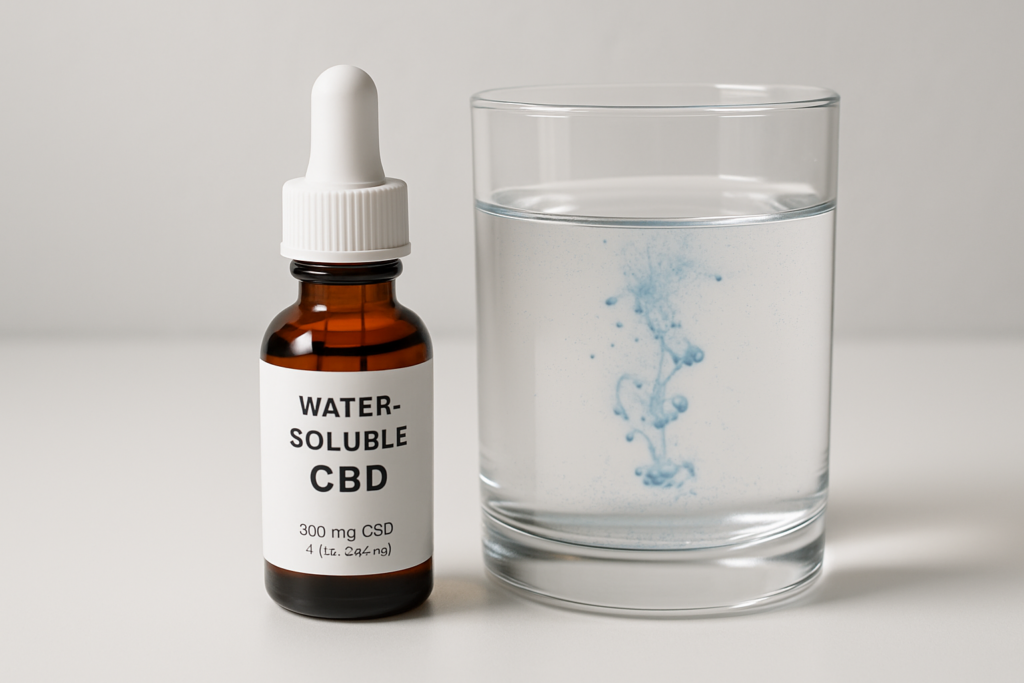
Water-soluble CBD is not actually dissolved in water. It is CBD oil broken into microscopic droplets and stabilised with emulsifiers, a process called nanoemulsion. The smaller droplet size improves absorption compared with plain oil, and onset is usually faster. The size of that advantage is often overstated in marketing, and the trade-offs are rarely mentioned.
The absorption problem it exists to solve
CBD is fat soluble and your digestive tract is a watery environment, so a swallowed oil is poorly absorbed. Much of what you take is also broken down by the liver before it reaches circulation, an effect called first-pass metabolism. The result is that only a fraction of an oral dose becomes available to the body.
Nanoemulsion attacks the first half of that problem. Shrinking oil droplets dramatically increases their surface area, which improves how much crosses the gut wall.
How nanoemulsion works
- CBD oil is combined with emulsifiers such as polysorbates or lecithin
- High-pressure homogenisation or ultrasonic energy shears the oil into droplets typically under 100 nanometres
- The emulsifiers hold the droplets stable so they disperse evenly through water rather than separating
- The result mixes into drinks and is absorbed more readily than an equivalent oil
Droplet size is the whole game. Products described as macroemulsions or simply emulsified sit at a much larger particle size and do not deliver the same benefit.
Water-soluble vs standard CBD oil
| Nanoemulsified, water-soluble | Standard CBD oil | |
|---|---|---|
| Onset | Typically faster, often 15 to 30 minutes | 30 to 90 minutes orally |
| Absorption | Improved, magnitude varies by formulation | Lower, and highly food-dependent |
| Mixes into drinks | Yes, without separating | No, it floats and clings to the glass |
| Added ingredients | Emulsifiers required | Carrier oil only |
| Taste | Usually milder, hemp flavour reduced | Distinctly earthy in full spectrum |
| Shelf stability | Emulsions can destabilise over time | Stable for 12 to 24 months stored properly |
| Cost per mg | Generally higher | Generally the cheapest format |
How much better is it, really?
This is where honesty matters. Nanoemulsion does improve bioavailability, and the mechanism is sound and well understood in pharmaceutics well beyond cannabis. What varies enormously is the formulation. Two products both labelled water-soluble can differ substantially in droplet size, emulsifier system and stability, and there is no standard a buyer can check.
Marketing claims of specific multiples, four times or five times more absorbable, generally trace back to manufacturer testing rather than independent head-to-head trials in humans. Treat the direction as credible and the exact number as unverified.
The trade-offs nobody advertises
- Emulsifiers are an added ingredient. Polysorbate 80 in particular is something some buyers prefer to avoid, and it appears in plenty of these products.
- Emulsions are less stable than oils. Heat and time can cause separation, which reverses the benefit you paid for.
- Faster onset also means shorter duration in many cases, which is a disadvantage if you want all-night coverage.
- Higher cost per milligram, so the improved absorption has to be large enough to justify the premium.
- Sublingual oil already bypasses part of the problem by absorbing through the mouth, narrowing the gap considerably.
Who it actually suits
| Situation | Verdict |
|---|---|
| You want CBD in coffee, water or a smoothie | Water-soluble, it is the only format that works |
| You dislike the taste of hemp oil | Water-soluble, milder flavour |
| You want fast onset for situational use | Water-soluble, or sublingual oil held under the tongue |
| You want long overnight coverage | Standard oil or a capsule |
| You are optimising cost per mg | Standard oil |
| You avoid synthetic emulsifiers | Standard oil |
How to judge a water-soluble product
- Look for a stated particle or droplet size, ideally under 100nm. Vagueness here usually means the number is unflattering.
- Read the emulsifier on the ingredient list and decide if you are comfortable with it.
- Check the batch COA as you would for any product, potency plus contaminant panels.
- Compare cost per milligram against a standard oil from the same brand, then ask whether the premium is worth it for your use case.
- Be sceptical of any absorption multiple quoted without a citation to independent human data.
Frequently asked questions
Is water-soluble CBD really dissolved in water?
No. It is an emulsion of very small oil droplets held in suspension. True dissolution is not what is happening.
Does nanoemulsified CBD work faster?
Usually yes, commonly 15 to 30 minutes against 30 to 90 for a swallowed oil. Sublingual oil narrows that gap.
Is it worth the extra cost?
If you want to mix CBD into drinks or you dislike the taste, yes. If you are simply looking for value per milligram, standard oil wins.
Are the emulsifiers safe?
The common ones are food-approved. Whether you want them daily is a personal call, and some buyers specifically avoid polysorbates.
Can I make oil water-soluble at home?
No. It requires high-pressure homogenisation or ultrasonic equipment. Shaking oil into water produces a temporary mixture, not a nanoemulsion.
Does it show differently on a drug test?
No. Improved absorption does not change what compounds are present. A full spectrum water-soluble product still contains trace THC.