Last updated: 8 September 2026. Informational only, not medical advice.
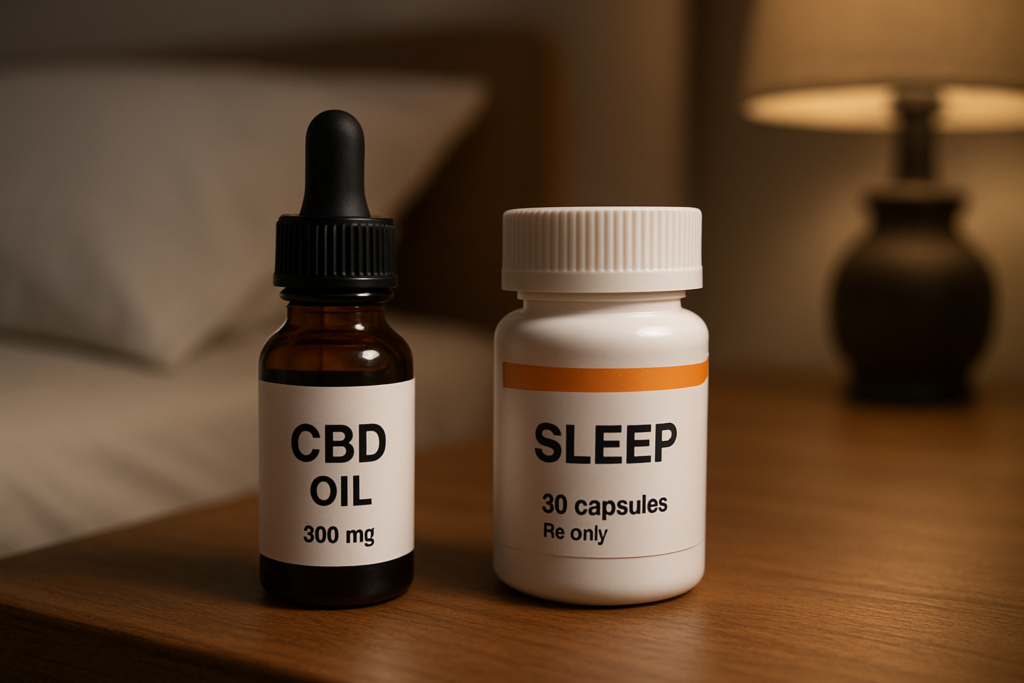
CBD and prescription sleep aids like zolpidem (Ambien) carry meaningful combined sedation risk, and zolpidem in particular is metabolized through CYP3A4, the same enzyme CBD inhibits. This creates a plausible mechanism for CBD raising zolpidem blood levels, on top of the already-additive drowsiness both substances cause independently. This combination warrants medical guidance rather than casual self-directed use.
CBD and sleep aids at a glance
| Sleep aid | Primary pathway | Combined concern level |
|---|---|---|
| Zolpidem (Ambien) | CYP3A4 | Higher, both enzyme overlap and additive sedation |
| Eszopiclone (Lunesta) | CYP3A4 | Higher, similar mechanism to zolpidem |
| Zaleplon (Sonata) | CYP3A4, less dependent | Moderate |
| Trazodone | CYP3A4 | Higher, also has its own broader interaction profile |
Why this combination needs real caution
Two separate mechanisms stack here. First, straightforward additive sedation, both CBD and prescription sleep aids cause drowsiness, and combining them can produce sedation beyond what either causes alone, this is true even without any enzyme interaction. Second, the enzyme overlap: zolpidem and similar drugs rely heavily on CYP3A4, which CBD inhibits, potentially raising the sleep aid’s blood levels beyond the prescribed dose’s intended effect.
Prescription sleep aids already carry known risks around next-day grogginess, complex sleep behaviors (like sleep-walking or sleep-driving in rare cases), and dependency with regular use. Amplifying blood levels through an enzyme interaction adds another variable to an already-sensitive risk profile.
What this could mean practically
- More pronounced next-day grogginess or “hangover” effect
- Increased risk of the rare but serious complex sleep behaviors associated with drugs like zolpidem
- Greater fall risk if waking during the night
- Potentially increased sedative effect beyond what’s needed or intended
Practical guidance
- Don’t combine CBD with prescription sleep medication without your prescribing doctor’s knowledge and guidance
- If your doctor approves combined use, expect to start with a lower CBD dose than you might otherwise
- Ensure a full, uninterrupted sleep window when using either or both, waking early after a sleep aid dose is when complex sleep behavior risk is more relevant
- Don’t drive or operate machinery in the morning until you’re certain the medication (and any CBD effect) has fully cleared
- Never combine this pairing with alcohol, which compounds sedation risk substantially
Why you shouldn’t just stop the sleep aid to add CBD
Prescription sleep medications, particularly with regular use, can involve withdrawal or rebound insomnia if stopped abruptly. If you’re interested in transitioning from a prescription sleep aid toward CBD or other approaches, this should be a gradual, medically supervised process, not an abrupt swap.
Who should be most cautious
- On zolpidem, eszopiclone, or trazodone specifically. Higher relevance given CYP3A4 dependence.
- History of complex sleep behaviors. Any factor that may increase sleep aid blood levels warrants extra caution.
- Older adults. Combined sedation carries higher fall and confusion risk.
- Live alone or have early morning obligations. Reduced margin for next-day grogginess effects.
Frequently asked questions
Can I take CBD with Ambien?
Only with your doctor’s guidance. The combination carries both additive sedation and a documented liver enzyme overlap that could raise zolpidem’s effective dose.
Is this combination dangerous?
It carries real, mechanism-based risk rather than being purely theoretical. This doesn’t mean harm is certain, but medical supervision is warranted rather than self-directed combination.
Should I stop my sleep medication to try CBD instead?
Not abruptly. Any transition away from a prescribed sleep aid should be gradual and medically supervised.
What are complex sleep behaviors?
Rare but documented activities like sleep-walking, sleep-eating, or sleep-driving associated with certain sleep medications, particularly zolpidem. Anything that raises blood levels of these drugs may increase this risk.
Is zaleplon safer to combine with CBD than zolpidem?
It has somewhat less CYP3A4 dependence, which may reduce (but not eliminate) the enzyme-related concern; additive sedation still applies regardless.