The CBD market grew faster than its rules did, and marketing filled the gap. Some brands are careful and transparent. Others rely on claims that no regulator or lab report would support. Here are 12 red flags we watch for, and what a trustworthy alternative looks like.
Why This Matters
In the US, the FDA has repeatedly sent warning letters to CBD sellers whose websites claimed their products treat pain, anxiety, ADHD or even cancer. The agency’s position is that a product claiming to treat a medical condition is treated as an unapproved drug, and that such claims can lead people to delay real care. Those warnings are a useful guide to what responsible brands avoid.
The 12 Red Flags
| # | Red flag | Why it is a problem |
|---|---|---|
| 1 | “Cures” or “treats” a disease | Drug claims no CBD supplement can legally make |
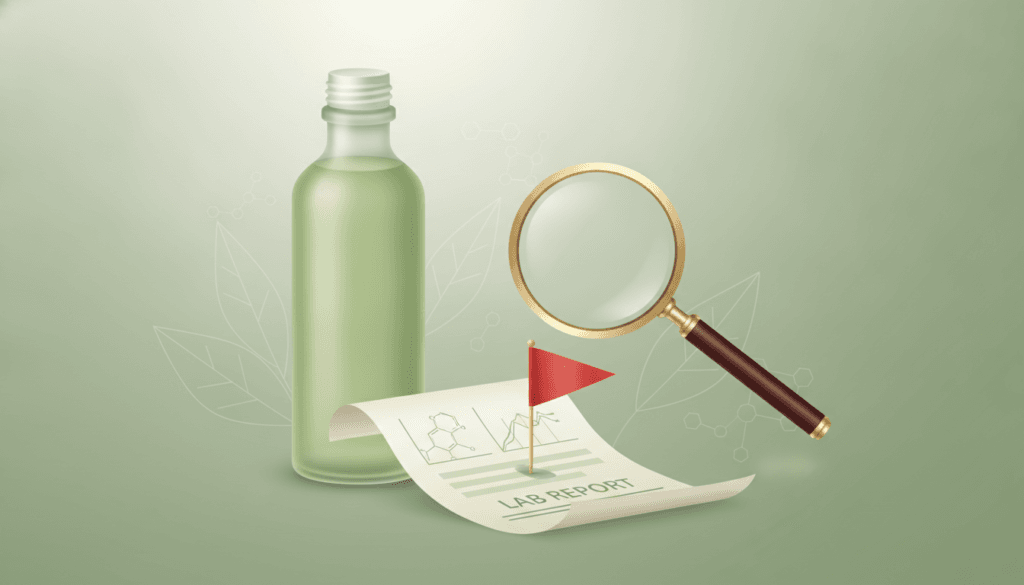
| 2 | No third-party lab report | You cannot verify potency or contaminants |
| 3 | COA does not match the batch number | The report may belong to a different product |
| 4 | “Hemp oil” with no CBD milligrams | Often just hemp seed oil with no cannabinoids |
| 5 | Dose shown only as bottle size (30 ml) | Bottle volume says nothing about CBD content |
| 6 | “Miracle”, “100% safe”, “no side effects” | No active compound is risk free |
| 7 | Fake or unnamed doctor endorsements | Borrowed authority without evidence |
| 8 | Price far below the market | Often under-dosed or mislabelled |
| 9 | “Clinically proven” with no study cited | Claim cannot be checked |
| 10 | Pressure tactics and countdown timers | Urgency replaces information |
| 11 | Zero mention of interactions or who should avoid it | Credible brands discuss limits |
| 12 | Vague sourcing (“premium hemp”) | No farm, region or extraction method named |
What Good Looks Like
- A batch-specific certificate of analysis from an accredited lab, linked or scannable from the label.
- CBD content stated in milligrams per serving and per container.
- Named extraction method and hemp origin.
- Language such as “may support” rather than “treats”, with honest caveats.
- Clear guidance about medications. Our drug interactions guide shows the standard we aim for.
A 60 Second Check Before You Buy
- Find the COA and match the batch number to the bottle.
- Confirm the milligrams of CBD, then divide price by milligrams to compare fairly.
- Read the ingredient list for the real carrier oil.
- Scan the page for cure language. If you see it, leave.
For the detailed steps, see how to read a CBD COA, how to read a hemp product label and how to choose a reputable brand.
Frequently Asked Questions
Is it illegal for a brand to say CBD treats anxiety?
In the US, claiming a product treats a condition generally makes it an unapproved drug in the FDA’s view, which is why many warning letters cite such claims. Rules differ by country, but the safe reading is that treatment claims are a red flag everywhere.
Can a good brand still have a small error on its label?
Yes. Testing studies have found potency variance even among decent products. A small gap is different from a missing COA or a product with almost no CBD.
Are celebrity or influencer endorsements reliable?
No. They tell you about marketing budgets, not quality. Judge the lab report instead.
Does a high price mean higher quality?
Not by itself. Compare cost per milligram of CBD and check testing. Expensive and cheap products can both fail those tests.
What should I do if a product made me feel unwell?
Stop using it, keep the packaging and batch number, and speak with a clinician if symptoms continue. You can also report problems to your local regulator.
Is hemp oil the same as CBD oil?
No. Hemp seed oil comes from seeds and contains no meaningful CBD. We explain the difference in our guide to hemp seed oil vs CBD oil.
This article is educational and not medical advice.