Starting CBD for the first time is easier than it seems from the outside, but the market’s sheer variety of products, concentrations, and formats can make the first decision feel overwhelming. This guide cuts through that and gives a clear, practical starting point for anyone who has not used CBD before.
Step 1: Know What You Are Actually Trying to Achieve
CBD is not a single-purpose supplement, and the format that suits someone using it for sleep is different from what suits someone using it for general wellness or for a specific skin concern. Before buying anything, decide what you are most interested in exploring. For general daily wellness, a sublingual tincture or capsule taken once daily is the simplest entry point. For anxiety or stress specifically, a sublingual tincture is preferable to capsules because the faster onset (15 to 45 minutes versus 30 to 90 minutes) allows you to take it more responsively. For sleep, a slightly higher dose taken 30 to 60 minutes before bed works better than a morning dose. For localised skin concerns, a topical (cream, balm, or serum) applied directly to the area is more relevant than an oral product. Knowing your goal helps you pick the right format before looking at any specific product.
Step 2: Choose the Right Product Type
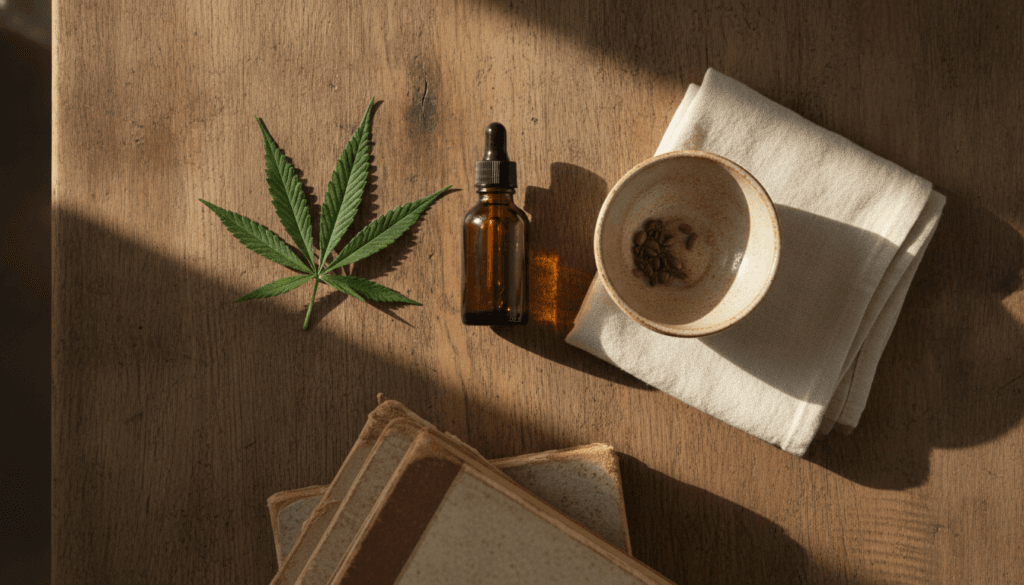
For most first-time users, a CBD oil tincture or softgel capsule is the best starting point. Tinctures are versatile (you can adjust drops easily for dose flexibility), faster-acting, and you can see and taste what you are taking. Capsules are more convenient, tasteless, and travel-friendly but have slower onset and less dosing flexibility. Avoid vape products as a first experience with CBD; the delivery method introduces additional considerations, as discussed in our vape content, and is not necessary for most CBD use cases. Gummies and edibles are a popular starting format but have the same delayed onset and liver metabolism considerations as any edible, discussed in our edibles piece, so they are not the most predictable first experience. Topicals are excellent for localised skin or muscle concerns but will not produce the systemic effects relevant to wellness, anxiety, or sleep goals.
Step 3: Choose Between Full Spectrum, Broad Spectrum, or Isolate
As a first-time user, broad spectrum CBD is often the recommended starting point. It contains CBD plus other minor cannabinoids and terpenes (which may enhance effects through the entourage effect, as discussed in our terpenes piece) but with THC removed, so there is no THC exposure at all. This makes it suitable for anyone with drug testing concerns and for anyone cautious about any THC content. Full spectrum is the alternative: it includes trace THC (up to 0.3%) alongside all other cannabinoids and terpenes. Most people do not notice any effect from this trace amount, but for those with THC sensitivity or drug test concerns, broad spectrum or isolate is safer. CBD isolate (pure CBD, nothing else) is the most predictable and simplest option but may be less effective than broad or full spectrum for some people due to the absence of complementary compounds.
Step 4: Understand CBD Concentration and Dose
CBD products list their total CBD content in milligrams. A standard tincture bottle might be 30 ml and contain 1,000 mg of CBD, meaning each 1 ml dropper full contains approximately 33 mg of CBD. The same bottle might come in 500 mg (17 mg per ml) or 2,000 mg (67 mg per ml) strengths. For a first-time user, a starting dose of 15 to 25 mg of CBD per day is a practical entry point. This is below the general population acceptable daily intake reference point of approximately 30 mg per day established in 2025 safety research. Take this consistently for 5 to 7 days before making any assessment; CBD’s effects in many use cases build cumulatively rather than appearing from a single dose. If no effect is noticed after a week at this dose, increase by 5 to 10 mg and reassess after another week.
Step 5: Verify the Product Before You Buy
The minimum quality check for any CBD product is a Certificate of Analysis (COA) from a named third-party laboratory. The COA should show the CBD content in mg per serving matching the label’s claim, THC content at or below the legal limit (or non-detectable for broad spectrum and isolate), a recent testing date within the last 12 months, and no flagged contaminants in the pesticide or heavy metal panels. If a brand cannot or will not provide a COA, do not buy from them. In the US, avoid products that make specific health claims about treating diseases, since this is not legally permitted for hemp CBD supplements and often signals a brand making claims beyond what the evidence supports.
Common First-Time Mistakes to Avoid
Do not judge CBD by a single dose. Most benefits for ongoing concerns (anxiety, sleep, wellness) require consistent daily use over at least two to four weeks. Do not start with a product that has no stated CBD milligram content. If a product says hemp oil or hemp extract without stating milligrams of CBD, it likely contains little to no actual CBD. Do not assume more expensive always means better. Price correlates with quality up to a point, then reflects branding. The COA is more reliable than price as a quality indicator. Do not start with a vape or high-dose edible as your first CBD experience. The delivery variables (inhaling technique for vapes, the delayed onset trap for edibles) make these formats harder to get right without prior experience. Do not expect immediate, dramatic results. CBD is not an acute drug in the way caffeine or alcohol is. Its effects at typical wellness doses are often described as subtle, a feeling of general ease rather than a noticeable acute effect.
Frequently Asked Questions
What is the best CBD oil for a complete beginner?
The best starting product for most beginners is a broad spectrum CBD oil tincture at a moderate potency (500 to 1,000 mg per 30 ml bottle, giving approximately 17 to 33 mg per full dropper), from a brand that publishes batch-specific COAs. Broad spectrum avoids any THC exposure while potentially providing more benefit than isolate through the entourage effect. A moderate potency allows easy dose adjustment without wasting money on very high concentrations before you know your response.
How will I know if CBD is working?
This depends on what you are using it for. For sleep, track how long you take to fall asleep and how often you wake up. For anxiety, notice whether situations that would normally feel more stressful feel different after two to three weeks of consistent use. For general wellness, the effects are often subtle enough that keeping a simple daily note (0 to 10 scale on sleep quality, mood, or whatever is relevant) over four weeks is the most reliable way to objectively assess whether things have changed. CBD’s effects are often described as the absence of previous discomfort rather than a noticeable new sensation.
Can I take CBD with my other medications or supplements?
CBD is metabolised by the same liver enzyme system (cytochrome P450) as many prescription medications, which means it can affect how quickly other medications are processed. This is a real consideration, not a hypothetical one. If you take any prescription medication, particularly blood thinners, anti-seizure medications, or immunosuppressants, discuss starting CBD with your doctor or pharmacist before beginning. For most common over-the-counter supplements, there is less concern, but checking with a healthcare provider is always the right first step.
Is CBD safe for older adults?
CBD has a generally good safety profile for older adults at typical wellness doses, and many older adults use it specifically for pain, sleep, and anxiety applications. However, older adults are more likely to be on prescription medications where the liver enzyme interaction discussed above is relevant, and more likely to have health conditions that require consideration. A conversation with a doctor before starting is particularly important for older adults, not because CBD is inherently unsafe for this group but because the medication interaction consideration is more commonly relevant.
Do I need a prescription to buy CBD?
In most markets, hemp-derived CBD supplements do not require a prescription. In the US, hemp-derived CBD with under 0.3% THC is available over the counter. In the UK, CBD products registered as novel foods with the FSA are available without prescription. In some countries, higher-dose CBD products or CBD pharmaceutical medications like Epidiolex do require a prescription. Check your specific country’s regulations, particularly for higher doses or if you are interested in CBD for a specific medical application.
What is the difference between cheap and expensive CBD oil?
Price differences in CBD reflect several real factors, including the cost of third-party testing, organic certification, extraction method quality, carrier oil quality, and marketing overhead. A legitimately cheap CBD oil from a brand with a clean COA and appropriate certifications can be a perfectly good product. An expensive CBD oil without a COA is not justified by its price. When comparing products, calculate the cost per milligram of CBD (price divided by total mg) and compare this across products with verified COAs, rather than assuming a higher price per bottle equals higher quality.