Last updated: 30 August 2026. Informational only, not medical advice.
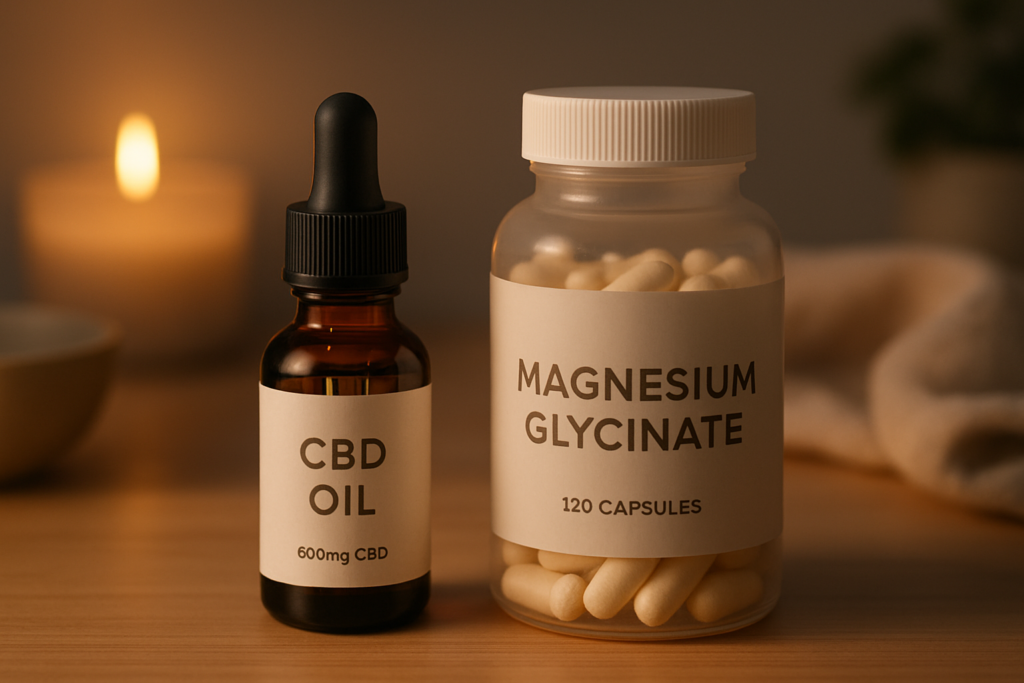
Magnesium and CBD address anxiety and sleep through different routes. Magnesium is an essential mineral involved in nervous system regulation, and many people are mildly deficient without realizing it, correcting that deficiency can meaningfully improve sleep and stress tolerance. CBD doesn’t correct a deficiency; it works through the endocannabinoid system and may reduce anxiety directly. For people who are magnesium-deficient, magnesium may show more noticeable results. For people who aren’t, CBD may be the more relevant option.
CBD vs magnesium at a glance
| Magnesium | CBD | |
|---|---|---|
| What it is | An essential mineral | A non-intoxicating cannabis compound |
| Mechanism | Regulates nervous system excitability, GABA support | Endocannabinoid modulation, 5-HT1A receptor activity |
| Best for | Correcting deficiency-related tension and poor sleep | Situational anxiety, racing thoughts |
| Onset | Days to weeks to see full effect if deficient | 30 to 90 minutes for acute effect, weeks for baseline changes |
| Common forms | Glycinate, citrate, threonate | Oil, capsule, edible |
| Deficiency common? | Yes, especially with poor diet, high stress, or alcohol use | Not applicable, no deficiency state |
| Cost per month | Typically under $15 | Typically $20 to $40 |
The deficiency question that changes everything
Magnesium’s biggest advantage is that a meaningful portion of the population is mildly deficient, often without obvious symptoms beyond tension, poor sleep, or irritability. If you’re deficient, supplementing corrects an actual physiological gap, which tends to produce more noticeable results than adding a substance to an already-sufficient system.
There’s no equivalent “CBD deficiency.” CBD doesn’t correct a baseline lack of anything, it’s working through receptor modulation regardless of your starting point. This is why response to CBD is more individually variable, some people notice clear effects, others notice little.
Which magnesium form matters
Not all magnesium supplements are equal for this purpose:
- Magnesium glycinate. Well absorbed, gentle on digestion, commonly recommended for sleep and anxiety specifically.
- Magnesium citrate. Well absorbed but more likely to have a laxative effect at higher doses.
- Magnesium threonate. Marketed for crossing the blood-brain barrier more effectively; evidence is promising but still developing.
- Magnesium oxide. Cheap and common but poorly absorbed, not the best choice for this purpose despite being widely sold.
What the evidence actually supports
Magnesium
Reasonably solid evidence supports magnesium supplementation improving sleep quality and reducing anxiety symptoms specifically in people with low or borderline magnesium status. Evidence for benefit in people who are already sufficient is weaker.
CBD
CBD’s anxiety evidence is comparatively stronger and more direct than its sleep evidence, several human trials show anxiety reduction, including in social anxiety and generalized anxiety contexts. Effects don’t depend on correcting any deficiency.
Which fits which situation
| Situation | Better starting point |
|---|---|
| High stress, poor diet, or regular alcohol use | Magnesium, deficiency is more likely |
| Muscle tension or cramping alongside anxiety | Magnesium |
| Racing thoughts, situational anxiety | CBD |
| Already taking a multivitamin with adequate magnesium | CBD, deficiency less likely |
| Budget-conscious, want to try the cheaper option first | Magnesium |
| Anxiety with a physical, situational trigger | CBD |
Can you take both together?
Yes, there’s no known dangerous interaction between magnesium and CBD, and they work through different enough mechanisms that combining them is common practice. Magnesium doesn’t share CBD’s liver enzyme interaction profile, so it’s generally considered lower-risk to combine with other medications too, though CBD’s own interaction list still applies.
Who should be cautious
- Kidney disease. Impaired kidneys can’t clear excess magnesium efficiently, raising toxicity risk. Medical guidance is essential.
- On certain heart medications. Some interact with magnesium levels; check with a pharmacist.
- On antibiotics. Magnesium can interfere with absorption of some antibiotic classes; space doses apart.
- CBD’s usual cautions apply. Liver enzyme interactions, pregnancy, and medication overlap considerations remain relevant regardless of magnesium use.
Frequently asked questions
Is magnesium or CBD better for anxiety?
If you’re magnesium deficient, correcting that often produces noticeable results. If you’re not deficient, CBD’s anxiety evidence is more directly relevant.
How do I know if I’m magnesium deficient?
Blood tests aren’t always reliable since most magnesium is stored in cells, not blood. Risk factors include high stress, poor diet, regular alcohol use, and certain medications; a doctor can help assess this.
Can I take CBD and magnesium at the same time?
Yes, no dangerous interaction is established, and many people use both together.
Which works faster?
CBD can have a same-day acute effect; magnesium’s benefit for deficiency-related symptoms typically builds over one to two weeks.
Is magnesium safer than CBD?
Both are generally well-tolerated. Magnesium has fewer known drug interactions than CBD, though excess magnesium carries its own risks, especially with kidney impairment.
Which is cheaper?
Magnesium, typically by a significant margin at equivalent monthly use.