Last updated: 2 September 2026. Informational only, not medical advice.
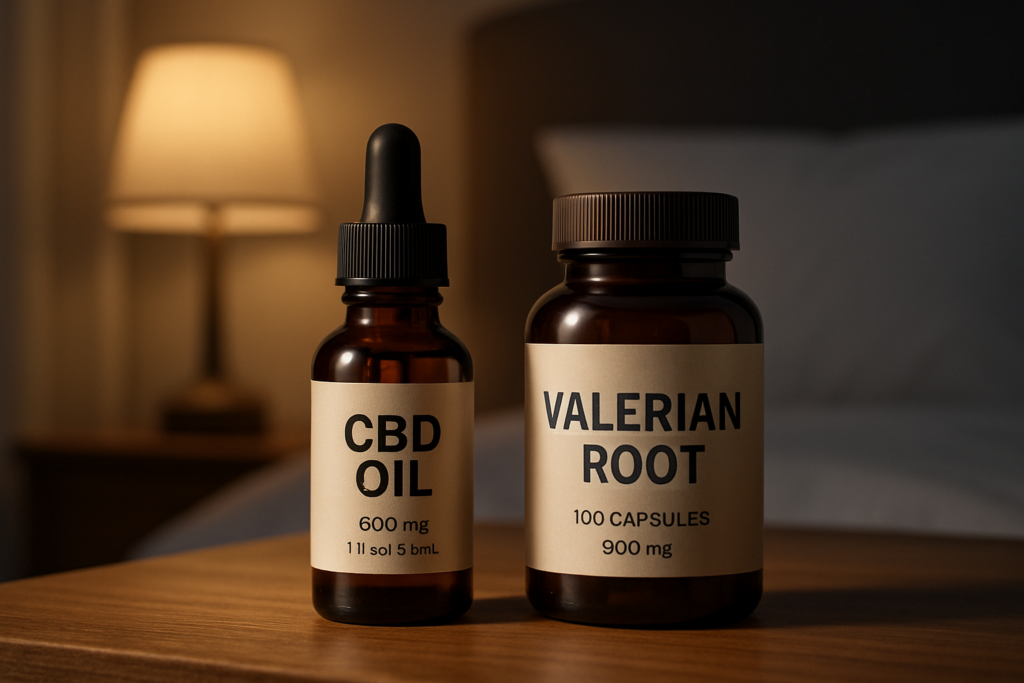
CBD and valerian root both support sleep but through different, less-understood mechanisms than melatonin. Valerian appears to affect GABA activity, the brain’s primary calming neurotransmitter system, and has a longer history of traditional and clinical use for insomnia. CBD’s sleep effects are more indirect, largely tied to anxiety reduction rather than a direct sedative action. Evidence for both is moderate rather than strong, and individual response varies more than marketing suggests.
CBD vs valerian root at a glance
| Valerian Root | CBD | |
|---|---|---|
| Mechanism | GABA system modulation | Endocannabinoid modulation, indirect calming |
| Best for | Difficulty falling asleep, mild insomnia | Sleep disrupted by anxiety or racing thoughts |
| Onset | 30 to 60 minutes, sometimes longer to build effect | 30 to 90 minutes orally |
| Smell/taste | Strong, often described as unpleasant | Earthy, milder |
| Evidence strength | Mixed, some trials positive, others show minimal effect | Mixed, stronger for anxiety than direct sleep |
| Next-day grogginess | Possible, especially at higher doses | Less commonly reported |
Why valerian’s evidence is inconsistent
Valerian has been used for sleep for centuries, but modern controlled trials give a mixed picture, some show meaningful improvement in sleep onset and quality, others show effects barely different from placebo. This inconsistency may partly reflect variable product quality and standardization, valerian extracts differ significantly in their active compound concentration between brands.
What the evidence actually supports
Valerian root
Best supported for mild to moderate difficulty falling asleep, with more consistent benefit reported after several weeks of regular use rather than as a single-night solution, despite often being marketed for immediate use.
CBD
Better evidence exists for anxiety reduction than for direct sleep induction. Where CBD seems most useful for sleep is when anxiety or racing thoughts are the actual barrier to falling asleep, rather than as a general-purpose sedative.
Which fits which situation
| Situation | Better starting point |
|---|---|
| Straightforward difficulty falling asleep, no clear cause | Valerian, give it 2 to 4 weeks |
| Sleep disrupted by anxious or racing thoughts | CBD |
| Sensitive to strong tastes or smells | CBD, valerian’s smell is a common complaint |
| Want same-night results | Neither is reliably fast; manage expectations either way |
Can you combine them?
No dangerous interaction between CBD and valerian is established, and combination products exist. Since both may contribute to drowsiness, combined use in the evening is reasonable, but starting with lower doses of both is sensible until you know your combined response.
Who should be cautious
- On other sedatives or sleep medications. Combined drowsiness with prescription sleep aids, benzodiazepines, or alcohol needs medical input.
- Before surgery. Valerian is often recommended to stop before procedures due to sedative interaction potential with anesthesia.
- Liver conditions. Valerian has rare case reports of liver-related concerns at high doses; discuss with a doctor if you have liver disease.
- Pregnant or breastfeeding. Neither is well-established as safe in pregnancy.
Frequently asked questions
Is valerian root or CBD better for sleep?
Valerian has a longer track record specifically for sleep onset, though evidence is mixed. CBD is more relevant when anxiety is the underlying barrier to sleep.
How long does valerian take to work?
Some people notice effects the same night; more consistent benefit is often reported after 2 to 4 weeks of regular use.
Can I take CBD and valerian together?
Yes, no dangerous interaction is established. Start with lower doses of both if trying them together for the first time.
Why does valerian smell bad?
The compounds responsible for its effects also produce a distinctive, often unpleasant smell; this is a known and common complaint, not a sign of a bad product.
Should I stop valerian before surgery?
Many surgical teams recommend stopping it in advance due to potential sedative interactions with anesthesia; follow your surgical team’s specific guidance.