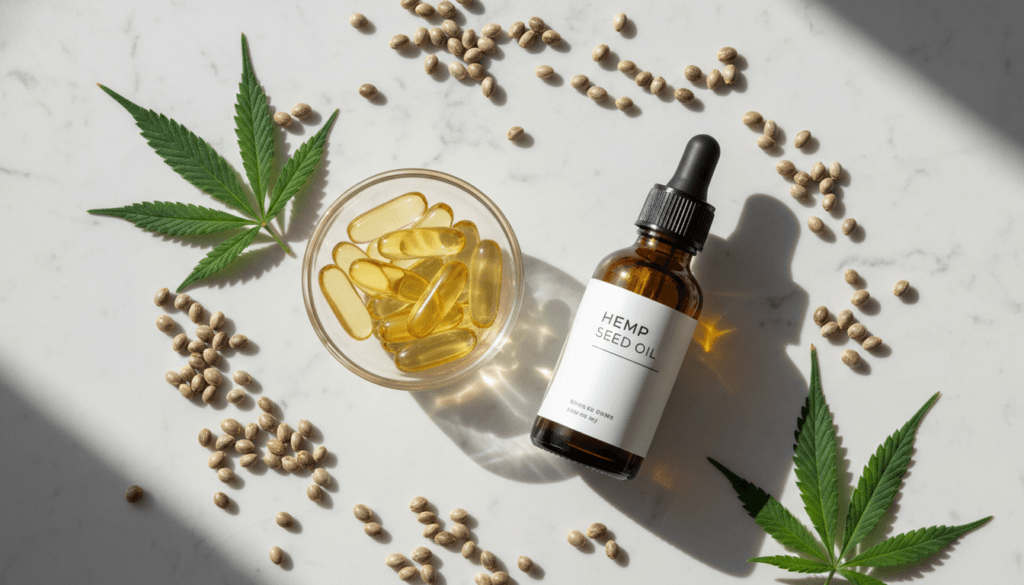
Hemp oil products come in two primary forms: liquid oil in bottles with droppers or measuring spoons, and capsules or soft gels. Both deliver the same hemp seed oil or CBD oil. What differs is everything around that core: convenience, absorption rate, cost, taste, and suitability for different lifestyles. Here is a complete comparison.
What Are Hemp Oil Capsules?
Hemp oil capsules are soft gel or hard shell capsules containing a measured dose of hemp seed oil or CBD oil. They are taken orally, swallowed whole, and processed through the digestive system. Capsules typically contain 500 mg to 1,500 mg of hemp seed oil per capsule, or for CBD products, commonly 10 mg, 15 mg, 25 mg, or 50 mg of CBD per capsule. They are convenient, tasteless, odourless, and provide a precise consistent dose every time.
What Is Liquid Hemp Oil?
Liquid hemp oil comes in bottles, typically 50 ml to 500 ml for hemp seed oil, or 10 ml to 100 ml for CBD oil tinctures. Hemp seed oil is used with measuring spoons for dietary consumption or applied topically. CBD oil tinctures are typically taken sublingually (under the tongue) for faster absorption. Liquid oils offer flexible dosing and are often more economical per dose than capsules.
Absorption: Where Liquid Wins
For CBD oil specifically, liquid sublingual tinctures have a meaningful absorption advantage. When CBD oil is held under the tongue for 60 to 90 seconds before swallowing, a portion of the CBD is absorbed directly through the mucous membranes into the bloodstream, bypassing the digestive system. This produces onset in 15 to 45 minutes and improves bioavailability compared to capsules. CBD capsules must pass through the entire digestive tract, with onset taking 30 to 90 minutes and bioavailability estimated at 4 to 20%, compared to approximately 20 to 35% for sublingual absorption. For hemp seed oil used nutritionally, the absorption difference between liquid and capsule is negligible as both are digested the same way.
Convenience: Where Capsules Win
Capsules are more convenient by almost every practical measure. They do not require measuring or a spoon. They have no taste or smell. They are easy to take on the go. They do not leak or require refrigeration in the way an open bottle does. They are discreet and can be kept in a bag or desk drawer without drawing attention. For people who find the earthy, grassy taste of hemp seed oil or the bitter, herbal taste of CBD oil off-putting, capsules remove the experience entirely.
Cost per Dose
Liquid hemp seed oil is almost always more economical per dose than capsules. A 250 ml bottle of quality cold-pressed hemp seed oil at $20 provides approximately 50 tablespoon-size servings at $0.40 per serving. Equivalent hemp oil capsule products typically cost more per equivalent dose due to the encapsulation process. For CBD oil, the premium for capsules over liquid tinctures of equivalent CBD content is typically 20 to 40%.
Which Format Should You Choose?
For hemp seed oil used nutritionally and for cooking, liquid is the practical choice due to versatility and cost. For CBD oil focused on faster onset and better bioavailability, sublingual liquid tinctures are preferable. For people who want the simplest, most portable, and tasteless option for daily supplementation, capsules are the more practical choice. For people measuring precise doses for medical or therapeutic use, both formats work, but liquids offer more granular dose adjustment.
Frequently Asked Questions
Do hemp oil capsules work as well as liquid?
For hemp seed oil used nutritionally, yes, capsules work as well as liquid for dietary benefit. Both are processed through digestion and deliver the same fatty acids. For CBD oil, liquid sublingual tinctures have a measurable absorption advantage due to direct mucous membrane absorption. If faster onset or higher bioavailability matters for your use case, liquid CBD oil held under the tongue is the better choice.
How long do hemp oil capsules take to work?
Hemp oil capsules, like all oral supplements, must pass through the digestive system. Onset for CBD capsules is typically 30 to 90 minutes after taking them, depending on whether you have eaten recently, your digestive rate, and your metabolism. Effects from hemp seed oil capsules as a nutritional supplement are cumulative over weeks rather than immediate. Taking capsules with a meal that contains some fat can improve absorption.
Are hemp oil capsules more expensive than liquid?
Yes, in almost all cases. The encapsulation process adds manufacturing cost that is passed on to the consumer. For equivalent doses of hemp seed oil or CBD, capsules typically cost 20 to 50% more per dose than liquid equivalents. For budget-conscious consumers who do not mind the taste of liquid hemp oil, liquid is significantly more economical.
Can I open hemp oil capsules and use the oil inside topically?
In principle yes, the oil inside hemp seed oil capsules is the same oil as in a bottle. However, capsule-grade hemp oil is formulated and packaged for ingestion, not topical use. The volume per capsule is small and the cost per milliliter significantly higher than buying hemp seed oil in a bottle for topical use. It is more practical and economical to buy a separate bottle of cold-pressed hemp seed oil for topical application.
What size hemp oil capsules should I look for?
For hemp seed oil nutritional capsules, 1,000 mg per capsule is a common and practical size, providing approximately one teaspoon equivalent per capsule. For CBD oil capsules, 10 to 25 mg per capsule is appropriate for most wellness users. Start at the lower end and adjust upward based on your experience. Always verify the CBD content per capsule against the product’s Certificate of Analysis to confirm accuracy.