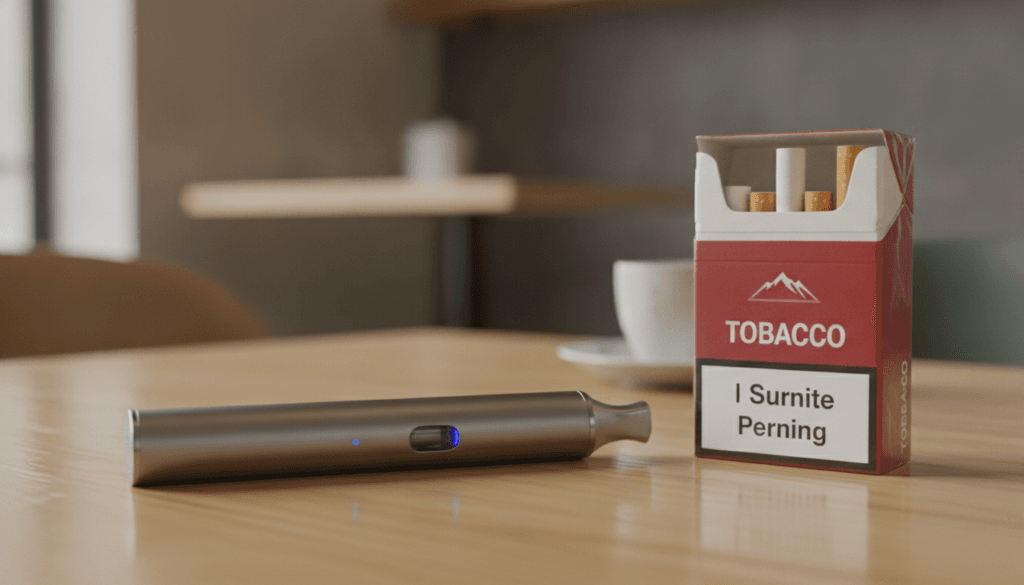
Few questions in consumer health generate as much conflicting messaging as whether vaping is safer than smoking. Public health bodies, researchers, and former smokers often arrive at different emphases, not because the underlying science is contradictory, but because the honest answer involves several true statements that can sound like they are in tension with each other.
The Short, Honest Answer
Vaping is less harmful than smoking conventional cigarettes. This is the consistent position of major health bodies including Cancer Research UK and the American Heart Association, based on the fact that vaping does not involve combustion and therefore does not produce the tar and many of the carcinogens found in cigarette smoke. However, less harmful than smoking is not the same as safe. Vaping is not risk-free, carries its own distinct set of health considerations, and its long-term effects are not yet fully understood because the products have not existed long enough for multi-decade studies.
What the 2025 Cochrane Review Found
A major 2025 Cochrane review consolidated evidence from 104 studies and concluded that switching from smoking to vaping was the most effective method for smoking cessation studied, for at least six months, when compared to other approaches. The review found that while only around 6% of smokers using nicotine replacement therapy (patches, gum, lozenges) successfully quit, up to twice as many smokers successfully quit using e-cigarettes. This is a significant finding because smoking cessation is one of the single most impactful interventions for long-term health, and it forms the basis for why some public health bodies, particularly in the UK, actively promote vaping as a harm-reduction tool for existing smokers specifically.
What the Research Says About Vaping’s Own Risks
Vaping is not without health considerations of its own. A 2025 study examining disposable vape pods found they emit more of certain toxic compounds than earlier e-cigarette devices, other disposables, and even traditional cigarettes in some measures, which is concerning given that disposable pods are currently the most popular device type, including among younger users. Research has linked vaping to increased risk for several acute and chronic conditions and to cancer-related biomarkers, although the absence of long-term studies (vapes have existed widely for roughly 15 years compared to over a century of smoking research) means the full long-term picture is not yet established. Vaping presents some unique risk factors compared to smoking, including grazing-style use (frequent small puffs throughout the day rather than discrete smoking episodes), the potency of nicotine salts which can be inhaled more deeply and smoothly than traditional nicotine, and these factors combining to potentially produce faster and more intense addiction in some users.
EVALI: What Actually Happened and Why It Matters
The 2019 EVALI (e-cigarette or vaping product use-associated lung injury) outbreak is frequently cited in vaping safety discussions, and understanding what actually caused it is important. By February 2020, EVALI had resulted in 2,807 hospitalisations and 68 deaths in the US. CDC investigation of over 2,000 EVALI patients found that 86% reported vaping products containing THC, 34% reported using THC-containing products exclusively, and only 11% reported using nicotine-only products. The investigations identified vitamin E acetate, a thickening agent used in illicitly produced THC vape cartridges, as strongly linked to the cases. Vitamin E acetate was not used in regulated nicotine vape products. This means EVALI was primarily a product safety and regulation issue affecting illicit THC vapes, rather than evidence that vaping as a category is inherently linked to this specific lung injury. However, EVALI demonstrated how quickly serious harm can occur when vape products are produced outside of regulated, tested supply chains, a lesson directly relevant to anyone considering THC or CBD vape products from unregulated sources.
Putting It Together: A Balanced View
For someone who currently smokes cigarettes and is trying to quit, switching to vaping is supported by strong evidence (including the 2025 Cochrane review) as a more effective cessation tool than nicotine replacement therapy, and as a meaningfully less harmful alternative if smoking continues to feel unavoidable. For someone who does not currently smoke, starting vaping is not supported by the safer than smoking framing, because the relevant comparison for a non-smoker is vaping versus not using any nicotine or inhaled product at all, not vaping versus smoking. For anyone using THC vape products, sourcing from licensed, regulated, and lab-tested suppliers is the single most important factor given what the EVALI outbreak revealed about illicit product risks specifically.
Long-Term Unknowns
Several areas remain genuinely uncertain due to the relative newness of vaping as a widespread consumer product. The cardiovascular effects of long-term vaping, particularly whether switching from smoking to vaping meaningfully reduces cardiovascular risk (as opposed to respiratory risk, where the evidence is clearer), remain less settled, with some research suggesting the cardiovascular risk reduction from switching may be smaller than the respiratory risk reduction. The effects of newer-generation devices and formulations, including high-nicotine disposables that did not exist when much of the foundational vaping research was conducted, are still being studied. And the population-level effects, including whether vaping serves primarily as a smoking cessation tool or also as an entry point to nicotine use for people who would not otherwise have smoked, particularly younger users, remains an active area of public health research and policy debate.
Frequently Asked Questions
Is vaping 95% safer than smoking?
The 95% figure originated from a 2015 Public Health England-commissioned estimate and has been widely repeated, but it has also been criticised by researchers as an oversimplification based on limited evidence available at the time. More recent research, including findings on disposable vape emissions, suggests the relative risk may vary significantly depending on device type and is more nuanced than a single percentage can capture. The directionally accurate statement, that vaping is less harmful than smoking, remains well supported; the specific 95% figure should be treated with caution as a precise measure.
Can vaping help me quit smoking?
According to a major 2025 Cochrane review of 104 studies, vaping was found to be the most effective smoking cessation method studied over a six-month period, with up to twice the success rate of nicotine replacement therapy (patches, gum, lozenges), which had only around a 6% success rate. If you are a smoker trying to quit, this evidence supports vaping as a more effective option than traditional nicotine replacement, though it should ideally be approached as a step toward eventually stopping nicotine use altogether rather than an indefinite substitute.
What caused the EVALI outbreak in 2019?
EVALI was strongly linked to vitamin E acetate, a thickening agent used in illicitly manufactured THC vape cartridges. CDC data on over 2,000 EVALI patients found that 86% had used THC-containing vape products, with the majority of those from informal or illicit sources rather than regulated dispensaries. EVALI was not found to be linked to vitamin E acetate use in regulated nicotine vape products. This is why sourcing any THC vape product from licensed, tested suppliers is considered critical for safety.
Does vaping cause cancer?
Vaping does not involve combustion and does not expose users to tobacco or the same range of carcinogens found in cigarette smoke, which is the primary basis for vaping being considered less harmful than smoking with respect to cancer risk specifically. However, vape aerosol does contain some potentially harmful chemicals, including certain compounds linked to cancer-related biomarkers in research, and because vaping has not existed long enough for multi-decade cancer studies, the long-term cancer risk of vaping itself (independent of the comparison to smoking) is not yet fully established.
Is vaping safe for someone who has never smoked?
No major health body recommends that non-smokers start vaping. The safer than smoking framing applies specifically to people who already smoke and are considering switching, not to people with no history of nicotine or tobacco use. For non-smokers, vaping introduces nicotine dependency risk and the other considerations discussed in this article without any offsetting benefit, since there is no existing smoking-related risk to reduce.
Are disposable vapes more dangerous than other types?
A 2025 study found that disposable vape pods emitted more of certain toxic compounds than earlier e-cigarette devices, other disposables, and traditional cigarettes in some measures. Disposable pods are also currently the most popular device category, including among younger and newer users, which compounds the relevance of this finding. This does not mean disposables are more dangerous than smoking in all respects, but it does suggest that not all vape devices carry equivalent risk profiles, and newer or unregulated disposable products warrant particular caution.