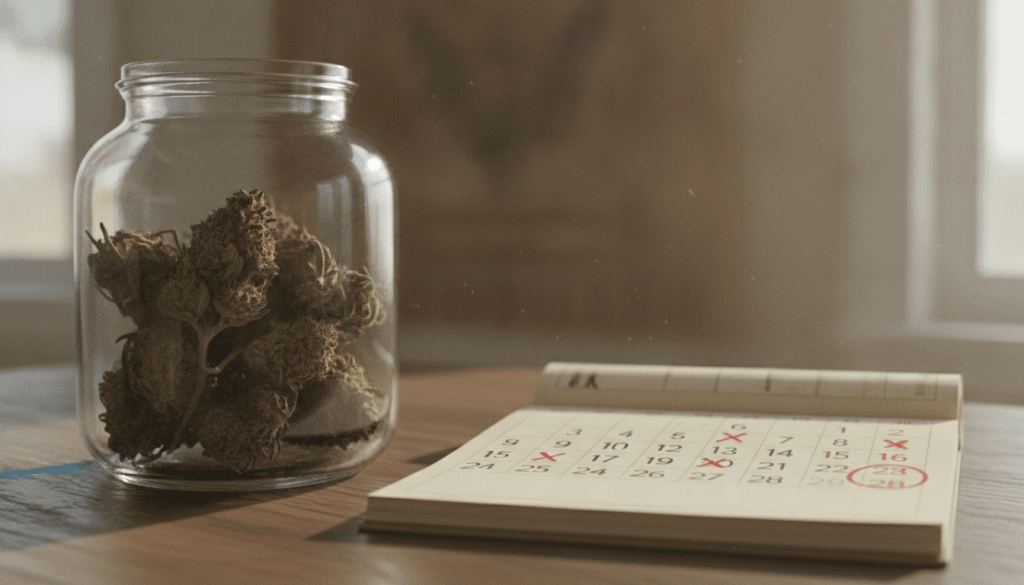
If cannabis that used to feel strong now barely registers, or if you find yourself needing more product to reach the same experience you used to get from less, you are describing tolerance. This is not a sign of anything being wrong with you; it is a well-documented, measurable, and reversible biological process.
The Receptor Science Behind Tolerance
THC produces its effects by binding to CB1 receptors, part of the endocannabinoid system, which are densely concentrated in brain regions governing pleasure, memory, coordination, appetite, and time perception. When THC is consumed regularly, these receptors are activated far more often than they would be under normal conditions (when only the body’s own endocannabinoids are present). The brain responds to this sustained overactivation through a process called downregulation: it reduces the total number of CB1 receptors available on neuron surfaces, and also decreases the sensitivity of the receptors that remain. With fewer and less sensitive receptors, the same amount of THC produces a smaller effect than it once did. To get the same experience, more THC is needed, which can drive a cycle of escalating use.
What Brain Imaging Studies Have Found
This is not a theoretical model; it has been directly observed using PET brain imaging. A widely cited 2012 study published in Molecular Psychiatry examined chronic daily cannabis users and found measurable, regionally selective downregulation of CB1 receptors compared to non-users. A 2016 study published in Biological Psychiatry: Cognitive Neuroscience and Neuroimaging examined how quickly this reverses: CB1 receptor availability began recovering within just 2 days of abstinence from cannabis. The same body of research suggests receptor density approaches baseline (non-user) levels after approximately 4 weeks of sustained abstinence, though the exact timeline can vary based on how heavy and how long-term the prior use was.
How a Tolerance Break (T-Break) Works
A tolerance break, commonly called a t-break, is a planned period of abstinence from THC products designed to allow CB1 receptor density and sensitivity to recover, a process called upregulation. The mechanism is the direct reverse of downregulation: without THC continuously activating CB1 receptors, the brain restores receptor numbers and sensitivity toward baseline over time. Once receptors have recovered, a given amount of THC produces a stronger effect than it did before the break, often described by users as their old dose hitting much harder.
How Long Should a T-Break Be?
| Break Length | What Research Suggests |
|---|---|
| 48 hours | CB1 receptor recovery begins; modest improvements in sensitivity reported |
| 7 to 14 days | More noticeable tolerance reduction; widely used as a practical middle ground |
| 21 to 28 days | CB1 receptor density approaches baseline (non-user) levels based on PET imaging studies |
The appropriate length depends significantly on how heavy and how long-term your prior use has been. For very heavy or long-term daily users, particularly those using high-potency concentrates, the deeper receptor downregulation may mean the full 4-week timeframe is more relevant than a shorter break. Research notes that THC potency in average cannabis products has increased substantially over recent decades, which means downregulation in regular users of modern high-potency products may be more pronounced than in the populations studied in some of the original imaging research.
What to Expect During a T-Break
The first few days are typically the most difficult. Mild withdrawal-type symptoms are common and can include sleep disturbances (including vivid or unusual dreams, which often return as cannabis use ends since THC suppresses REM sleep), irritability, reduced appetite, and general restlessness or boredom, particularly if cannabis use was tied to specific daily routines. These symptoms are generally most pronounced in the first 3 days and tend to ease as the break continues. They are a normal part of the body’s adjustment process, not a sign that something is wrong.
Returning to Use After a Break
This is the step people most often get wrong, and it is important. Because CB1 receptors have recovered, your previous dose will produce a stronger effect than it did before the break. Returning to your old dose immediately can result in an unexpectedly intense experience, particularly with edibles where delayed onset can lead to redosing before the first dose has fully taken effect. Start with a meaningfully smaller amount than you used before the break, perhaps a quarter to a half of your previous typical dose, and reassess from there. This is especially important for anyone returning to high-potency concentrates or edibles after a break.
Preventing Tolerance from Climbing Back
Several approaches can help manage tolerance on an ongoing basis without requiring frequent extended breaks. Reducing frequency of use, even modestly, slows the rate of receptor downregulation compared to daily use. Microdosing, using lower-THC products or smaller amounts of higher-potency products, achieves desired effects with less receptor overactivation. Scheduling regular shorter breaks (for example, a few days each month) into a routine can help maintain a lower baseline tolerance compared to continuous daily use without any breaks, preventing tolerance from climbing back to pre-break levels as quickly.
Frequently Asked Questions
How quickly does THC tolerance build?
Tolerance can build relatively quickly with regular use, sometimes noticeable within a couple of weeks of daily consumption, though the exact timeline varies significantly between individuals based on frequency, dose, and product potency. CB1 receptor downregulation is a graded process that intensifies with more frequent and higher-dose use, meaning occasional users typically experience less tolerance buildup than daily users of high-potency products.
How long does a tolerance break need to be to make a difference?
Research using PET brain imaging found that CB1 receptor recovery begins within just 2 days of abstinence, meaning even a 48-hour break can produce a noticeable, if modest, difference. However, the same research found that receptor density approaches baseline levels at around 4 weeks (28 days) of sustained abstinence. A practical middle ground commonly used is 1 to 2 weeks, though heavy or long-term users of high-potency products may benefit more from the fuller 3 to 4 week timeframe.
Will I have withdrawal symptoms during a t-break?
Many regular users experience mild withdrawal-type symptoms during the first few days of a tolerance break, including disrupted sleep, vivid dreams, irritability, reduced appetite, and restlessness. These symptoms are generally most intense in the first 3 days and ease as the break continues. They reflect the body’s adjustment to the absence of THC and are a normal, expected, and temporary part of the process, not a medical emergency for most users, though anyone with concerns about dependence should discuss this with a healthcare provider.
Why does my old dose feel so much stronger after a break?
During the break, your CB1 receptors recovered in both number and sensitivity (upregulation), reversing the downregulation that built up tolerance. Your previous dose, which used to produce a moderate effect on your downregulated receptors, now interacts with a fully recovered receptor population, producing a stronger effect. This is the entire point of a tolerance break, but it means returning to your old dose immediately after a break can result in a much more intense experience than expected, particularly with edibles.
Does taking a tolerance break mean I have a problem with cannabis?
Not inherently. Tolerance is a normal physiological response to regular cannabinoid receptor activation and occurs in essentially all regular users to some degree, similar to how tolerance develops with many other substances that interact with specific receptor systems. Taking a planned break to manage tolerance is a recognised harm-reduction and cost-management strategy used by many regular cannabis users. However, if you find it difficult to stop using cannabis even when you want to, or if attempting a break causes significant distress, this may be worth discussing with a healthcare provider, as it could indicate a different relationship with use that benefits from additional support.
Do CBD products cause the same tolerance issue?
CBD does not bind directly to CB1 receptors in the same way THC does, and CBD-specific tolerance in the sense of CB1 downregulation is not the primary mechanism discussed in CBD research. Some users do report that CBD seems less effective over very long periods of continuous use, though the mechanisms here are less well-characterised than THC’s CB1 downregulation. If you use full spectrum products containing both THC and CBD regularly, the THC tolerance mechanisms described in this article would still apply to the THC component.