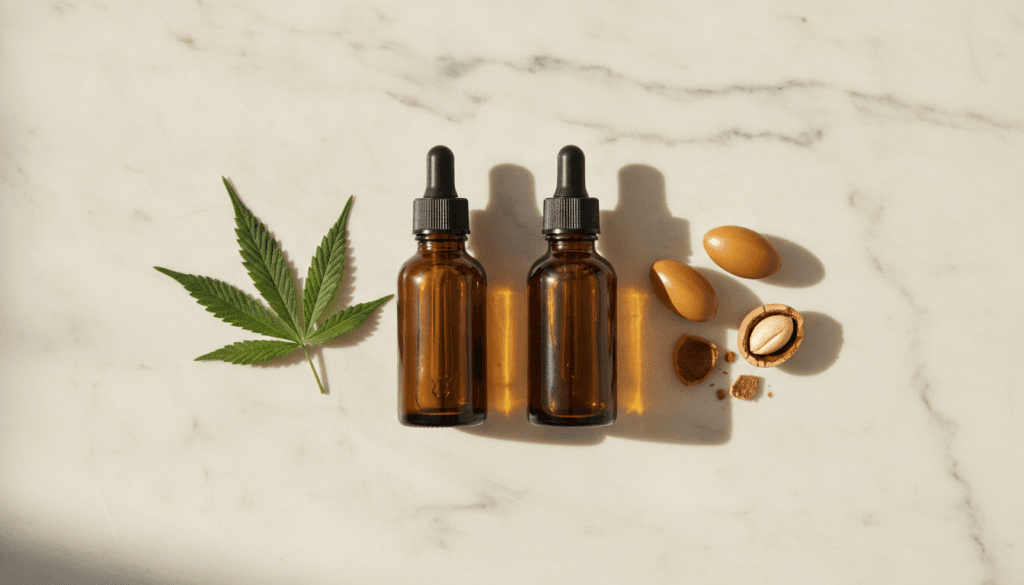
Hemp seed oil and argan oil are two of the most frequently recommended natural oils in skincare, and they appear in similar contexts, as facial oils, hair treatments, and dry skin remedies, enough that people regularly ask which is better. The honest answer is that they are genuinely different in composition and mechanism, and the better choice depends on what you specifically need them to do.
What Hemp Seed Oil Contains
Hemp seed oil, as covered in depth across our hemp skincare content, is cold-pressed from hemp seeds and is rich in polyunsaturated fatty acids. Its composition is approximately 54 to 60% linoleic acid (Omega-6), 17 to 24% alpha-linolenic acid (Omega-3), 2 to 4% Gamma-Linolenic Acid (GLA), and 9 to 11% oleic acid. The Omega-3 and Omega-6 fatty acids in a roughly 3:1 ratio are structural components of the skin’s lipid barrier. Hemp seed oil has a comedogenic rating of zero (will not clog pores), absorbs relatively quickly, and retains natural vitamin E and antioxidants when cold-pressed and unrefined.
What Argan Oil Contains
Argan oil is cold-pressed from the kernels of the argan tree (Argania spinosa), native to Morocco. It is predominantly composed of oleic acid (Omega-9 monounsaturated fatty acid) at approximately 43 to 49%, linoleic acid (Omega-6) at approximately 29 to 36%, and palmitic acid (a saturated fatty acid) at approximately 12 to 15%. It also contains relatively high levels of vitamin E (tocopherols) and squalene, a lipid that closely mimics components of human skin sebum. Argan oil has a comedogenic rating of 0 to 1 (essentially non-comedogenic for most people), a medium absorption speed, and a longer shelf life than hemp seed oil due to its higher oleic acid and antioxidant content.
Side-by-Side Comparison
| Factor | Hemp Seed Oil | Argan Oil |
|---|---|---|
| Primary fatty acids | Linoleic (Omega-6), ALA (Omega-3), GLA | Oleic (Omega-9), Linoleic (Omega-6) |
| Comedogenic rating | 0 | 0-1 |
| Vitamin E content | Good, varies by extraction quality | Very high, particularly stable tocopherols |
| Absorption speed | Medium-fast | Medium |
| Shelf life (opened) | 1-3 months refrigerated | 3-6 months at room temperature |
| GLA content | Yes (2-4%) | No |
| Anti-inflammatory properties | Strong (via Omega-3 and GLA) | Moderate (via Vitamin E and oleic acid) |
| Skin barrier support | Strong (via linoleic acid) | Good (via oleic acid and squalene) |
| Frizz control/hair | Light, penetrates shaft | Better for frizz, seals cuticle effectively |
Which Is Better for Acne-Prone Skin
Hemp seed oil has the more specific advantage here. Research has established that people with acne-prone skin tend to have lower levels of linoleic acid in their sebum, and hemp seed oil’s 54 to 60% linoleic acid content directly addresses this deficit. Argan oil’s linoleic content (approximately 30%) is meaningful but lower. Both have near-zero comedogenic ratings, making both generally safe for acne-prone skin, but hemp seed oil has a stronger theoretical case for addressing one of the underlying biochemical factors in acne specifically.
Which Is Better for Dry or Mature Skin
Argan oil’s higher oleic acid and squalene content gives it a slight edge for dry and mature skin. Oleic acid is a larger molecule than linoleic acid and sits more at the surface of the skin, providing a better sealing and moisture-retention effect. Squalene specifically mimics components of human sebum that decrease naturally with age. For very dry or mature skin where moisture retention is the primary concern, argan oil tends to feel richer and more occlusive. Hemp seed oil is better for barrier repair through fatty acid replenishment. Combining both, applying hemp seed oil first for barrier support and a small amount of argan oil on top for moisture sealing, is an approach used by many users with dry or mature skin.
Which Is Better for Hair
Argan oil is considered the stronger choice for most hair applications, particularly for frizz control and cuticle smoothing. Its oleic acid content helps coat and seal the hair cuticle, reducing frizz and improving shine more effectively than hemp seed oil’s lighter profile. Hemp seed oil penetrates the hair shaft more effectively due to its smaller molecule size, making it better for nourishing from within and for addressing scalp-level concerns like dryness and inflammation. For a comprehensive hair treatment approach, argan oil as a finishing product for frizz and shine and hemp seed oil as a pre-wash scalp and shaft treatment are naturally complementary rather than competing options.
Frequently Asked Questions
Can I use hemp seed oil and argan oil together?
Yes, and they are genuinely complementary due to their different fatty acid profiles and mechanisms. A layering approach works well: apply hemp seed oil first (for its linoleic acid barrier repair and anti-inflammatory GLA) and follow with a small amount of argan oil (for its moisture-sealing oleic acid and vitamin E). This combination addresses both barrier repair and moisture retention, which is particularly useful for dry or mature skin that benefits from both mechanisms simultaneously.
Which oil lasts longer once opened?
Argan oil has a significantly longer shelf life after opening, typically 3 to 6 months at room temperature, due to its higher oleic acid content and natural antioxidant (vitamin E and squalene) stability. Hemp seed oil is high in polyunsaturated fatty acids that are prone to oxidation, giving it a shorter post-opening shelf life of approximately 1 to 3 months when refrigerated. If you tend not to use oils quickly, argan oil is more practical from a waste prevention standpoint.
Is argan oil better for anti-ageing than hemp seed oil?
Both have relevant anti-ageing properties through different mechanisms. Argan oil’s high vitamin E content provides strong antioxidant protection against oxidative stress, which is one driver of skin ageing. Its squalene content supports the skin’s natural lipid balance that diminishes with age. Hemp seed oil’s anti-inflammatory GLA and balanced Omega fatty acids support the skin barrier from within and may help reduce chronic low-grade inflammation associated with accelerated skin ageing. For an anti-ageing focus specifically, argan oil has a stronger direct antioxidant case, while hemp seed oil has a stronger anti-inflammatory and barrier repair case.
Does argan oil clog pores?
Argan oil has a comedogenic rating of 0 to 1, meaning it is unlikely to clog pores for most people but is not as definitively non-comedogenic as hemp seed oil’s rating of zero. The rating of 1 indicates a very small clogging potential for some individuals. For most people, argan oil does not cause breakouts, but for those with very acne-prone skin who have had issues with other oils, hemp seed oil’s zero comedogenic rating makes it the more reliably safe choice.
Is argan oil more expensive than hemp seed oil?
Generally yes. Argan oil production is labour-intensive, primarily from women’s cooperatives in Morocco extracting kernels by hand or semi-mechanical methods from argan trees. High-quality cold-pressed argan oil commands a premium accordingly. Hemp seed oil is produced from hemp seeds at significantly larger scale with less specialised labour, making it more economical per millilitre in most markets. If budget is a consideration, hemp seed oil provides excellent skincare value relative to its price, particularly for those who use facial oil daily.
Which oil is better for oily skin?
Hemp seed oil has the edge for oily skin. Its zero comedogenic rating, lightweight texture, fast absorption, and high linoleic acid content (which may help rebalance sebum composition in oily skin over time) all favour it over argan oil for this skin type. Argan oil’s slightly higher oleic acid content and slightly slower absorption make it feel a little heavier on oily skin, though it is generally still well-tolerated. For very oily skin, hemp seed oil at 2 to 3 drops is typically sufficient and non-greasy; argan oil may leave slightly more surface residue.