Last updated: 4 October 2026. Informational only, not medical advice.
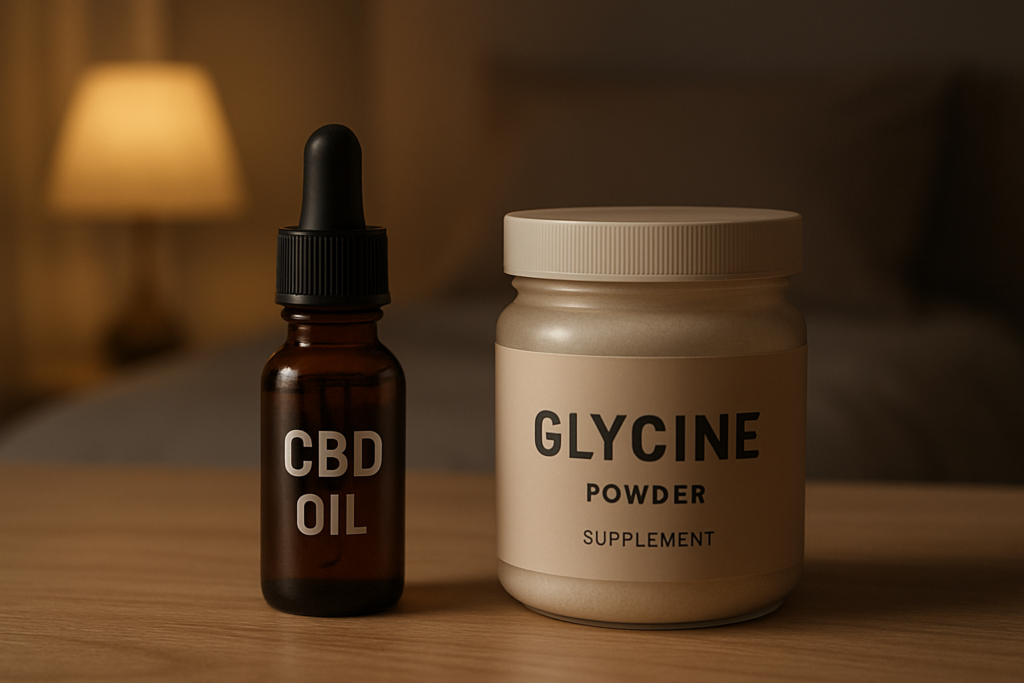
CBD and glycine are both explored for sleep, but through very different mechanisms. Glycine is an amino acid with research support for improving sleep quality, particularly subjective sleep satisfaction and next-day alertness, through a mechanism involving core body temperature regulation. CBD’s sleep-adjacent evidence, by contrast, works primarily through anxiety reduction rather than a direct sleep-architecture mechanism.
CBD vs glycine at a glance
| Glycine | CBD | |
|---|---|---|
| What it is | A non-essential amino acid | A non-intoxicating cannabis compound |
| Mechanism | May lower core body temperature, involved in sleep onset signaling | Endocannabinoid modulation, indirect calming via anxiety reduction |
| Best for | Sleep quality and next-day alertness, evidence-backed | Sleep disrupted specifically by anxiety or racing thoughts |
| Onset | Taken shortly before bed, effects same night | 30 to 90 minutes orally |
| Taste | Mildly sweet, generally easy to take | Earthy, product-dependent |
| Evidence quality | Several controlled trials specifically on sleep quality measures | Stronger for anxiety than for direct sleep architecture |
What makes glycine’s research relatively specific and encouraging
Several controlled studies have examined glycine specifically for sleep quality, not just sleep-adjacent symptoms, finding improvements in subjective sleep satisfaction, reduced time to fall asleep, and importantly, improved next-day alertness and cognitive performance, addressing the common concern that sleep aids leave you groggy the following day. This is a more direct, sleep-specific research base than exists for CBD, whose sleep evidence more often works through the anxiety-reduction pathway rather than direct sleep mechanism confirmation.
The temperature-regulation mechanism, briefly
One proposed mechanism for glycine’s sleep effect involves core body temperature, the body’s natural temperature drop that helps signal sleep onset. Glycine may support this process, which is a genuinely different mechanism than anything CBD is understood to do, making these two supplements more complementary than competing when both sleep-timing and anxiety-driven sleep disruption are factors.
Which fits which situation
| Situation | Better starting point |
|---|---|
| General sleep quality concerns, no clear anxiety driver | Glycine, more direct sleep-specific evidence |
| Sleep disrupted by anxious or racing thoughts | CBD |
| Concerned about next-day grogginess | Glycine, research specifically shows preserved next-day alertness |
| Want to address both sleep quality and anxiety | Either alone, or combined |
Can you combine them?
Yes, no dangerous interaction between CBD and glycine is established, and their different, complementary mechanisms (temperature regulation versus anxiety reduction) make combining them a reasonable approach for people whose sleep difficulties involve both components. As with other combinations discussed on this site, introducing them separately first helps clarify which is contributing what to your experience.
Who should be cautious
- Kidney conditions. Amino acid metabolism involves the kidneys; discuss with a doctor if you have kidney disease.
- On CBD’s usual interaction-relevant medications. CBD’s standard interaction profile still applies regardless of combining with glycine.
- Pregnant or breastfeeding. Discuss any new supplement with a doctor during pregnancy.
Frequently asked questions
Is glycine or CBD better for sleep?
Glycine has more direct, sleep-specific research support, including preserved next-day alertness. CBD is more relevant when anxiety or racing thoughts are the specific barrier to sleep.
Does glycine cause next-day grogginess like some sleep aids?
Research specifically suggests the opposite, some studies show preserved or even improved next-day alertness with glycine use.
Can I take CBD and glycine together?
Yes, no dangerous interaction is established, and their different mechanisms make combining them reasonable for some people.
How much glycine is typically used for sleep?
Studies commonly use around 3 grams taken shortly before bed, though individual needs vary.