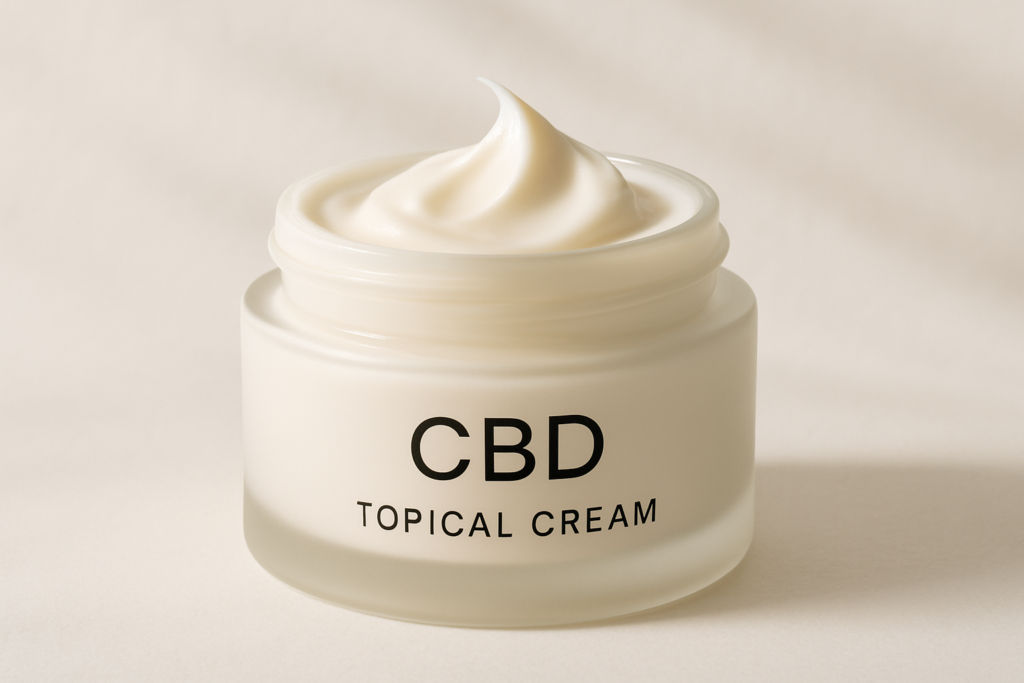
Last updated: 30 September 2026. Informational only, not medical advice.
CBD’s evidence for eczema and other inflammatory skin conditions is more encouraging than for many conditions discussed on this site, since the skin has its own dense network of cannabinoid receptors, and topical CBD’s minimal systemic absorption makes it a lower-risk experiment than oral use for many people. Still, most supporting research is preclinical or small-scale, and CBD should complement, not replace, standard eczema management.
Why skin conditions are a relatively favorable area for topical CBD
| Factor | Relevance to eczema |
|---|---|
| Skin cannabinoid receptor density | The skin has substantial CB1 and CB2 receptor presence, giving topical CBD a plausible local mechanism |
| Anti-inflammatory mechanism | Eczema involves inflammatory skin response; CBD’s anti-inflammatory properties are relevant, if not conclusively proven for this specific condition |
| Systemic risk | Topical application carries minimal systemic absorption, reducing drug interaction and side effect concerns compared to oral use |
| Research maturity | Small studies and preclinical research are promising but limited in scale |
What the research actually shows
Small studies on cannabinoid-containing topicals for skin conditions, including eczema and psoriasis, have shown some improvement in itching, redness, and skin barrier measures, though these studies are typically small, and many combine CBD with other ingredients, making it hard to isolate CBD’s specific contribution. This is meaningfully more research than exists for several other conditions covered on this site, but it still falls short of the large, well-controlled trials needed to make confident treatment claims.
What CBD topicals might help with in eczema specifically
- Itching (pruritus). A prominent, often distressing eczema symptom; some research suggests cannabinoid receptor activation may help reduce itch signaling.
- Visible redness and inflammation. Plausible given CBD’s anti-inflammatory mechanism, though eczema-specific confirmation is limited.
- Skin barrier support. Some formulations combine CBD with other skin-barrier-supporting ingredients, making it hard to isolate CBD’s individual contribution to any observed benefit.
What CBD should not replace
Standard eczema management, moisturizing routines, identifying and avoiding triggers, and prescribed treatments like topical corticosteroids or other dermatologist-recommended options, have substantially more evidence than CBD topicals. For moderate to severe eczema, CBD should be considered a potential complementary addition discussed with a dermatologist, not a replacement for established treatment.
Practical guidance for trying a CBD topical for eczema
- Patch test any new topical product on a small area first, given eczema-prone skin’s tendency toward sensitivity and reactions
- Choose products formulated specifically for sensitive or eczema-prone skin where possible, avoiding added fragrances or irritating ingredients
- Continue your existing dermatologist-recommended routine; add CBD topical use alongside it rather than instead of it
- Give it several weeks of consistent use before assessing effect, similar to how most topical skin treatments require sustained use
- Discontinue if you notice increased irritation, redness, or any allergic-type reaction
Who should be cautious
- Severe or widespread eczema. See a dermatologist rather than relying on CBD topicals as a primary approach.
- Known sensitivities to topical ingredients. Carrier oils and additional ingredients in CBD topicals can themselves cause reactions independent of the CBD.
- Broken or actively weeping skin. Avoid applying any new topical to compromised skin without checking with a dermatologist first.
Frequently asked questions
Does CBD help eczema?
Some small studies and the skin’s dense cannabinoid receptor presence make this a plausible, relatively favorable area, though research remains limited in scale. It shouldn’t replace dermatologist-recommended treatment.
Is CBD topical safer than oral CBD for skin conditions?
Generally yes, in terms of systemic interaction risk, since topical application has minimal systemic absorption. Local skin reactions to the topical itself remain possible regardless.
Can CBD topicals replace my prescribed eczema treatment?
No, continue prescribed treatment. Consider CBD topicals as a potential complementary addition, discussed with your dermatologist.
How long before I’d notice a difference?
Several weeks of consistent use is reasonable before assessing effect, consistent with how most topical skin treatments are evaluated.