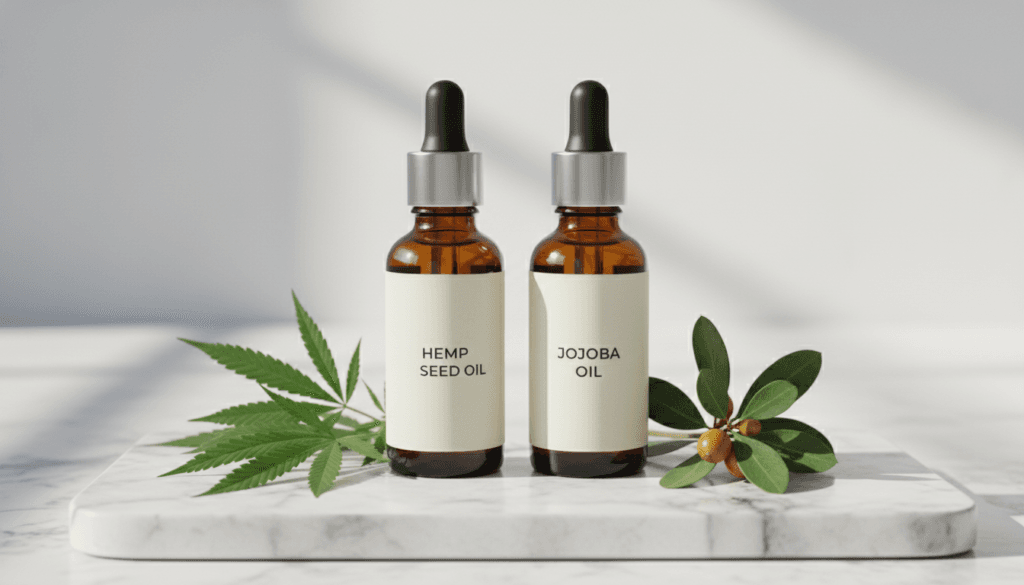
Hemp seed oil and jojoba oil are two of the most recommended plant oils in evidence-based skincare. Both have strong profiles, both are widely available, and both are used across a range of skin types. But they are quite different in their composition, how they behave on skin, and which use cases they serve best.
What Is Hemp Seed Oil?
Hemp seed oil is cold-pressed from the seeds of the Cannabis sativa plant. It is rich in polyunsaturated fatty acids, particularly linoleic acid (Omega-6) at 54 to 60% and alpha-linolenic acid (Omega-3) at 17 to 24%, with an additional 2 to 4% Gamma-Linolenic Acid (GLA). It has a comedogenic rating of zero and a relatively fast absorption rate for a plant oil. Its main value for skin is replenishing the skin’s essential fatty acid content, supporting barrier function, and providing anti-inflammatory fatty acid support.
What Is Jojoba Oil?
Jojoba oil is technically not an oil but a liquid wax ester, pressed from the seeds of the Simmondsia chinensis shrub. Its molecular structure is notably similar to human sebum, which is one reason it is so widely used across different skin types. It has a comedogenic rating of 2 (low to moderate), is very stable due to its wax structure, has a long shelf life, and is highly resistant to oxidation. Its primary value for skin is as a long-lasting moisturiser and barrier protectant that mimics the skin’s natural lipid balance.
Key Differences at a Glance
Hemp seed oil has a comedogenic rating of zero while jojoba has a rating of two. Hemp seed oil absorbs relatively quickly while jojoba sits slightly longer on the skin. Hemp seed oil has a shelf life of 12 to 14 months while jojoba lasts up to 2 years. Hemp seed oil is higher in Omega-3 and Omega-6 fatty acids while jojoba contains wax esters as its primary component. Hemp seed oil contains GLA while jojoba does not. Hemp seed oil is suitable for all skin types including acne-prone while jojoba suits all skin types but particularly oily skin. Hemp seed oil has a light nutty aroma while jojoba is nearly odourless.
Which Is Better for Oily and Acne-Prone Skin?
Hemp seed oil has the edge here. Its zero comedogenic rating and high linoleic acid content (which may help rebalance sebum composition in acne-prone skin) make it the safer and potentially more beneficial choice. Jojoba’s sebum-mimicking properties also make it generally suitable for oily skin, but its comedogenic rating of 2 means it is not completely pore-safe for everyone.
Which Is Better for Dry Skin?
Both work well for dry skin but in slightly different ways. Jojoba provides a longer-lasting occlusive-like effect, sitting on the skin and preventing moisture loss effectively. Hemp seed oil provides active fatty acid replenishment to rebuild the skin’s lipid barrier from within. For very dry skin, layering both (hemp seed oil applied first, jojoba on top to seal) can be effective.
Which Is Better for Sensitive Skin?
Both are generally well-tolerated by sensitive skin. Hemp seed oil’s anti-inflammatory fatty acids give it a slight edge for reactive or eczema-prone skin. Jojoba’s structural similarity to human sebum means it is rarely irritating and is widely used in hypoallergenic formulations.
Frequently Asked Questions
Can I use hemp seed oil and jojoba oil together?
Yes, and they work well as a combination. A common approach is to apply hemp seed oil first (for fatty acid delivery and barrier repair) followed by a small amount of jojoba oil on top (for its sealing and moisture-locking properties). This layering approach works particularly well for dry or mature skin that benefits from both active fatty acid support and longer-lasting occlusion.
Which oil lasts longer: hemp seed oil or jojoba oil?
Jojoba oil has a significantly longer shelf life. Due to its wax ester structure, jojoba is highly resistant to oxidation and lasts approximately 2 years or more, even after opening. Cold-pressed hemp seed oil has a shelf life of 12 to 14 months unopened and 1 to 3 months after opening when refrigerated. If you are prone to not finishing bottles quickly, jojoba is more practical from a waste perspective.
Is hemp seed oil or jojoba better for hair?
Both are used in hair care but with different roles. Jojoba is commonly used as a scalp oil to mimic and balance scalp sebum production. Hemp seed oil provides the scalp with Omega-3 and Omega-6 fatty acids and anti-inflammatory GLA. For scalp health and follicle nourishment, hemp seed oil has more specific nutritional value. For sebum regulation on an oily scalp, jojoba’s sebum-mimicking properties may be more precisely targeted. Many hair care routines use both.
Does jojoba oil clog pores?
Jojoba oil has a comedogenic rating of 2, which is in the low to moderate range. For most people it does not cause breakouts, particularly when used in small amounts. However, its rating of 2 means it may clog pores in some individuals, particularly those with very acne-prone skin. Hemp seed oil at a rating of zero is the safer choice specifically for acne-prone skin.
Which oil absorbs faster: hemp seed oil or jojoba oil?
Hemp seed oil absorbs somewhat faster than jojoba oil, typically within 5 to 10 minutes on most skin types. Jojoba’s wax ester structure means it sits on the skin slightly longer before fully absorbing, which is one reason it provides a good sealing effect. For morning use when absorption speed matters for makeup application, hemp seed oil is the more practical choice.